🔐 Private Research Portal

Epstein Research Portal

Access the full investigative corpus, ranked smoking guns, OCR-linked imagery, and intel briefs.

Front-of-house site Sign In / Sign Up
Same BENED DNA · Investigative Skin
← Back to Entities

📁 Judicial system Dossier

9 documents connected to this entity

Page 1 of 1 (9 items)
#1 Strength: 9.0/10
Document preview

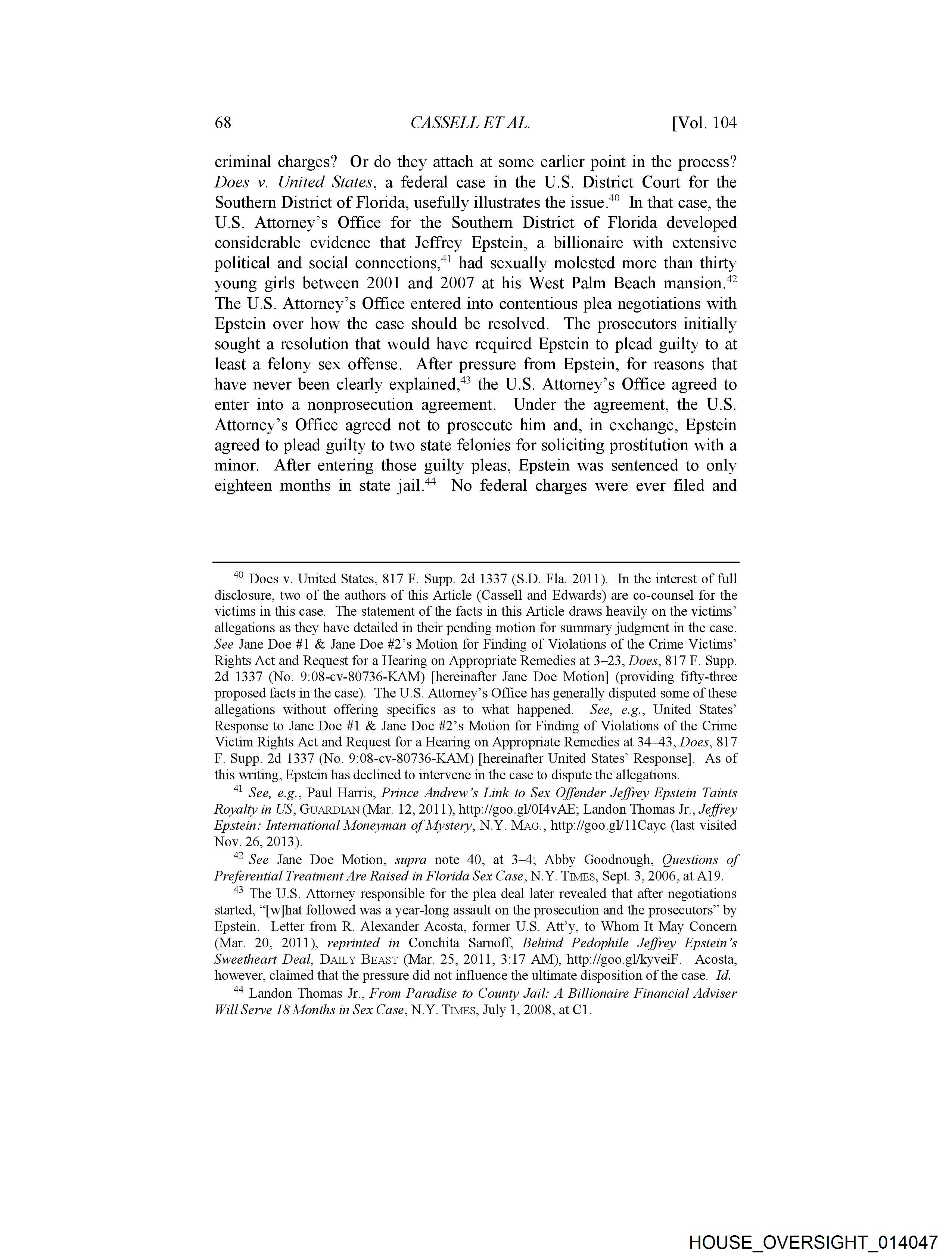
HOUSE_OVERSIGHT_014047

This document highlights the controversial plea deal that Jeffrey Epstein received from the U.S. Attorney’s Office, which raises serious questions about potential corruption and preferential treatment in the judicial process. The evidence presented indicates that Epstein was able to avoid federal prosecution despite substantial allegations of sexual misconduct involving numerous minors.

🔑 Key Evidence:
  • The U.S. Attorney’s Office for the Southern District of Florida developed considerable evidence that Jeffrey Epstein...had sexually molested more than thirty young girls between 2001 and 2007.
  • After pressure from Epstein, for reasons that have never been clearly explained, the U.S. Attorney’s Office agreed to enter into a nonprosecution agreement.
  • Under the agreement, the U.S. Attorney’s Office agreed not to prosecute him and, in exchange, Epstein agreed to plead guilty to two state felonies for soliciting prostitution with a minor.
👥 Connected Entities:
U.S. Attorney’s Office for the Southern District of Florida Jeffrey Epstein Victims represented by Cassell and Edwards
From: Bates: HOUSE_OVERSIGHT_014047
No comments yet.
#2 Strength: 5.0/10
Document preview

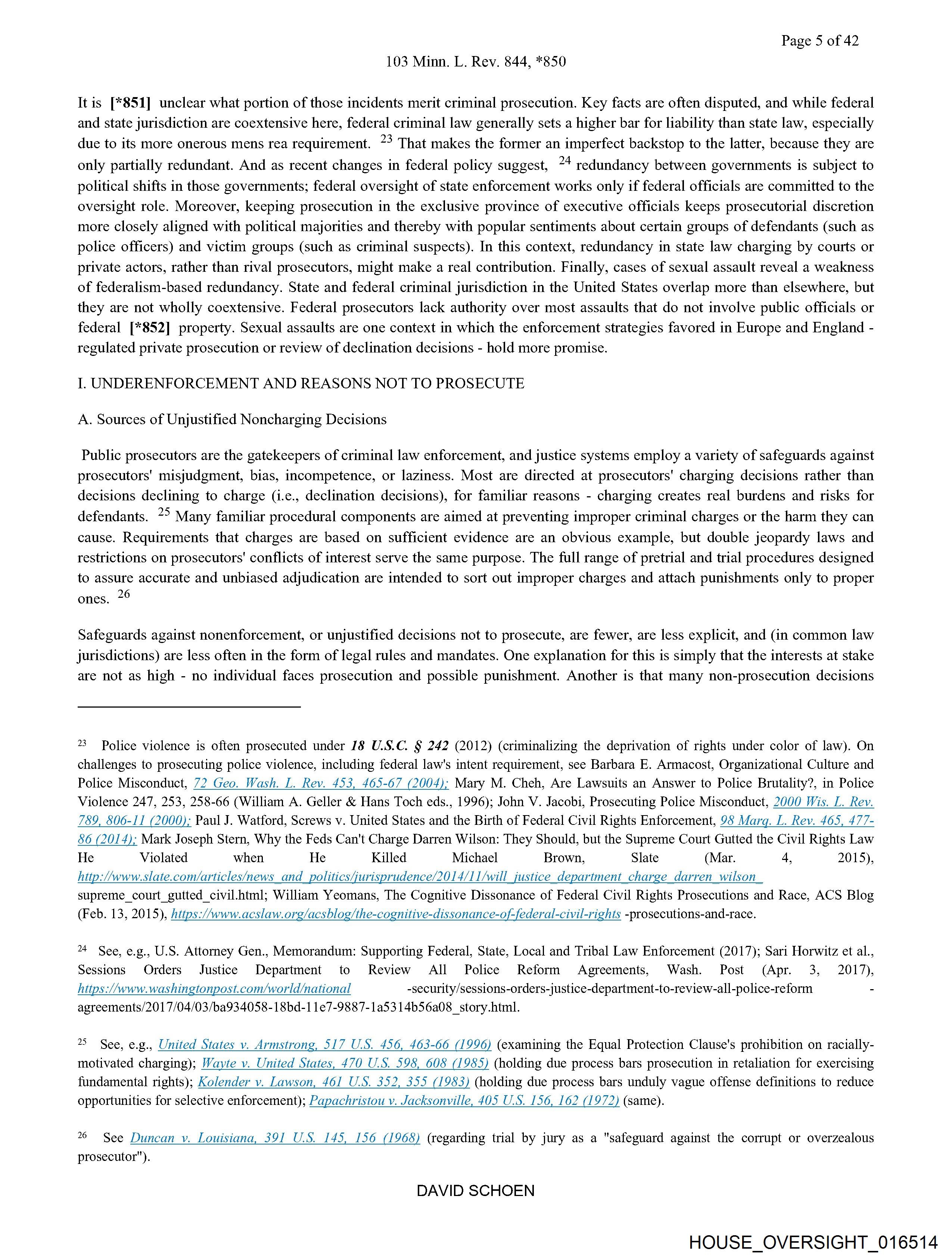
HOUSE_OVERSIGHT_016514

This document discusses the complexities of prosecutorial discretion and the challenges of enforcing sexual assault laws, particularly in the context of federal and state jurisdiction. While it does not directly implicate specific individuals or activities related to Jeffrey Epstein, it highlights systemic issues that may have allowed for underenforcement of sexual crimes, which is relevant to understanding the broader failures in prosecuting Epstein and his associates.

🔑 Key Evidence:
  • Federal criminal law generally sets a higher bar for liability than state law, especially due to its more onerous mens rea requirement.
  • Public prosecutors are the gatekeepers of criminal law enforcement, and justice systems employ a variety of safeguards against prosecutors’ misjudgment, bias, incompetence, or laziness.
  • Safeguards against nonenforcement, or unjustified decisions not to prosecute, are fewer, are less explicit, and... are less often in the form of legal rules and mandates.
👥 Connected Entities:
Federal prosecutors State prosecutors Victims of sexual assault
From: Bates: HOUSE_OVERSIGHT_016514
No comments yet.
#3 Strength: 6.0/10
Document preview

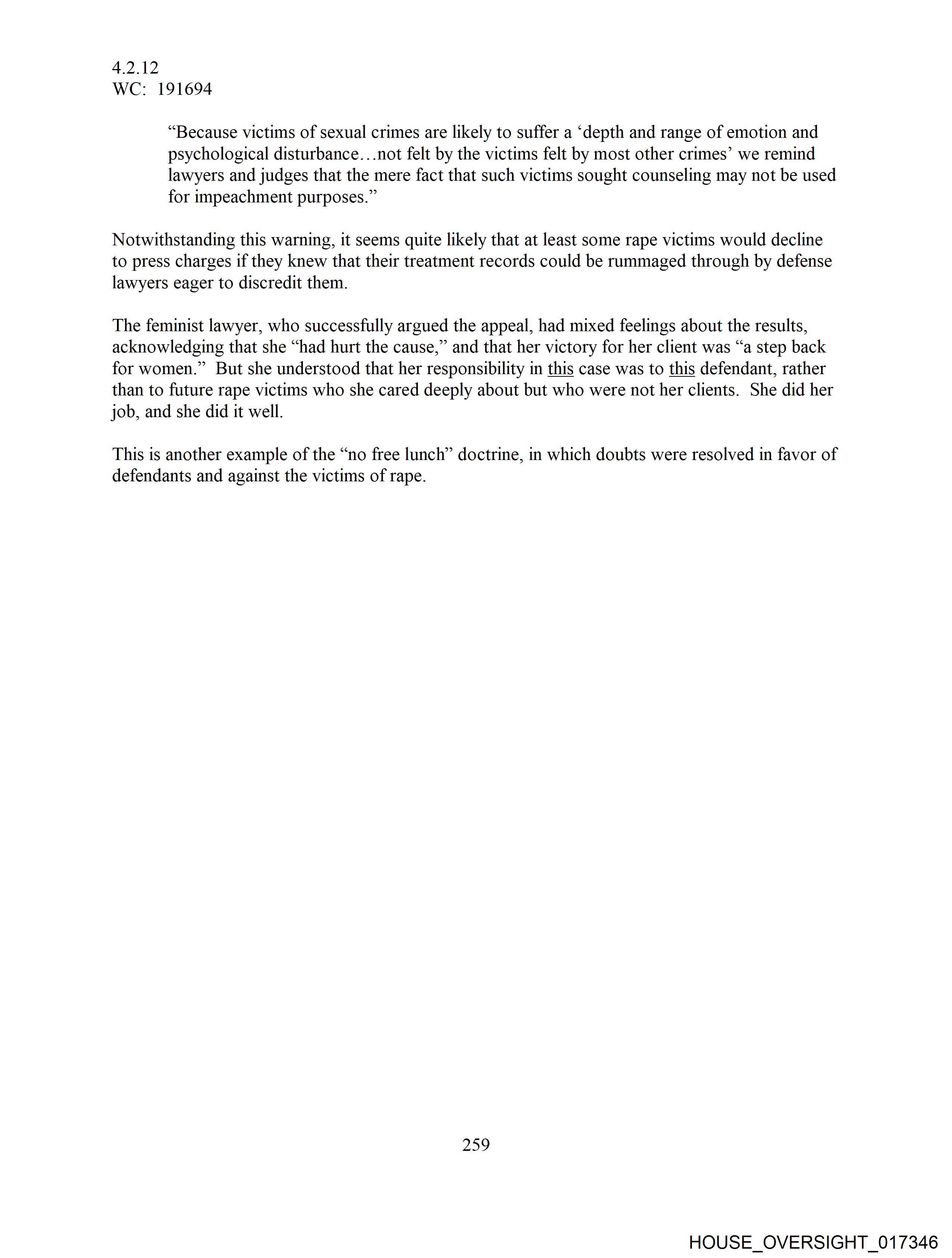
HOUSE_OVERSIGHT_017346

This document highlights the systemic issues surrounding the treatment of sexual crime victims in legal proceedings, particularly how their counseling records can be weaponized against them. It underscores the challenges faced by victims in seeking justice, which is relevant to understanding the broader context of Jeffrey Epstein's operations and the intimidation tactics used against his victims.

🔑 Key Evidence:
  • Victims of sexual crimes are likely to suffer a ‘depth and range of emotion and psychological disturbance...not felt by the victims felt by most other crimes’
  • The mere fact that such victims sought counseling may not be used for impeachment purposes.
  • It seems quite likely that at least some rape victims would decline to press charges if they knew that their treatment records could be rummaged through by defense lawyers eager to discredit them.
👥 Connected Entities:
Feminist legal advocates Defense attorneys in sexual crime cases Victims of sexual crimes
From: Bates: HOUSE_OVERSIGHT_017346
No comments yet.
#4 Strength: 5.0/10
Document preview

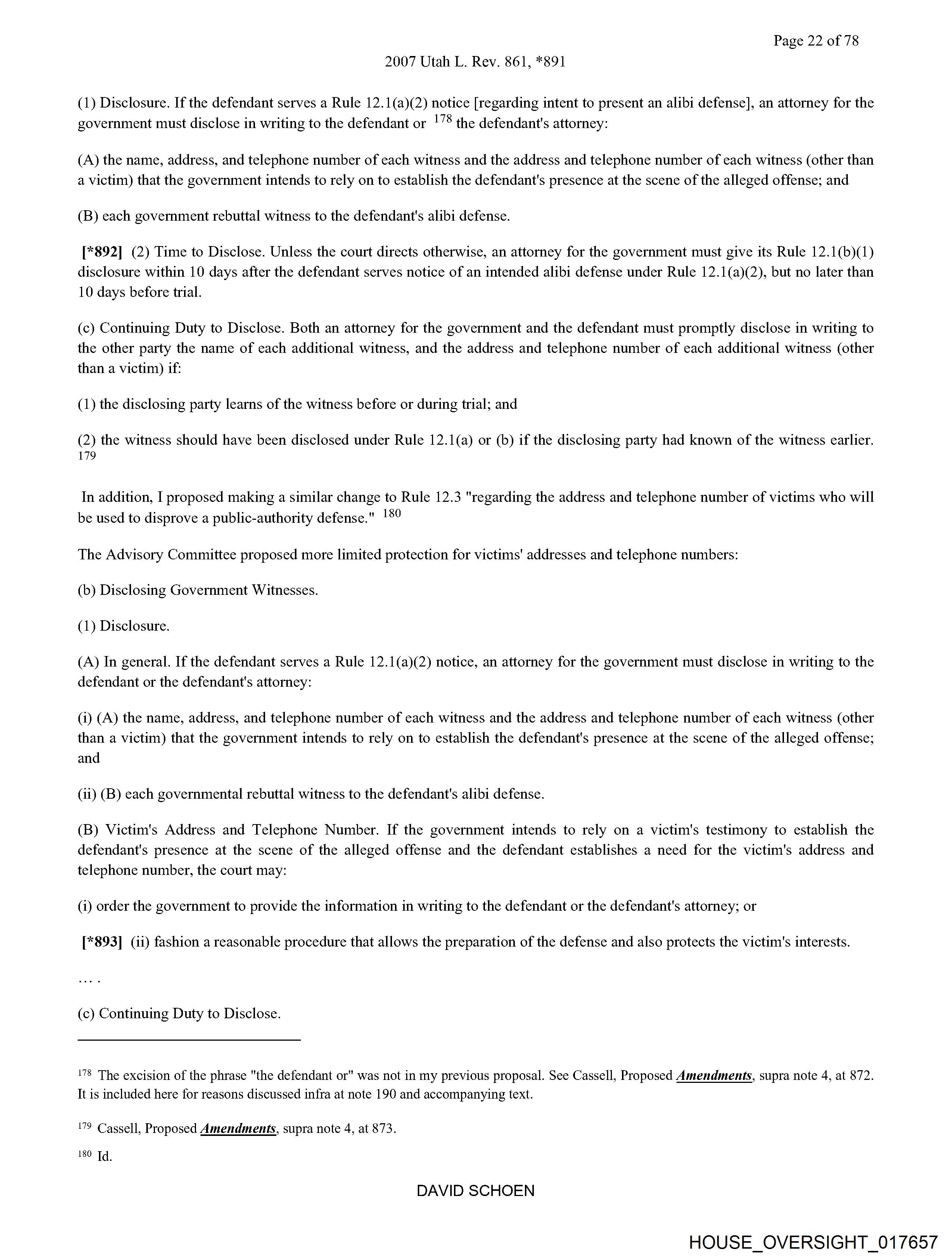
HOUSE_OVERSIGHT_017657

This document outlines procedural rules regarding the disclosure of witness information in criminal cases, particularly focusing on the protection of victims' addresses and telephone numbers. While it does not directly implicate individuals in misconduct, it highlights the legal framework that could be exploited to discredit victims, which is relevant in the context of Epstein's history of victim intimidation and manipulation.

🔑 Key Evidence:
  • The document discusses the government's obligation to disclose witness information, which could include victims if their testimony is used against a defendant.
  • It mentions the potential for a court to order the disclosure of a victim's address and telephone number if the defendant establishes a need for it, raising concerns about victim safety.
  • The proposed changes to Rule 12.3 indicate a legal environment where victims' information could be accessed, potentially leading to intimidation or discrediting tactics.
👥 Connected Entities:
Jeffrey Epstein Victims of Epstein Government legal representatives
From: Bates: HOUSE_OVERSIGHT_017657
No comments yet.
#5 Strength: 5.0/10
Document preview

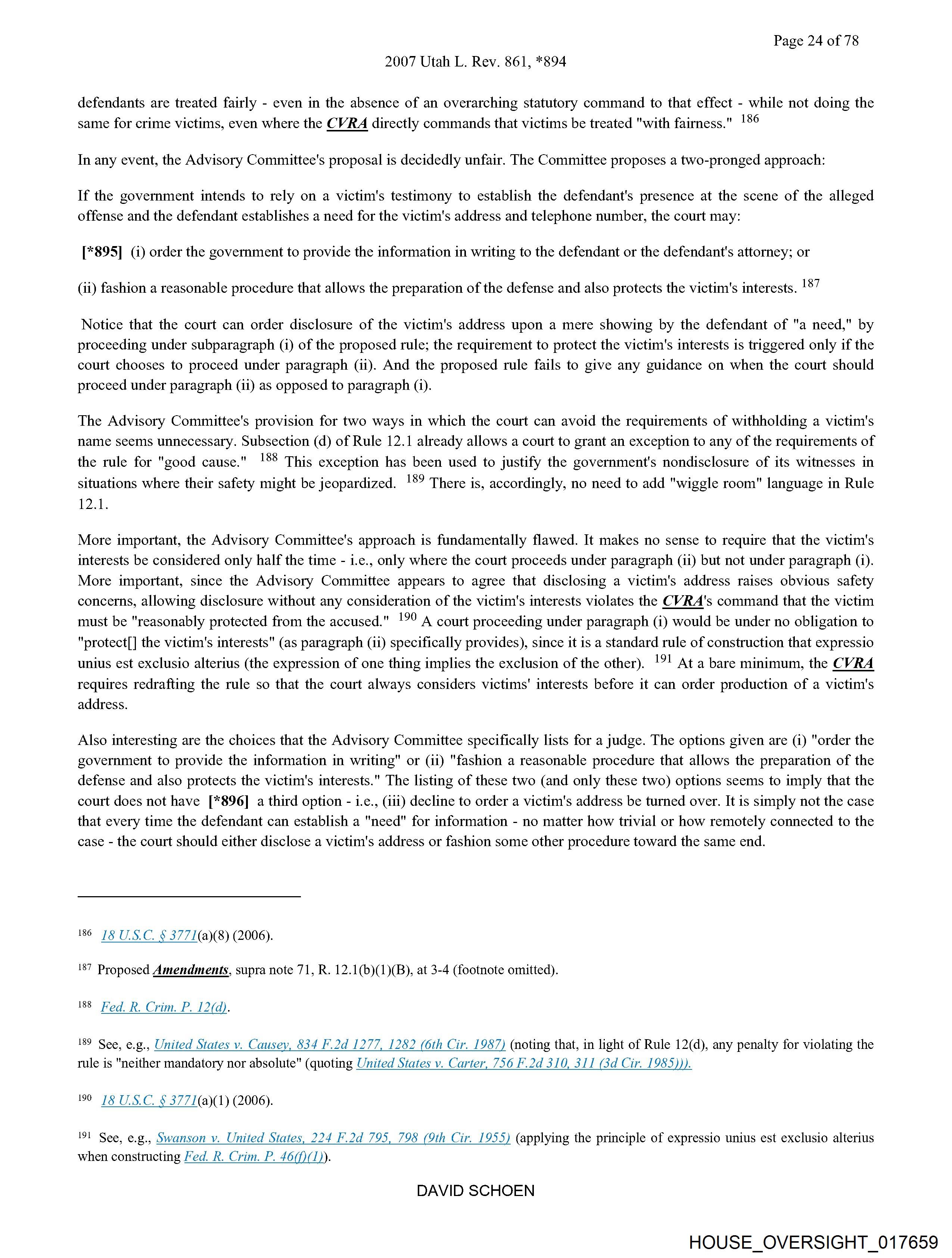
HOUSE_OVERSIGHT_017659

This document highlights procedural concerns regarding the treatment of crime victims, specifically in the context of disclosing their personal information during legal proceedings. While it does not directly implicate individuals in criminal activity, it raises significant issues about victim protection that are relevant to the broader Epstein case, particularly regarding the treatment of victims in high-profile cases.

🔑 Key Evidence:
  • The CVRA directly commands that victims be treated 'with fairness.'
  • The proposed rule allows for the disclosure of a victim's address upon a mere showing by the defendant of 'a need.'
  • The Advisory Committee's approach is fundamentally flawed as it only considers victim interests under certain conditions, potentially endangering them.
👥 Connected Entities:
Advisory Committee on Rules Crime Victims' Rights Act (CVRA) Judicial System
From: Bates: HOUSE_OVERSIGHT_017659
No comments yet.
#6 Strength: 5.0/10
Document preview

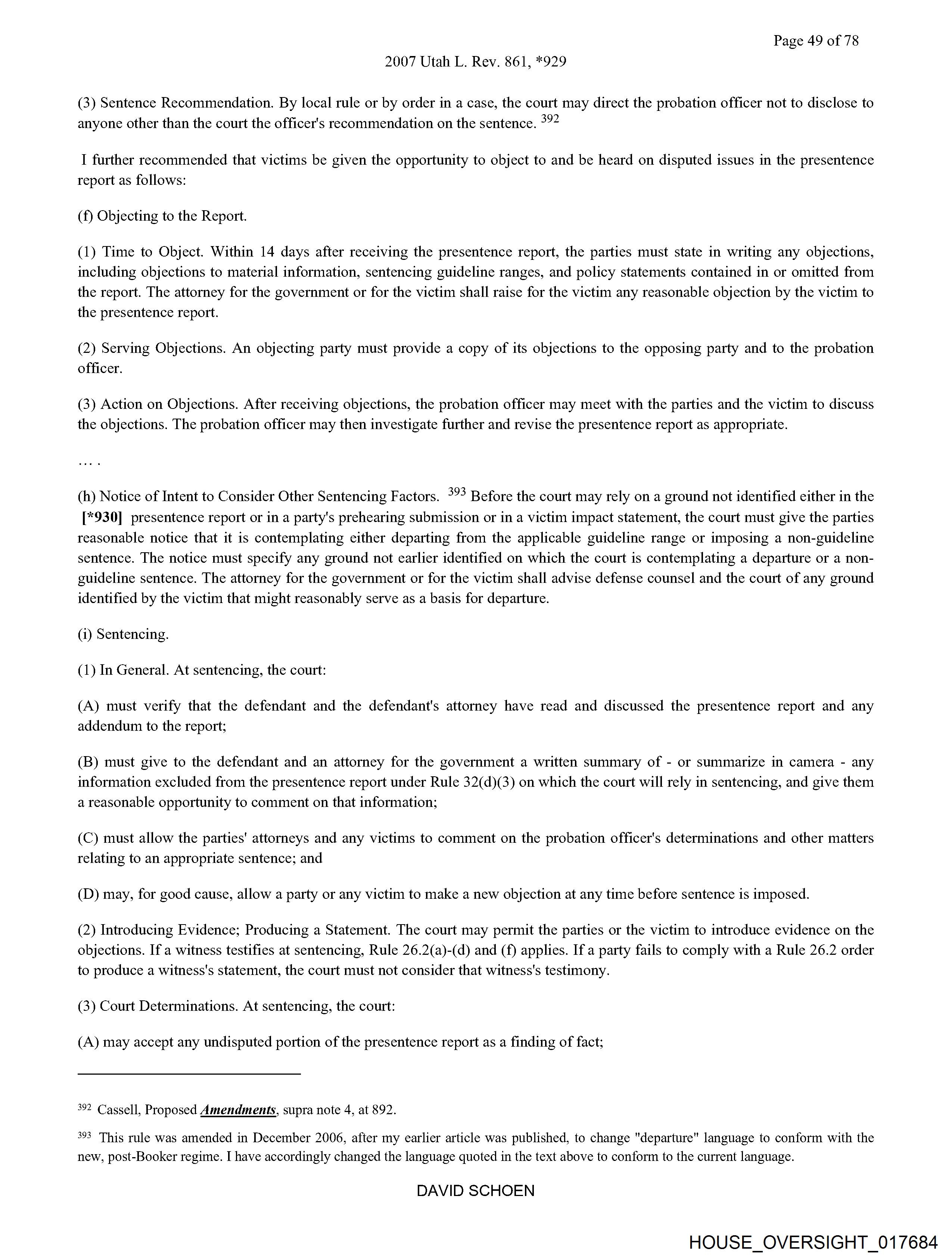
HOUSE_OVERSIGHT_017684

This document outlines procedural recommendations regarding victim rights in the context of presentence reports, which is significant in understanding the judicial processes that may have been manipulated or inadequately applied in Epstein's case. It highlights the importance of victim participation in sentencing, which is crucial given the allegations of intimidation and discrediting tactics used against Epstein's victims.

🔑 Key Evidence:
  • The document emphasizes that victims must be given the opportunity to object to and be heard on disputed issues in the presentence report.
  • It states that the attorney for the government or for the victim shall raise any reasonable objection by the victim to the presentence report.
  • The court must verify that the defendant and the defendant's attorney have read and discussed the presentence report, ensuring transparency in the sentencing process.
👥 Connected Entities:
Judicial System Victims of Epstein Government Attorneys
From: Bates: HOUSE_OVERSIGHT_017684
No comments yet.
#7 Strength: 5.0/10
Document preview

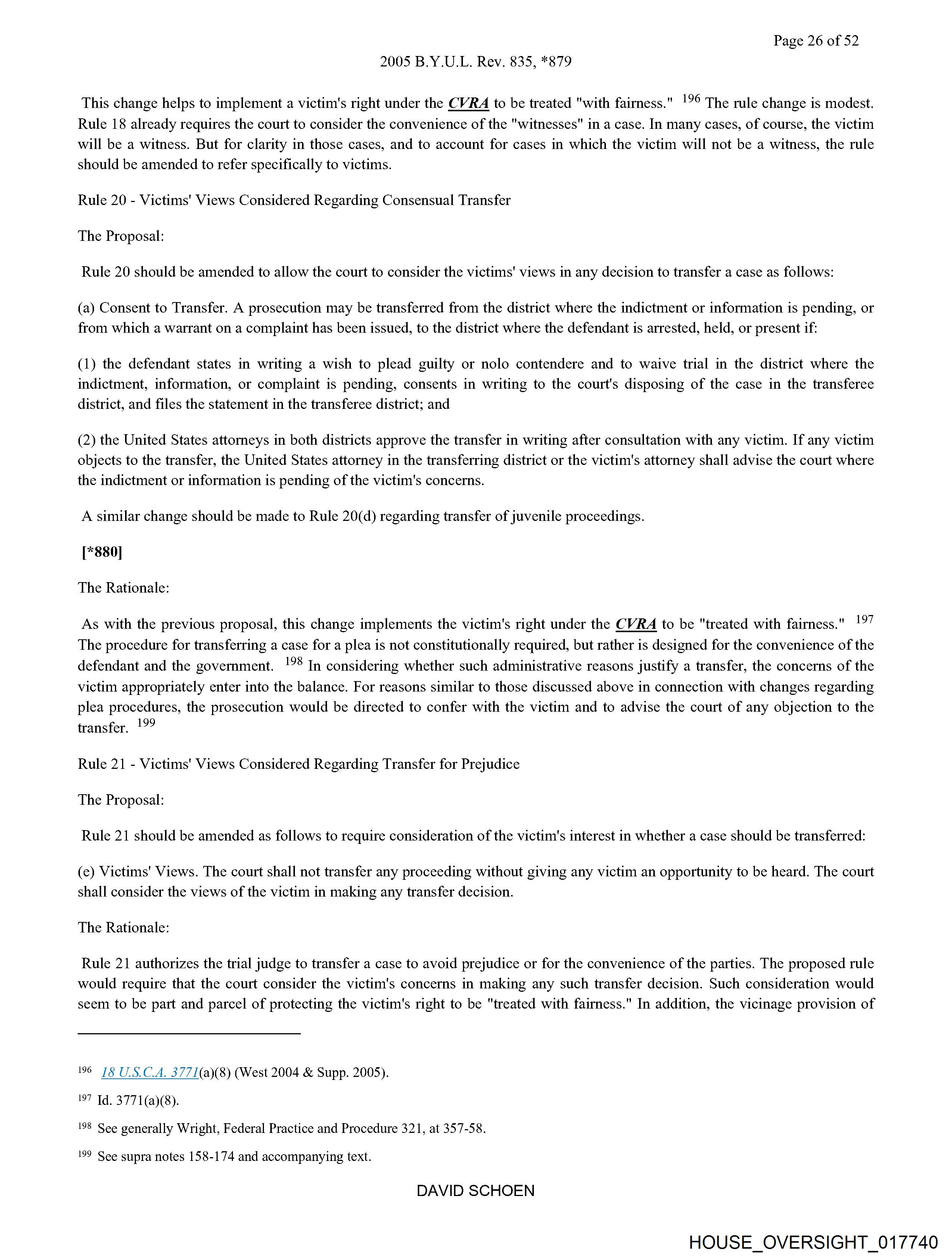
HOUSE_OVERSIGHT_017740

This document outlines proposed amendments to legal rules regarding the treatment of victims in the judicial process, emphasizing their rights under the Crime Victims' Rights Act (CVRA). While it does not directly implicate individuals in criminal activity, it highlights systemic issues in how victims' voices may be marginalized, which is relevant to the broader context of the Epstein case where victim intimidation and discrediting were prevalent.

🔑 Key Evidence:
  • The rule change is modest. Rule 18 already requires the court to consider the convenience of the 'witnesses' in a case.
  • Rule 20 should be amended to allow the court to consider the victims' views in any decision to transfer a case.
  • The procedure for transferring a case for a plea is not constitutionally required, but rather is designed for the convenience of the defendant and the government.
👥 Connected Entities:
Crime Victims' Rights Act (CVRA) U.S. Attorneys' Offices Judicial System
From: Bates: HOUSE_OVERSIGHT_017740
No comments yet.
#8 Strength: 4.0/10
Document preview

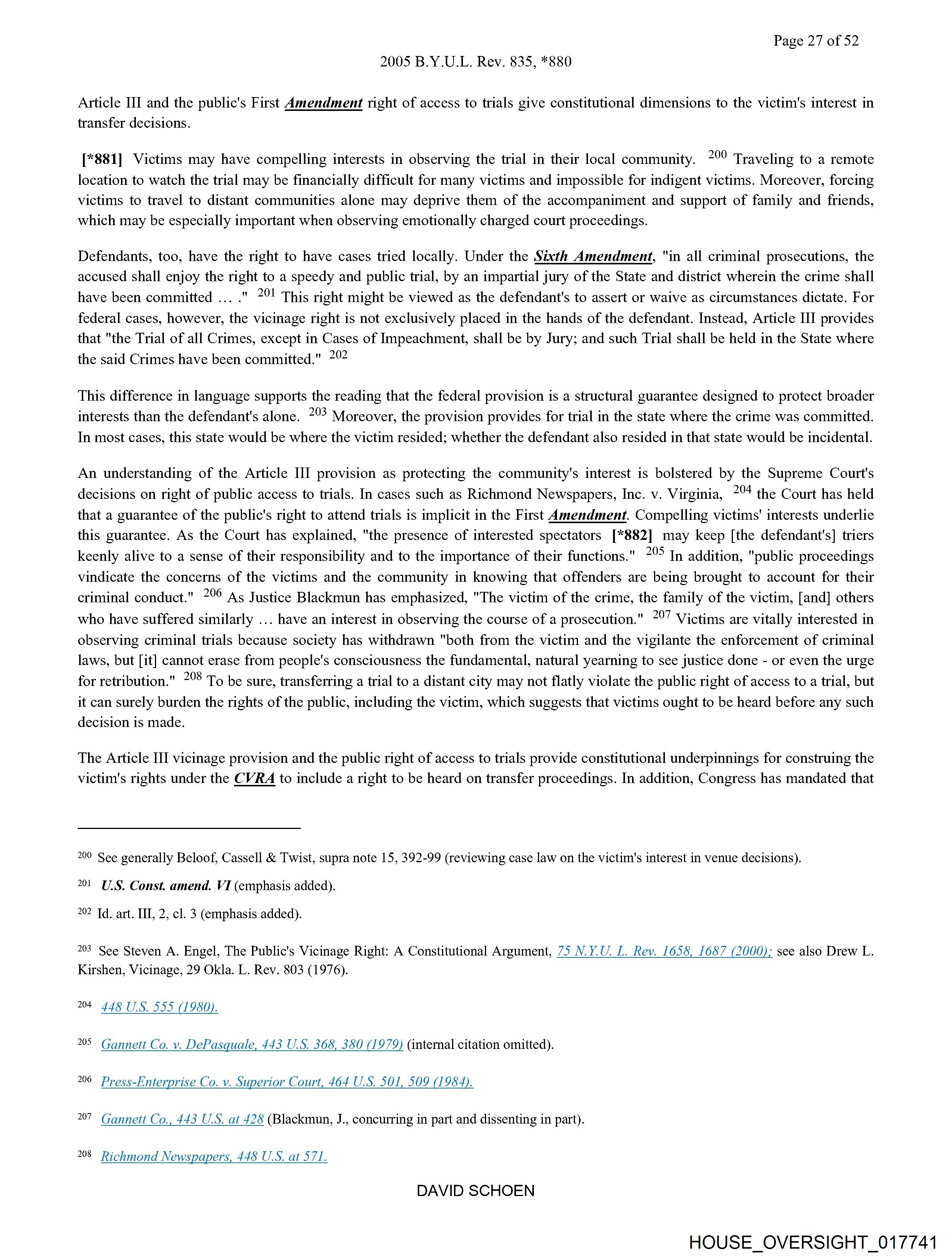
HOUSE_OVERSIGHT_017741

This document discusses the constitutional rights of victims in the context of trial proceedings, emphasizing their interest in observing trials locally. While it does not provide direct evidence of misconduct related to Jeffrey Epstein, it highlights the broader implications of victim rights and access to justice, which are critical in understanding the dynamics of the Epstein case and the treatment of victims.

🔑 Key Evidence:
  • Victims may have compelling interests in observing the trial in their local community.
  • Traveling to a remote location to watch the trial may be financially difficult for many victims and impossible for indigent victims.
  • The presence of interested spectators may keep the defendant's triers keenly alive to a sense of their responsibility.
👥 Connected Entities:
Victims of Jeffrey Epstein Judicial system Supreme Court (Richmond Newspapers, Inc. v. Virginia case)
From: Bates: HOUSE_OVERSIGHT_017741
No comments yet.
#9 Strength: 5.0/10
Document preview

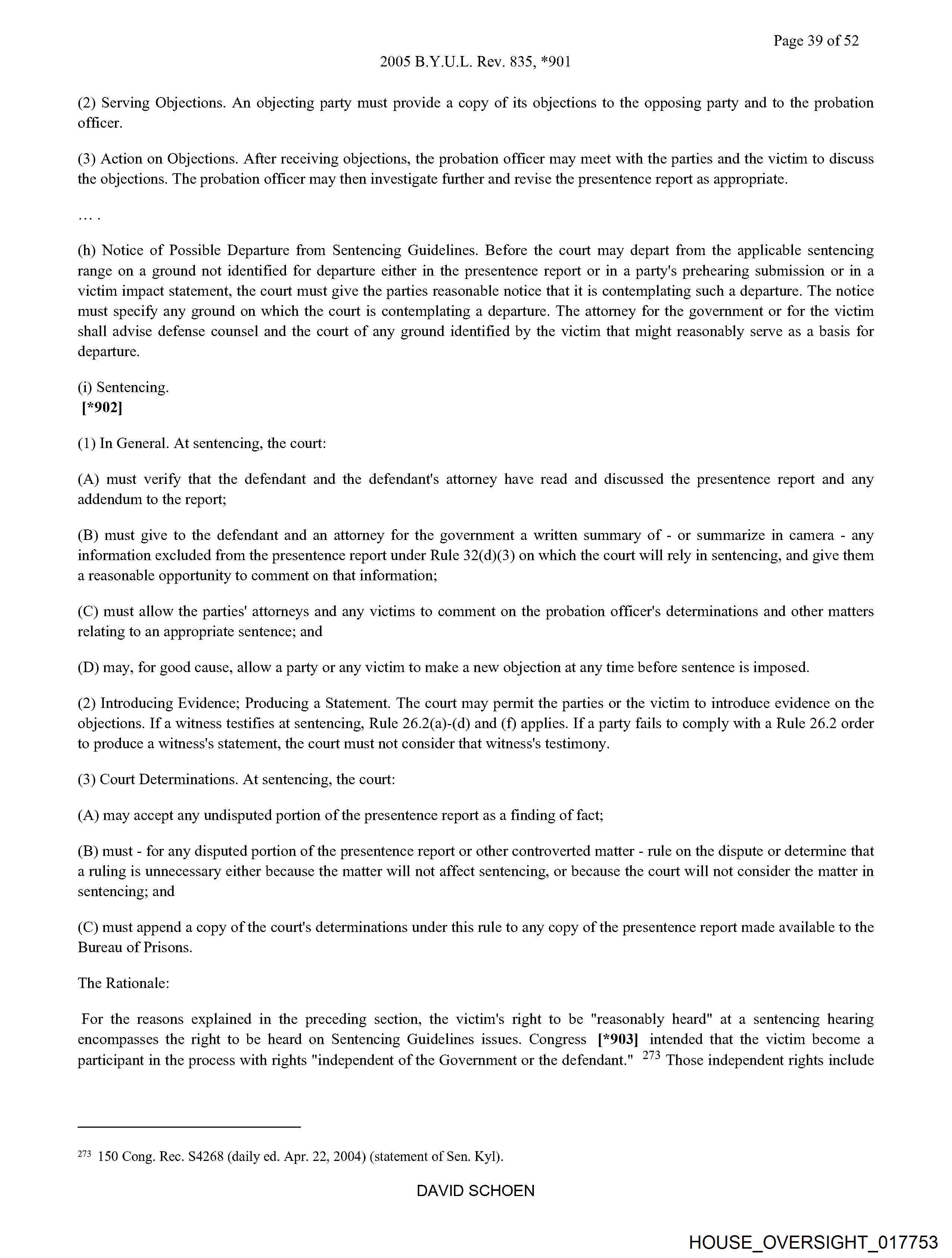
HOUSE_OVERSIGHT_017753

This document outlines procedural aspects of sentencing, particularly the rights of victims to be heard and the obligations of the court regarding presentence reports. While it does not directly implicate individuals in criminal activity, it highlights the legal framework that could be relevant in cases involving Epstein's victims and the judicial process they faced.

🔑 Key Evidence:
  • The document emphasizes the victim's right to be 'reasonably heard' at a sentencing hearing, which is crucial in the context of Epstein's numerous victims.
  • It details the requirement for the court to provide notice of any potential departure from sentencing guidelines, which could relate to how Epstein's case was handled.
  • The mention of the probation officer's role in discussing objections with victims indicates a procedural safeguard that may not have been adequately applied in Epstein's case.
👥 Connected Entities:
Victims of Jeffrey Epstein U.S. Probation Officers Judicial System
From: Bates: HOUSE_OVERSIGHT_017753
No comments yet.