🔐 Private Research Portal

Epstein Research Portal

Access the full investigative corpus, ranked smoking guns, OCR-linked imagery, and intel briefs.

Front-of-house site Sign In / Sign Up
Same BENED DNA · Investigative Skin
← Back to Entities

📁 U.S. Department of Justice Dossier

34 documents connected to this entity

Page 2 of 2 (34 items)
#21 Strength: 5.0/10
Document preview

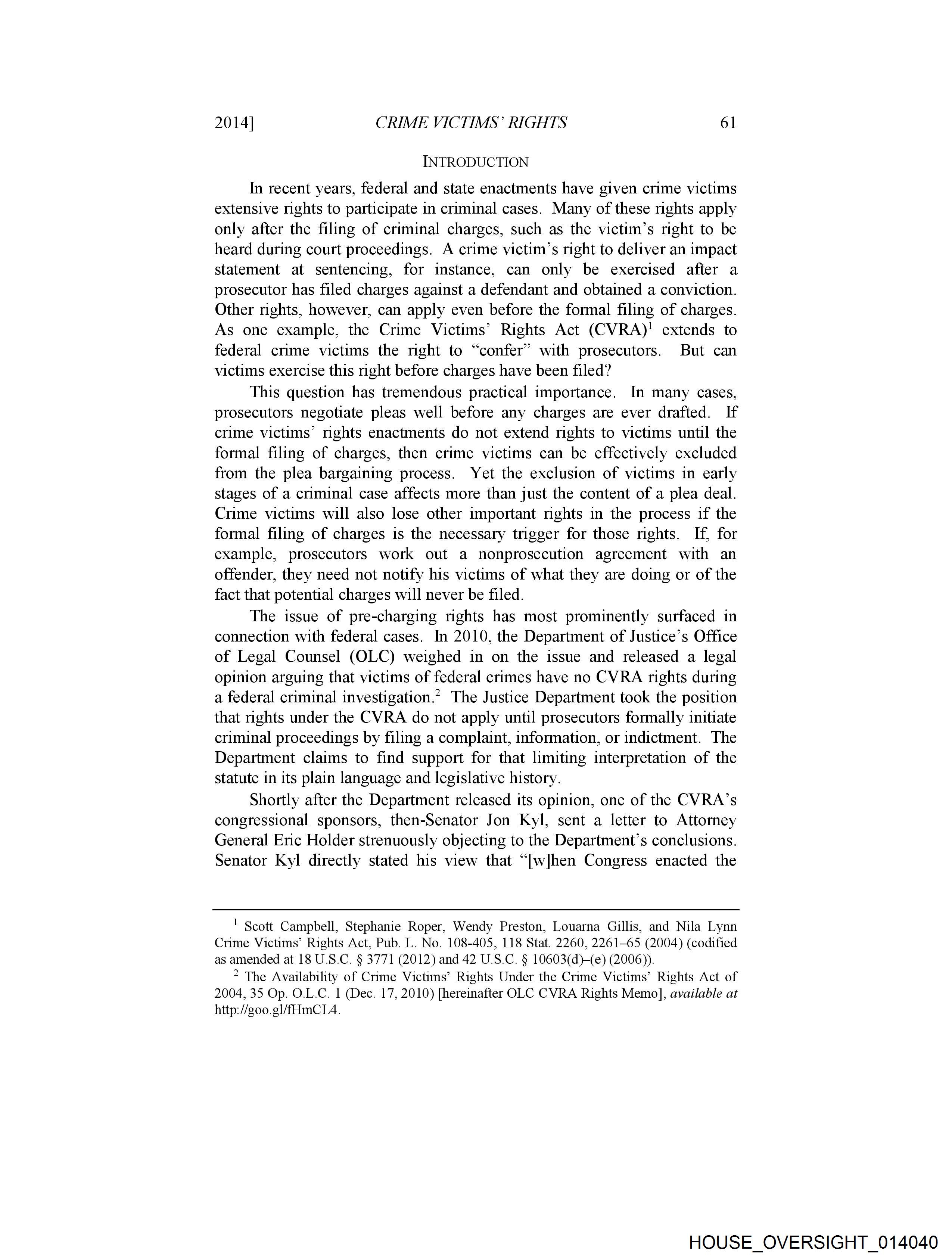
HOUSE_OVERSIGHT_014040

This document highlights the complexities surrounding crime victims' rights, particularly in the context of pre-charging scenarios, which could have implications for victims of Jeffrey Epstein's alleged crimes. It underscores the potential for victims to be excluded from critical stages of the legal process, such as plea negotiations, which is particularly relevant given the allegations of Epstein's extensive network and the handling of his cases.

🔑 Key Evidence:
  • The Crime Victims’ Rights Act (CVRA) extends to federal crime victims the right to 'confer' with prosecutors.
  • The Department of Justice’s Office of Legal Counsel (OLC) argued that victims of federal crimes have no CVRA rights during a federal criminal investigation.
  • Senator Jon Kyl objected to the Department’s conclusions, emphasizing that victims should have rights even before formal charges are filed.
👥 Connected Entities:
Department of Justice Senator Jon Kyl Crime Victims’ Rights Act (CVRA)
From: Bates: HOUSE_OVERSIGHT_014040
No comments yet.
#22 Strength: 5.0/10
Document preview

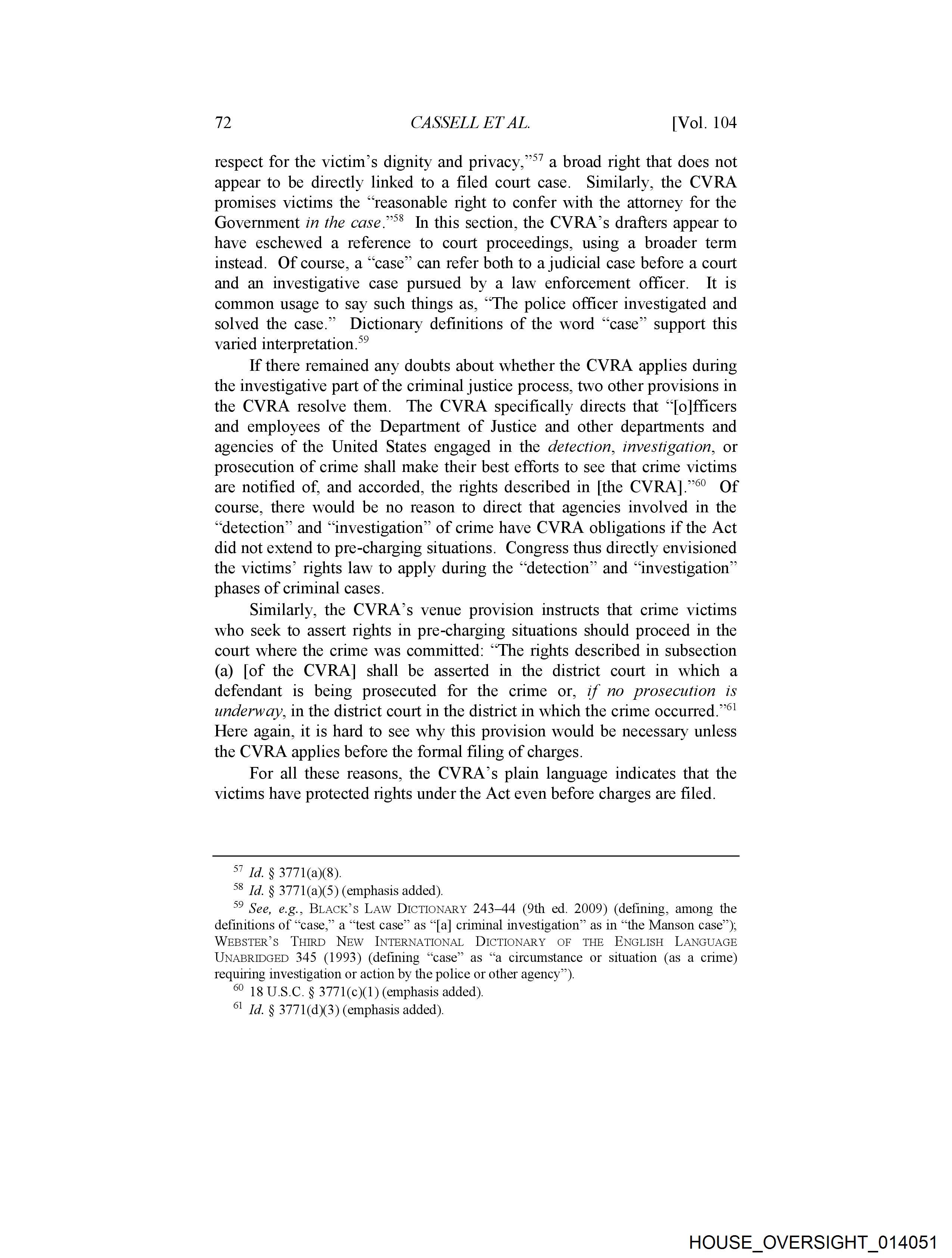
HOUSE_OVERSIGHT_014051

This document outlines the rights of victims under the Crime Victims' Rights Act (CVRA), emphasizing that these rights extend to the investigative phase of criminal cases. While it does not provide direct evidence of misconduct, it highlights the legal framework that could support victims in the Epstein case, particularly regarding their rights to be informed and involved during investigations.

🔑 Key Evidence:
  • The CVRA promises victims the 'reasonable right to confer with the attorney for the Government in the case.'
  • The CVRA specifically directs that '[o]fficers and employees of the Department of Justice... engaged in the detection, investigation, or prosecution of crime shall make their best efforts to see that crime victims are notified of, and accorded, the rights described in [the CVRA].'
  • The rights described in subsection (a) [of the CVRA] shall be asserted in the district court in which a defendant is being prosecuted for the crime or, if no prosecution is underway, in the district court in the district in which the crime occurred.
👥 Connected Entities:
Department of Justice Victims of Jeffrey Epstein Law enforcement agencies involved in the Epstein investigation
From: Bates: HOUSE_OVERSIGHT_014051
No comments yet.
#23 Strength: 8.0/10
Document preview

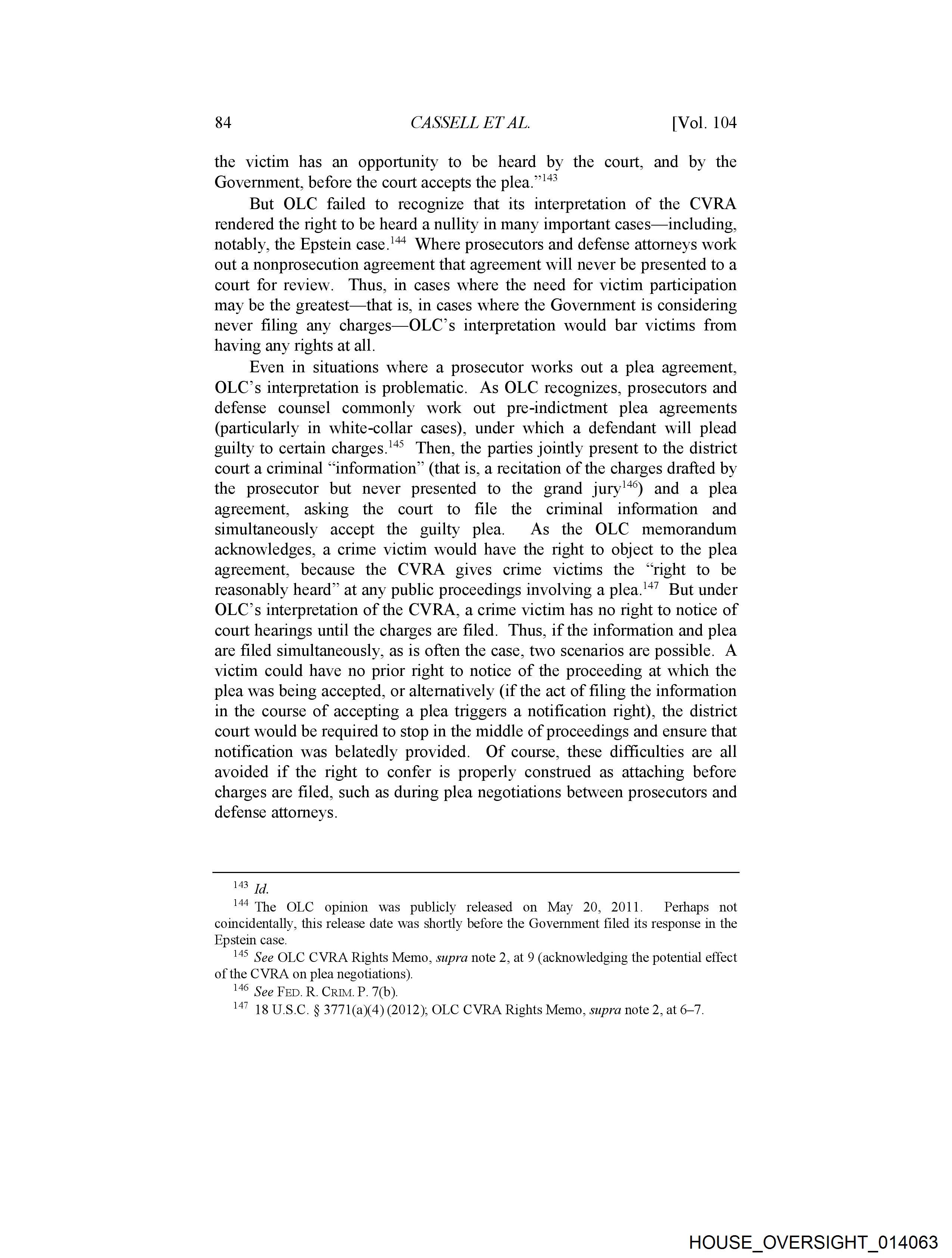
HOUSE_OVERSIGHT_014063

This document highlights significant flaws in the interpretation of the Crime Victims' Rights Act (CVRA) by the Office of Legal Counsel (OLC), which directly impacted the rights of victims in the Epstein case. It reveals how the lack of victim notification and participation in plea negotiations could have allowed Epstein and others to evade accountability, thereby facilitating ongoing criminal activity.

🔑 Key Evidence:
  • OLC’s interpretation rendered the right to be heard a nullity in many important cases—including, notably, the Epstein case.
  • In cases where the Government is considering never filing any charges, OLC’s interpretation would bar victims from having any rights at all.
  • A crime victim would have the right to object to the plea agreement, but under OLC’s interpretation, a crime victim has no right to notice of court hearings until the charges are filed.
👥 Connected Entities:
Office of Legal Counsel (OLC) Department of Justice Jeffrey Epstein
From: Bates: HOUSE_OVERSIGHT_014063
No comments yet.
#24 Strength: 6.0/10
Document preview

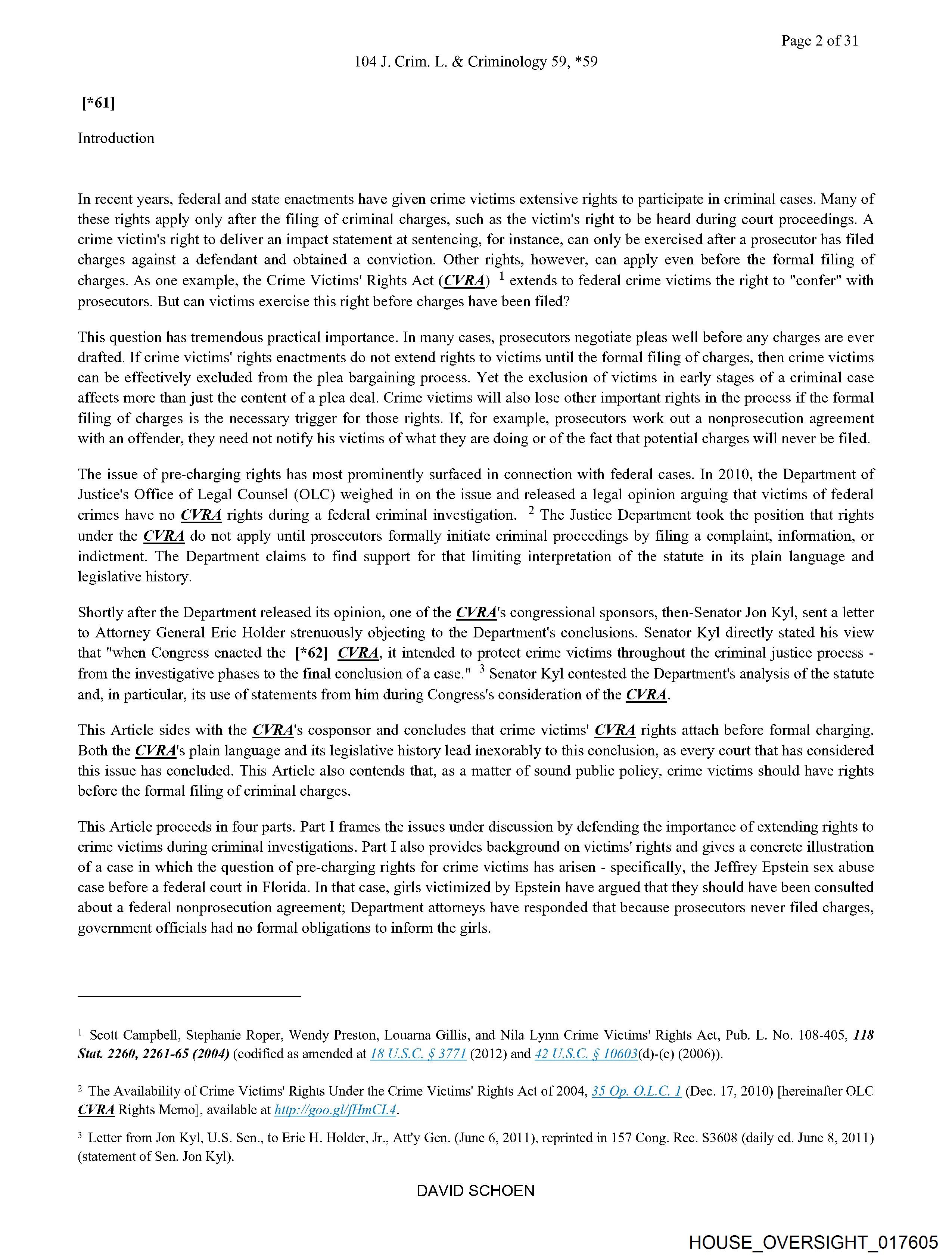
HOUSE_OVERSIGHT_017605

This document highlights the legal complexities surrounding the rights of crime victims, particularly in the context of the Crime Victims' Rights Act (CVRA). It underscores the potential exclusion of victims from the plea bargaining process, which is particularly relevant to the Epstein case, where victims may have been denied their rights during the investigation and prosecution phases.

🔑 Key Evidence:
  • The document discusses the implications of the CVRA and the rights of victims before formal charges are filed, which is crucial in understanding how victims in the Epstein case may have been marginalized.
  • It references the Department of Justice's Office of Legal Counsel (OLC) opinion that victims have no CVRA rights during a federal criminal investigation, which could relate to how Epstein's case was handled.
  • Senator Jon Kyl's objection to the DOJ's interpretation indicates a significant disagreement on victim rights, suggesting that victims in high-profile cases like Epstein's may have been overlooked.
👥 Connected Entities:
Department of Justice Senator Jon Kyl Crime Victims' Rights Act (CVRA)
From: Bates: HOUSE_OVERSIGHT_017605
No comments yet.
#25 Strength: 5.0/10
Document preview

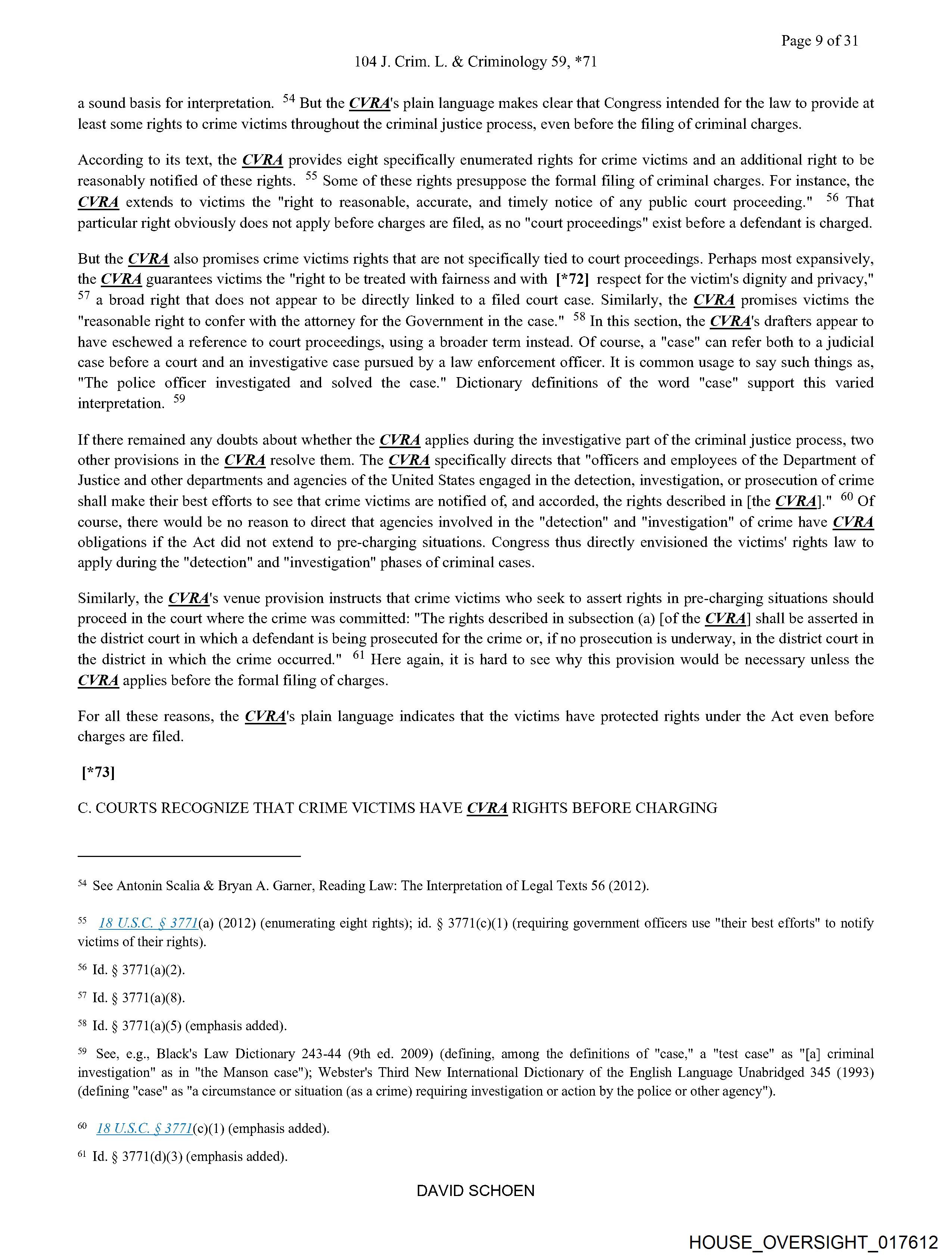
HOUSE_OVERSIGHT_017612

This document outlines the rights of crime victims under the Crime Victims' Rights Act (CVRA), emphasizing that these rights extend to the investigative phase of criminal cases. While it does not provide direct evidence of misconduct, it highlights the obligations of law enforcement and government agencies to inform victims of their rights, which is particularly relevant in the context of the Epstein case where victim intimidation and discrediting were prevalent.

🔑 Key Evidence:
  • The CVRA provides eight specifically enumerated rights for crime victims and an additional right to be reasonably notified of these rights.
  • The CVRA guarantees victims the 'right to be treated with fairness and with respect for the victim's dignity and privacy.'
  • The CVRA specifically directs that 'officers and employees of the Department of Justice and other departments and agencies of the United States engaged in the detection, investigation, or prosecution of crime shall make their best efforts to see that crime victims are notified of, and accorded, the rights described in [the CVRA].'
👥 Connected Entities:
Department of Justice Congress Victims of Jeffrey Epstein
From: Bates: HOUSE_OVERSIGHT_017612
No comments yet.
#26 Strength: 5.0/10
Document preview

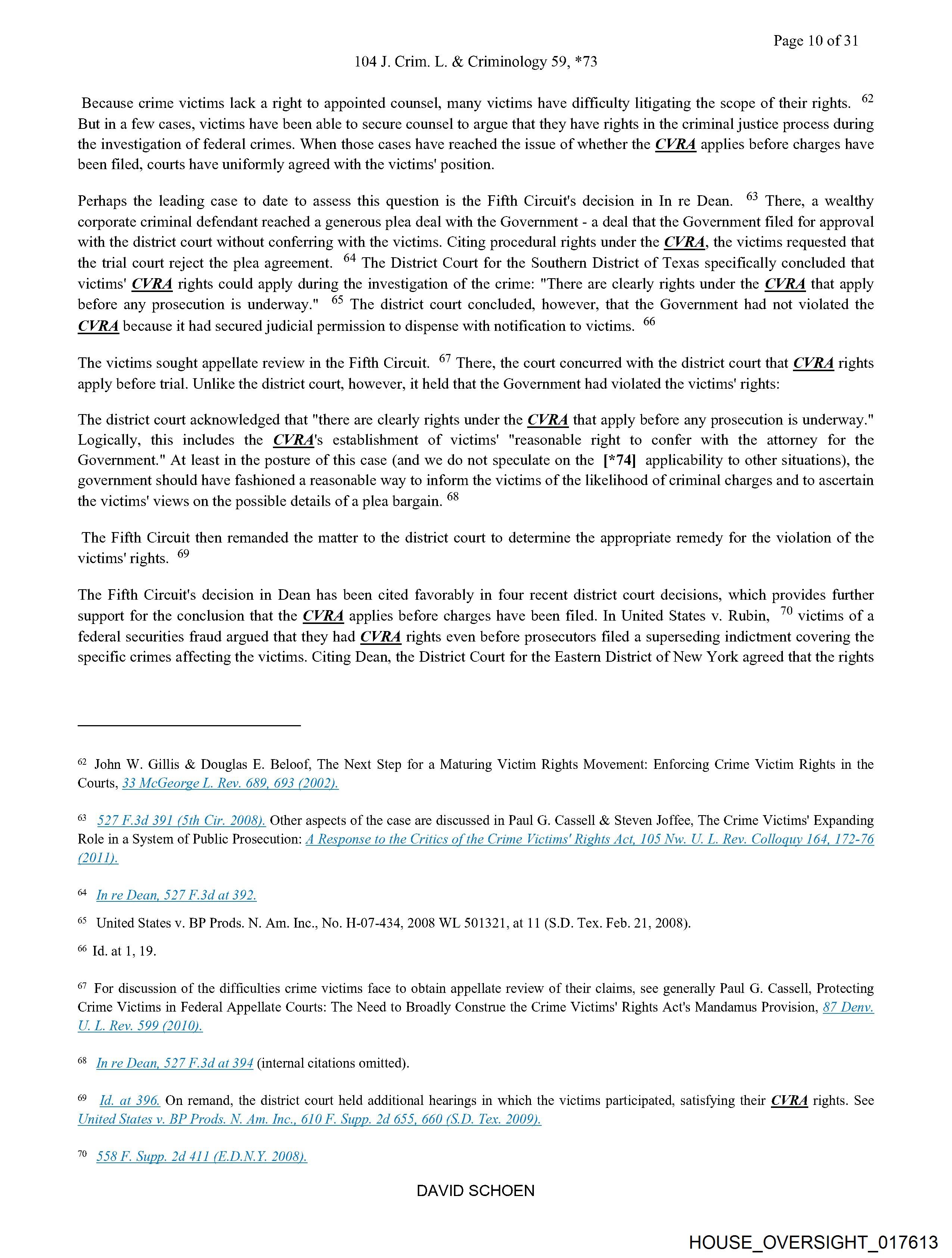
HOUSE_OVERSIGHT_017613

This document highlights the legal framework surrounding victims' rights under the Crime Victims' Rights Act (CVRA), particularly in the context of plea deals and the government's obligations to inform victims. While it does not directly implicate Epstein or his associates, it underscores the challenges victims face in asserting their rights, which is relevant to the broader context of Epstein's case and the treatment of his victims.

🔑 Key Evidence:
  • The Fifth Circuit's decision in In re Dean establishes that victims' CVRA rights apply before any prosecution is underway.
  • The court concluded that the government should have fashioned a reasonable way to inform the victims of the likelihood of criminal charges.
  • The document cites that victims have difficulty litigating the scope of their rights due to the lack of a right to appointed counsel.
👥 Connected Entities:
Fifth Circuit Court Department of Justice Crime Victims' Rights Act (CVRA)
From: Bates: HOUSE_OVERSIGHT_017613
No comments yet.
#27 Strength: 8.0/10
Document preview

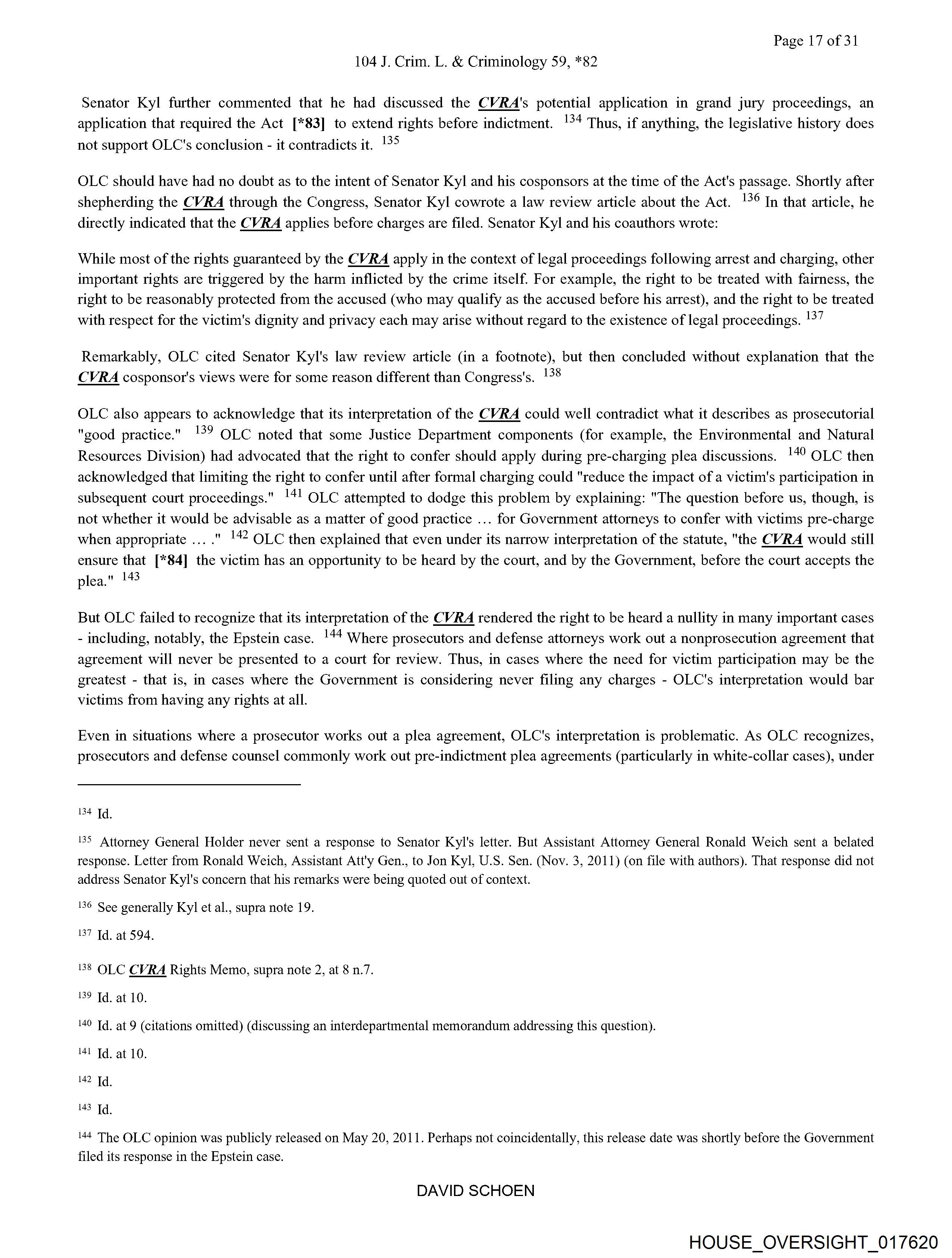
HOUSE_OVERSIGHT_017620

This document highlights significant issues regarding the application of the Crime Victims' Rights Act (CVRA) in the context of the Epstein case, revealing potential misconduct by the Office of Legal Counsel (OLC) in interpreting victims' rights. It underscores how the OLC's narrow interpretation could effectively silence victims, particularly in cases where no charges are filed, which is critical given Epstein's history of evading accountability.

🔑 Key Evidence:
  • Senator Kyl's law review article indicates that the CVRA applies before charges are filed, contradicting OLC's interpretation.
  • OLC acknowledged that limiting the right to confer until after formal charging could 'reduce the impact of a victim's participation in subsequent court proceedings.'
  • OLC's interpretation rendered the right to be heard a nullity in many important cases, including the Epstein case, where nonprosecution agreements could prevent victim participation.
👥 Connected Entities:
Senator Jon Kyl Office of Legal Counsel (OLC) Department of Justice
From: Bates: HOUSE_OVERSIGHT_017620
No comments yet.
#28 Strength: 5.0/10
Document preview

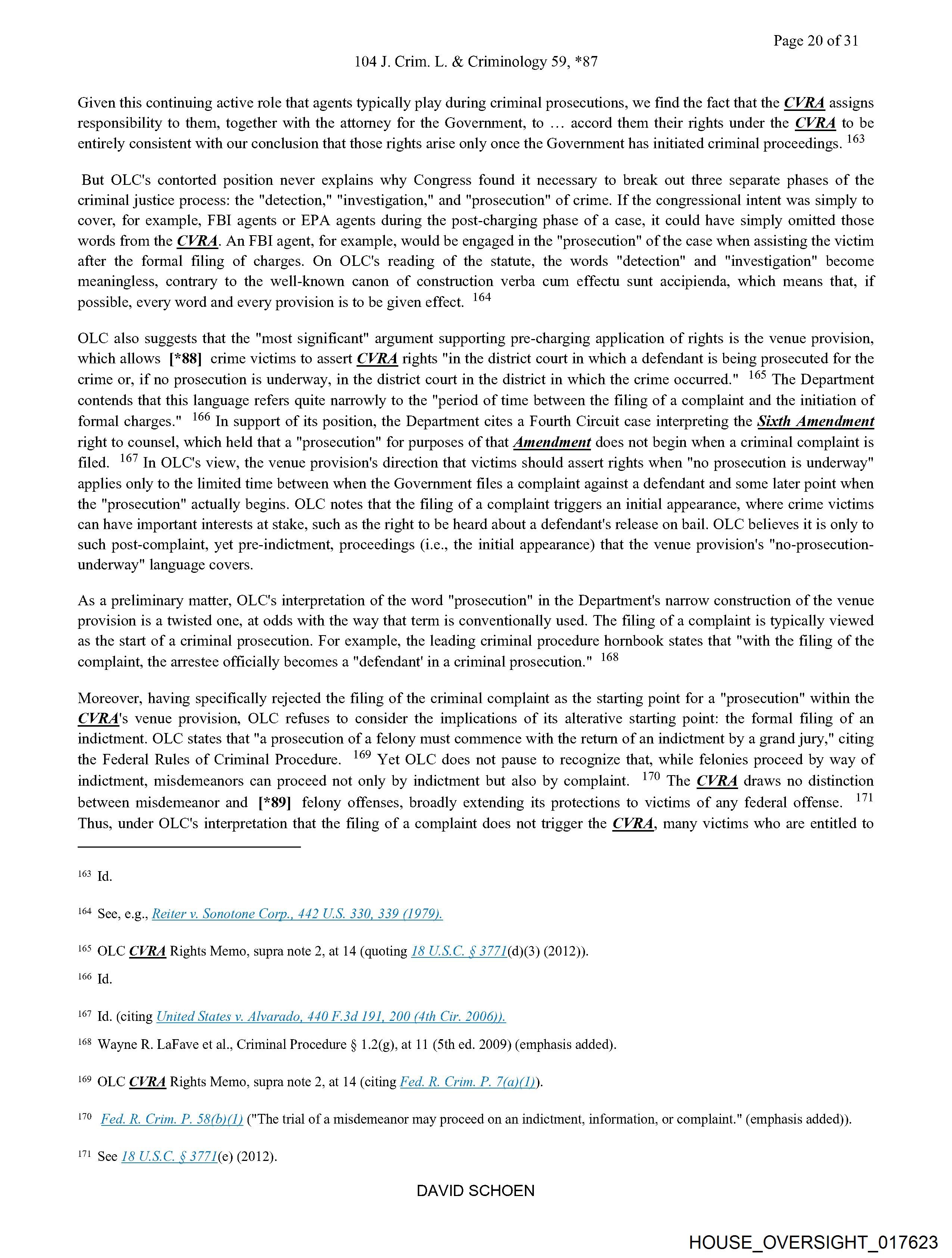
HOUSE_OVERSIGHT_017623

This document highlights the complexities surrounding the rights of crime victims under the Crime Victims' Rights Act (CVRA) and the interpretation of 'prosecution' in legal contexts. While it does not provide direct evidence of misconduct, it raises concerns about the treatment of victims and the potential for governmental oversight failures in the Epstein case.

🔑 Key Evidence:
  • The document discusses the CVRA's assignment of rights to victims only after the initiation of criminal proceedings, which could imply a lack of support for victims during earlier stages of investigation.
  • It critiques the Office of Legal Counsel's (OLC) interpretation of 'prosecution' and suggests that their narrow view undermines the intent of Congress to protect victims throughout the criminal justice process.
  • The mention of the venue provision indicates that victims may have limited recourse to assert their rights, particularly in the pre-charging phase, which could affect how victims of Epstein's trafficking were treated.
👥 Connected Entities:
Office of Legal Counsel (OLC) Department of Justice Crime Victims' Rights Act (CVRA)
From: Bates: HOUSE_OVERSIGHT_017623
No comments yet.
#29 Strength: 5.0/10
Document preview

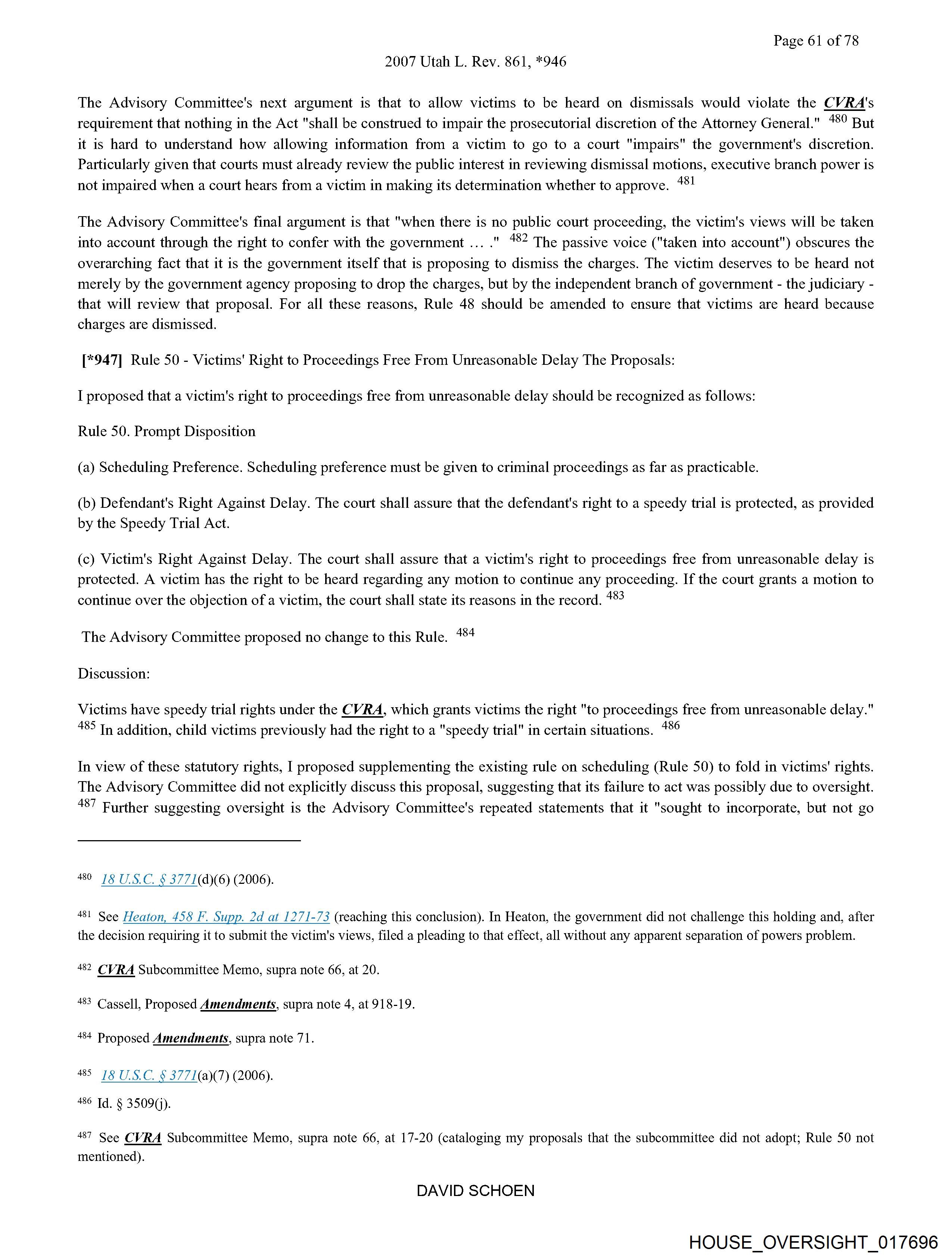
HOUSE_OVERSIGHT_017696

This document highlights the legal framework surrounding victims' rights in criminal proceedings, particularly in relation to the dismissal of charges. While it does not directly implicate individuals or reveal new evidence of misconduct, it underscores systemic issues that may have allowed for the dismissal of charges against powerful individuals, potentially including Epstein.

🔑 Key Evidence:
  • The Advisory Committee's argument that allowing victims to be heard on dismissals would violate prosecutorial discretion raises concerns about the balance of power in the judicial process.
  • The document emphasizes that victims deserve to be heard by the judiciary, not just the government, which could indicate a lack of accountability in cases involving influential defendants.
  • The proposal for victims' rights to proceedings free from unreasonable delay suggests a recognition of systemic delays that could be exploited in high-profile cases.
👥 Connected Entities:
Advisory Committee on Rules Department of Justice Victims of Epstein's trafficking network
From: Bates: HOUSE_OVERSIGHT_017696
No comments yet.
#30 Strength: 5.0/10
Document preview

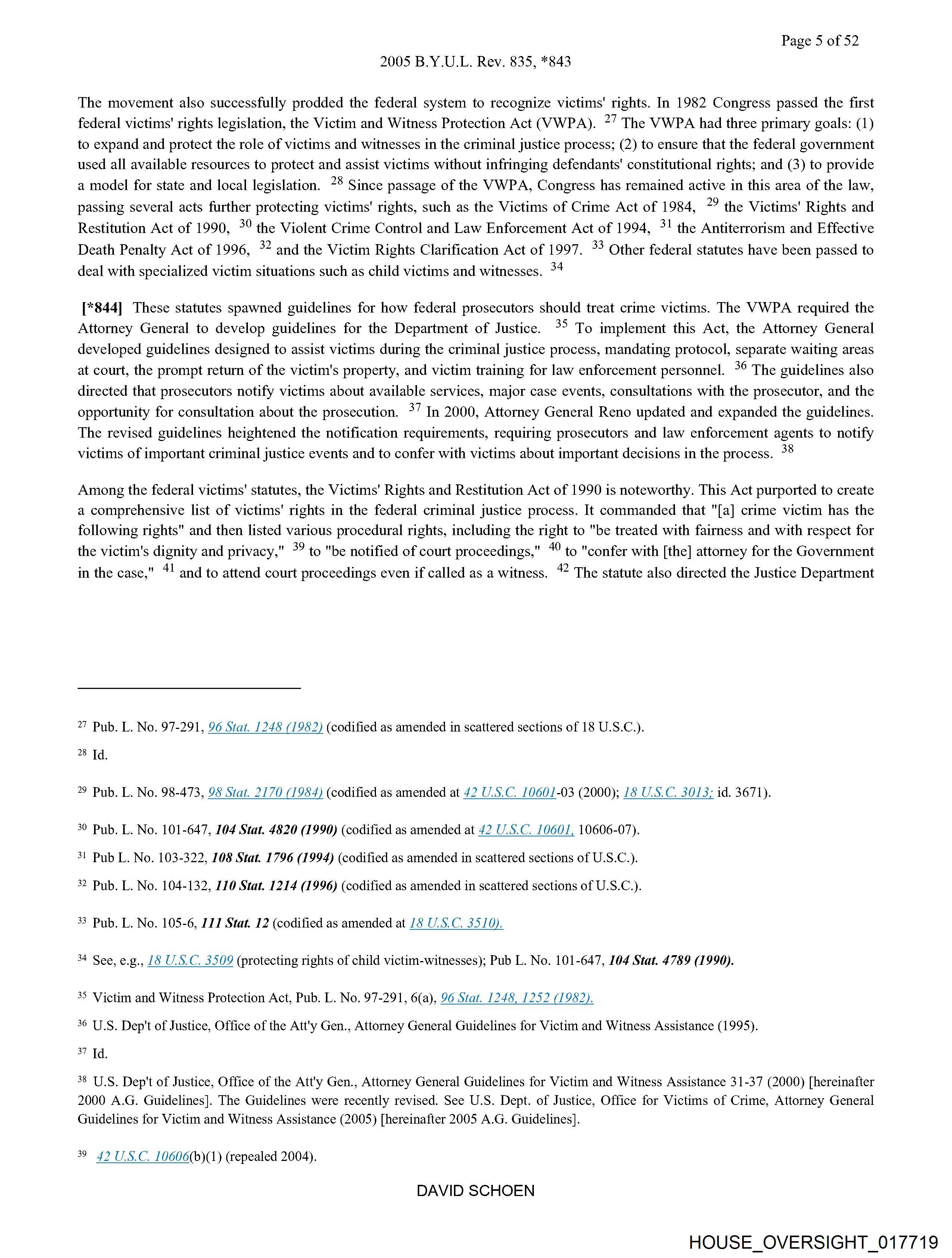
HOUSE_OVERSIGHT_017719

This document outlines the evolution of victims' rights legislation, which is significant in the context of the Epstein case as it highlights the legal framework that should protect victims of crimes, including sex trafficking. While it does not directly implicate Epstein or his associates, it underscores the systemic issues surrounding victim treatment that may have been exploited in his operations.

🔑 Key Evidence:
  • The VWPA had three primary goals: (1) to expand and protect the role of victims and witnesses in the criminal justice process; (2) to ensure that the federal government used all available resources to protect and assist victims without infringing defendants’ constitutional rights; and (3) to provide a model for state and local legislation.
  • The guidelines also directed that prosecutors notify victims about available services, major case events, consultations with the prosecutor, and the opportunity for consultation about the prosecution.
  • The Victims' Rights and Restitution Act of 1990 purported to create a comprehensive list of victims' rights in the federal criminal justice process.
👥 Connected Entities:
U.S. Congress Department of Justice Victims of Crime Act
From: Bates: HOUSE_OVERSIGHT_017719
No comments yet.
#31 Strength: 4.0/10
Document preview

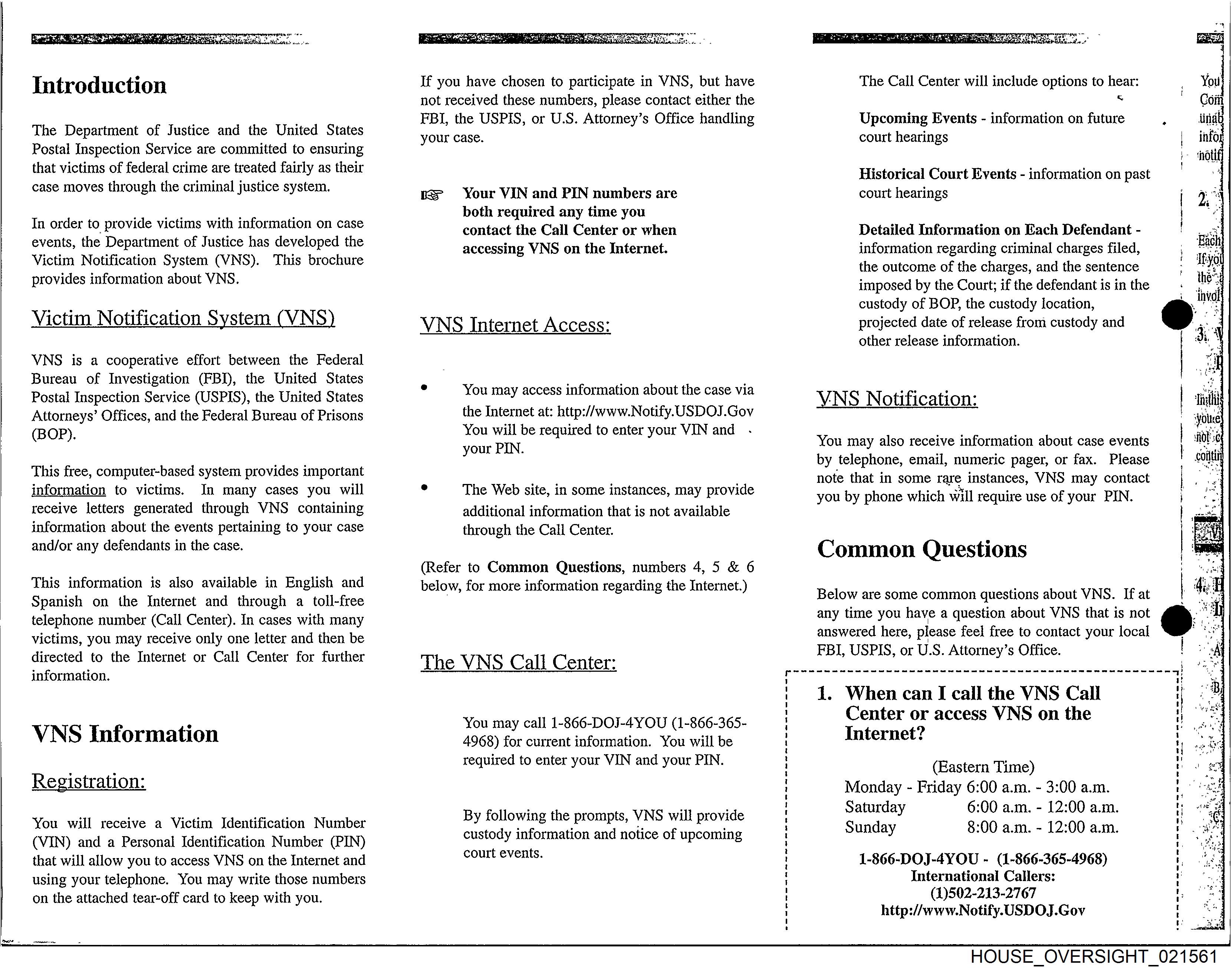
HOUSE_OVERSIGHT_021561

This document outlines the Victim Notification System (VNS) established by the Department of Justice, which is crucial for ensuring that victims of federal crimes, including those related to the Epstein case, are informed about case developments. While it does not directly implicate individuals or reveal misconduct, it highlights the systemic efforts to support victims, which is significant in the context of Epstein's extensive network of abuse.

🔑 Key Evidence:
  • The document mentions the cooperative effort between the FBI, USPIS, U.S. Attorneys’ Offices, and BOP, indicating a structured approach to victim support.
  • It provides details on how victims can access information about their cases, emphasizing the importance of victim rights in the judicial process.
  • The inclusion of a toll-free number and an internet portal for victims to receive updates reflects an organized response to the needs of victims, which is particularly relevant given the scale of Epstein's crimes.
👥 Connected Entities:
Department of Justice Federal Bureau of Investigation (FBI) United States Postal Inspection Service (USPIS)
From: Bates: HOUSE_OVERSIGHT_021561
No comments yet.
#32 Strength: 9.0/10
Document preview

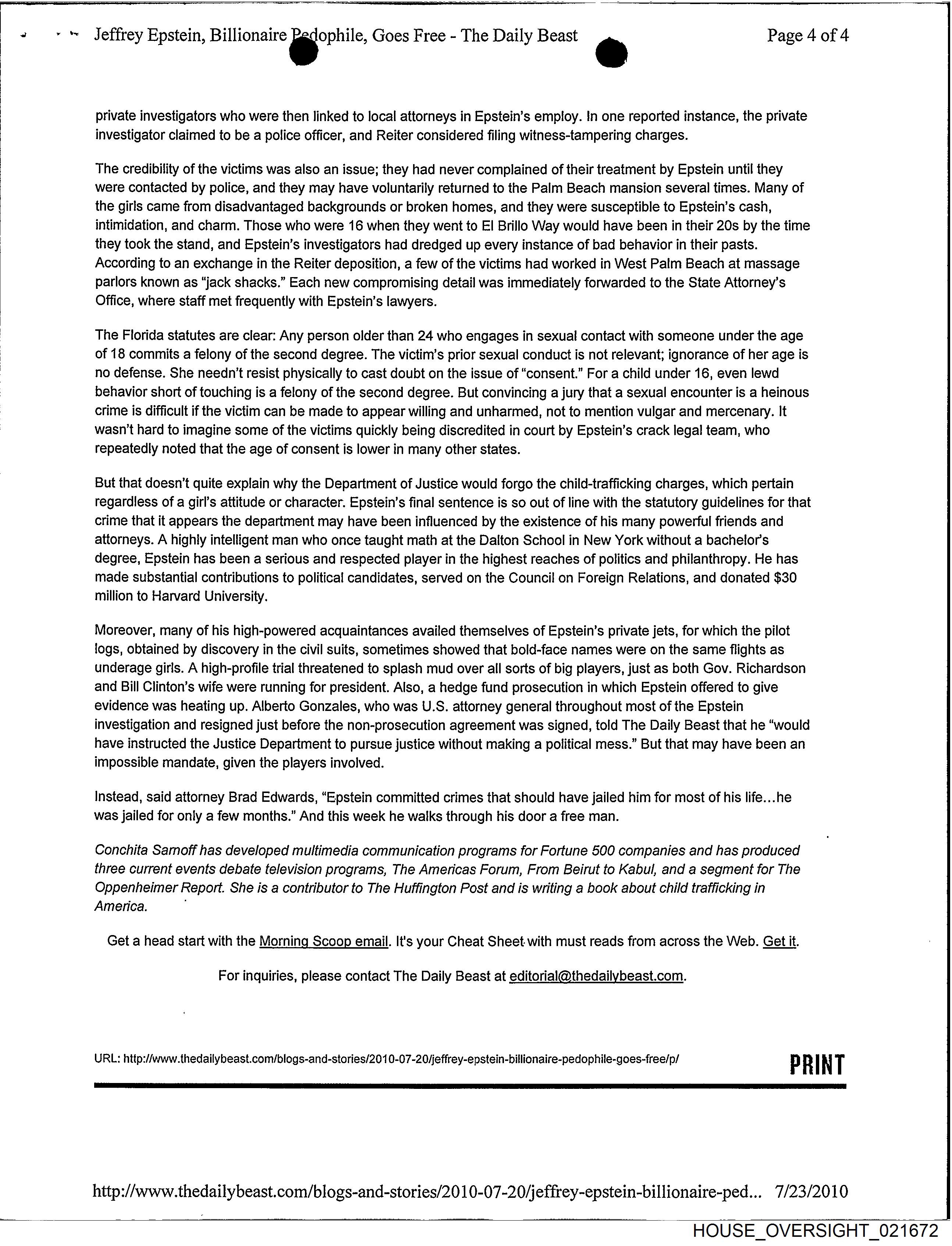
HOUSE_OVERSIGHT_021672

This document reveals significant insights into the tactics used by Epstein's legal team to discredit victims and the apparent influence of Epstein's connections on the judicial process. It highlights the troubling intersection of power, wealth, and the manipulation of legal outcomes in cases of sexual exploitation.

🔑 Key Evidence:
  • The credibility of the victims was also an issue; they had never complained of their treatment by Epstein until they were contacted by police.
  • Epstein’s investigators had dredged up every instance of bad behavior in their pasts.
  • Convincing a jury that a sexual encounter is a heinous crime is difficult if the victim can be made to appear willing and unharmed.
👥 Connected Entities:
Jeffrey Epstein Department of Justice State Attorney’s Office
From: Bates: HOUSE_OVERSIGHT_021672
No comments yet.
#33 Strength: 5.0/10
Document preview

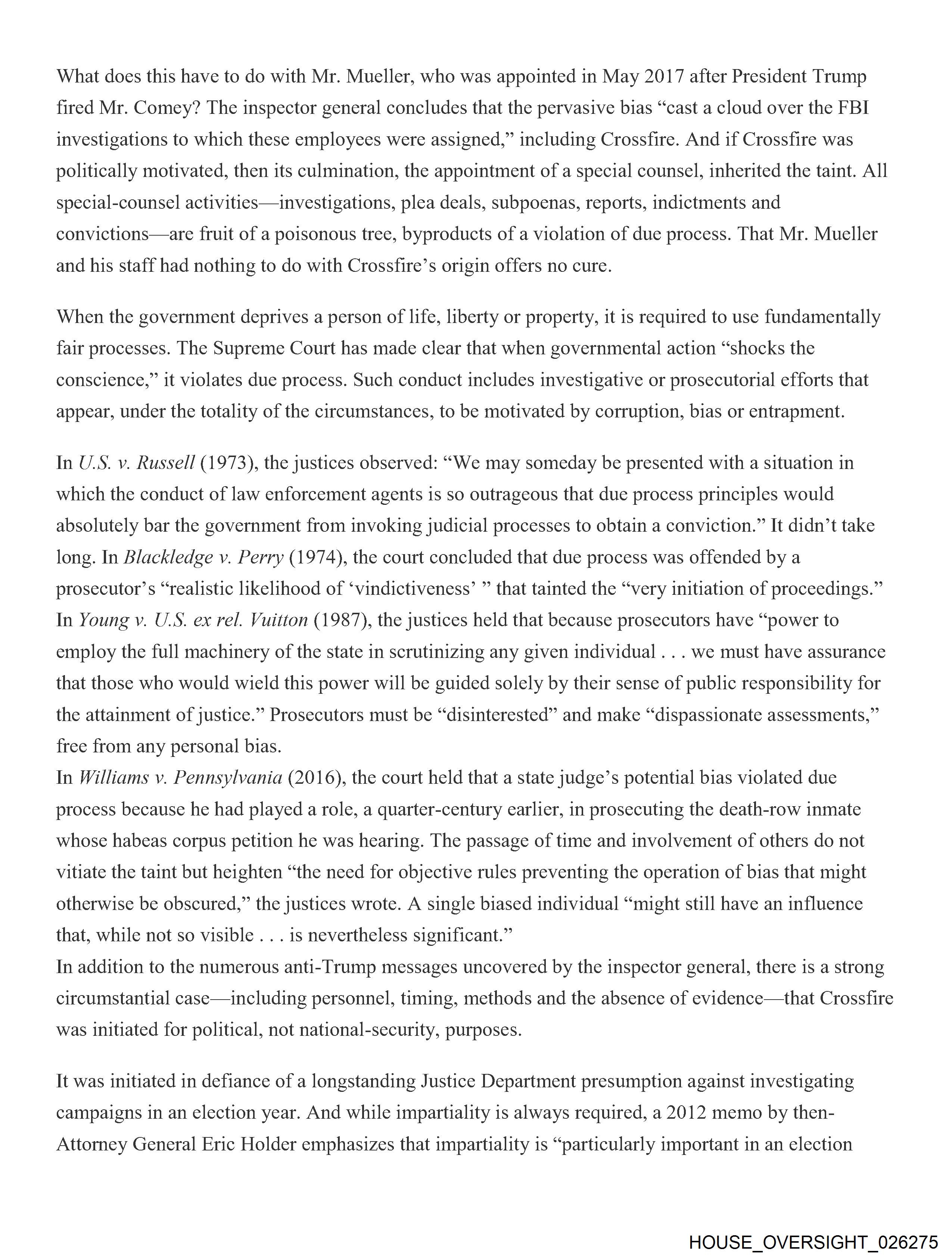
HOUSE_OVERSIGHT_026275

This document discusses the potential bias and misconduct within the FBI and the implications of such actions on due process, particularly in relation to investigations like Crossfire. While it does not directly implicate Epstein or his activities, it raises concerns about the integrity of governmental investigations that could relate to broader issues of corruption and misconduct in high-profile cases, including Epstein's.

🔑 Key Evidence:
  • The inspector general concludes that the pervasive bias 'cast a cloud over the FBI investigations to which these employees were assigned.'
  • All special-counsel activities—investigations, plea deals, subpoenas, reports, indictments and convictions—are fruit of a poisonous tree, byproducts of a violation of due process.
  • The Supreme Court has made clear that when governmental action 'shocks the conscience,' it violates due process.
👥 Connected Entities:
Robert Mueller James Comey FBI
From: Bates: HOUSE_OVERSIGHT_026275
No comments yet.
#34 Strength: 5.0/10
Document preview

HOUSE_OVERSIGHT_030208

This document discusses the legal implications of indicting a sitting president, which indirectly highlights the complexities of prosecuting high-profile individuals involved in serious criminal activities, such as those associated with Jeffrey Epstein. It raises questions about the intersection of political power and accountability, particularly in cases involving potential misconduct by influential figures.

🔑 Key Evidence:
  • concluding that a president can be indicted does not mean that he or she should be indicted
  • awaiting action by the House of Representatives may in some circumstances be the prudent course
  • some offenses might be seen as better suited for initial consideration by Congress in the impeachment process
👥 Connected Entities:
U.S. Congress Supreme Court Department of Justice
From: Bates: HOUSE_OVERSIGHT_030208
No comments yet.