🔐 Private Research Portal

Epstein Research Portal

Access the full investigative corpus, ranked smoking guns, OCR-linked imagery, and intel briefs.

Front-of-house site Sign In / Sign Up
Same BENED DNA · Investigative Skin
← Back to Entities

📁 U.S. Department of Justice Dossier

34 documents connected to this entity

Page 1 of 2 (34 items)
#1 Strength: 9.0/10
Document preview

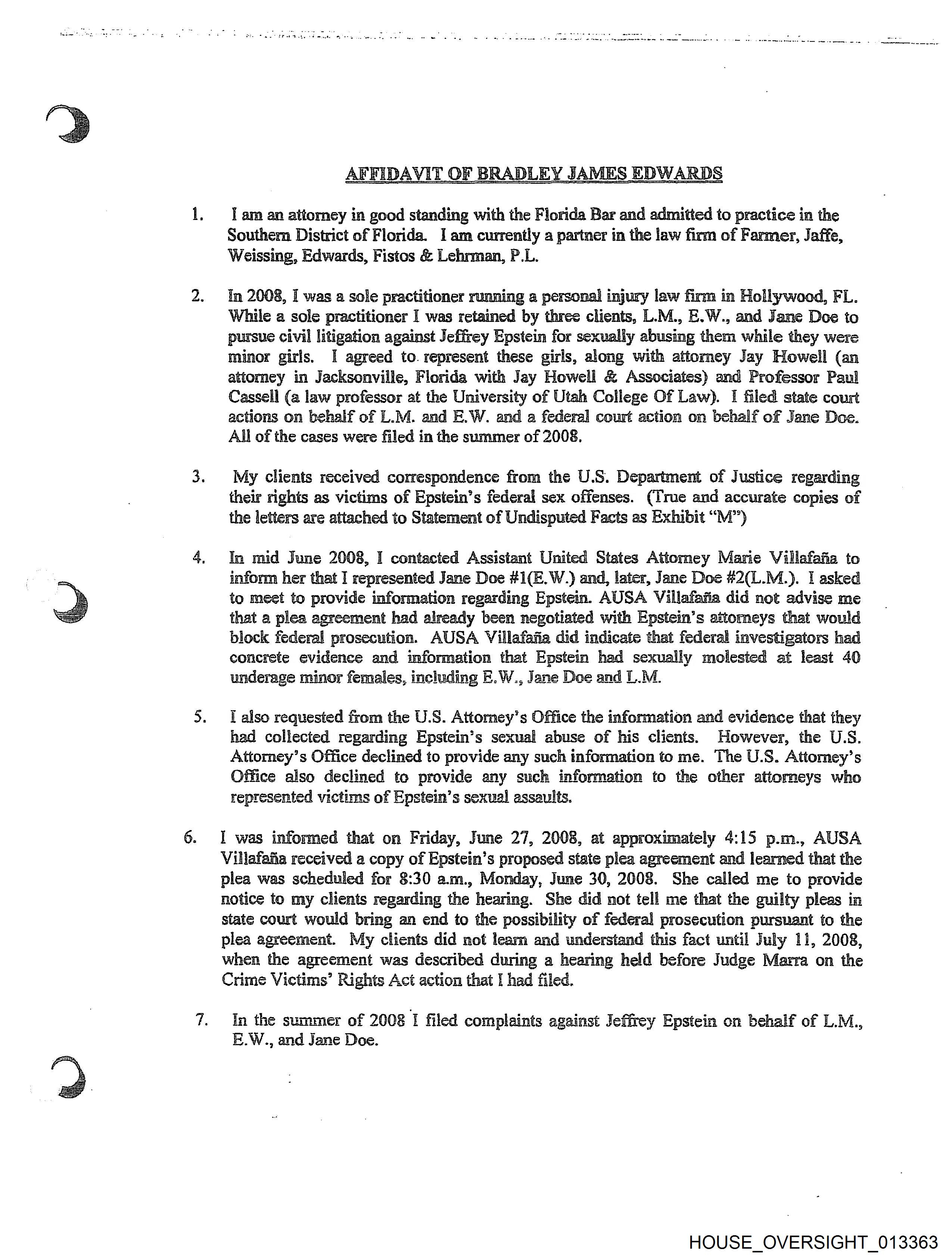
HOUSE_OVERSIGHT_013363

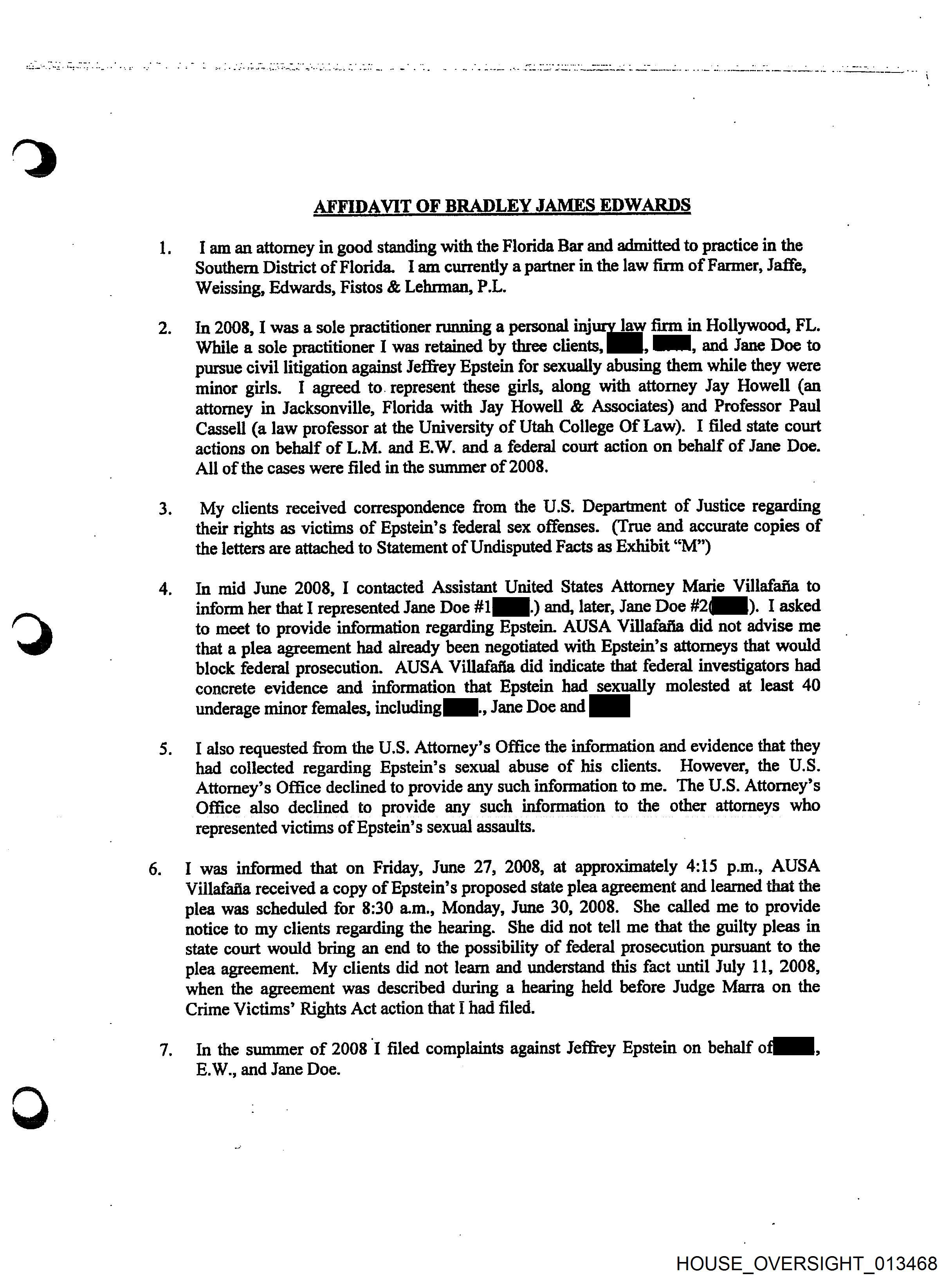
This affidavit reveals critical information about the legal representation of Epstein's victims and the apparent lack of communication from federal prosecutors regarding the plea agreement that effectively shielded Epstein from federal prosecution. The document highlights potential misconduct by the U.S. Attorney's Office in failing to inform victims of the implications of the plea deal, suggesting systemic issues in the handling of Epstein's case.

🔑 Key Evidence:
  • AUSA Villafafia did not advise me that a plea agreement had already been negotiated with Epstein’s attorneys that would block federal prosecution.
  • AUSA Villafafia indicated that federal investigators had concrete evidence and information that Epstein had sexually molested at least 40 underage minor females.
  • The U.S. Attorney’s Office declined to provide any such information to me. The U.S. Attorney’s Office also declined to provide any such information to the other attorneys who represented victims of Epstein’s sexual assaults.
👥 Connected Entities:
Bradley James Edwards Marie Villafafia U.S. Department of Justice
From: Bates: HOUSE_OVERSIGHT_013363
No comments yet.
#2 Strength: 5.0/10
Document preview

HOUSE_OVERSIGHT_013407

This document highlights the broader context of prosecutorial misconduct and the violation of victims' rights, which is significant in understanding the systemic failures that may have allowed Jeffrey Epstein's criminal activities to persist. It underscores the challenges faced by victims in seeking justice, particularly in high-profile cases like Epstein's.

🔑 Key Evidence:
  • Attorneys Say Miami Prosecutors Violated Crime Victims’ Rights Act
  • Federal Prosecutors Violated Laws, Ethics Rules in 201 Cases Since 1998, Study Finds
  • Wmakers Bemoan Lack of Funding For Victims’ Rights
👥 Connected Entities:
Miami Prosecutors Department of Justice House Judiciary Committee
From: Bates: HOUSE_OVERSIGHT_013407
No comments yet.
#3 Strength: 9.0/10
Document preview

HOUSE_OVERSIGHT_013468

This affidavit by attorney Bradley James Edwards reveals significant misconduct by federal prosecutors in their handling of Jeffrey Epstein's case, particularly regarding the lack of communication about the plea agreement that effectively shielded Epstein from federal prosecution. The document highlights the systemic failures in protecting the rights of victims and raises questions about the integrity of the judicial process.

🔑 Key Evidence:
  • AUSA Villafafia did not advise me that a plea agreement had already been negotiated with Epstein’s attorneys that would block federal prosecution.
  • AUSA Villafafia indicated that federal investigators had concrete evidence and information that Epstein had sexually molested at least 40 underage minor females.
  • The U.S. Attorney’s Office declined to provide any such information to me or the other attorneys who represented victims of Epstein’s sexual assaults.
👥 Connected Entities:
Bradley James Edwards Marie Villafafia U.S. Department of Justice
From: Bates: HOUSE_OVERSIGHT_013468
No comments yet.
#4 Strength: 4.0/10
Document preview

HOUSE_OVERSIGHT_014045

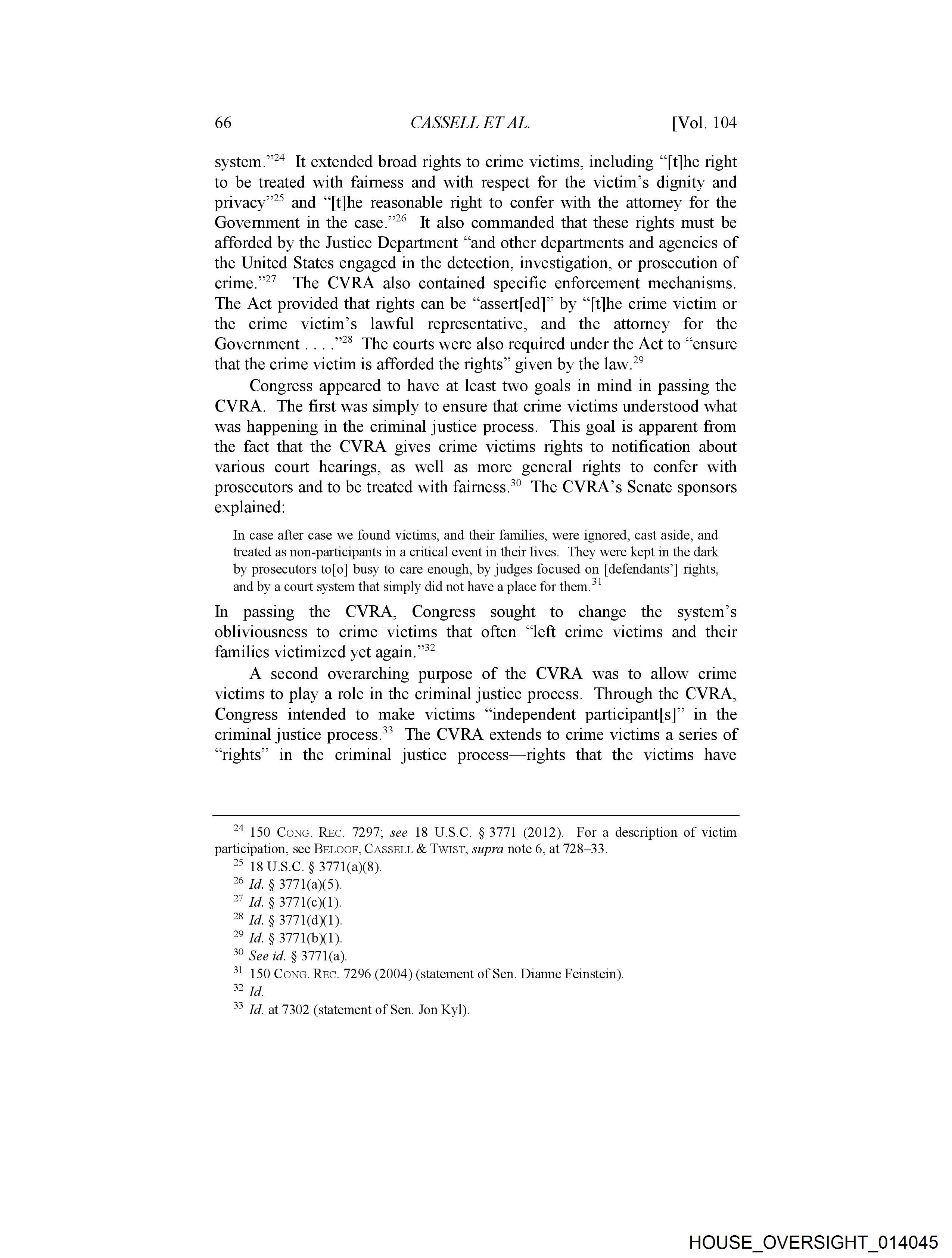
This document outlines the Crime Victims' Rights Act (CVRA) and emphasizes the importance of victim participation in the criminal justice process. While it does not directly implicate individuals or reveal new evidence of misconduct, it highlights systemic issues that may have allowed Epstein's activities to persist without adequate victim support or legal recourse.

🔑 Key Evidence:
  • The CVRA extends broad rights to crime victims, including the right to be treated with fairness and respect for their dignity and privacy.
  • Congress sought to change the system’s obliviousness to crime victims that often left them victimized yet again.
  • The Act provides that rights can be asserted by the crime victim or the crime victim’s lawful representative, indicating a legal framework for victims to engage in the justice process.
👥 Connected Entities:
U.S. Department of Justice Congress Victims of Epstein's crimes
From: Bates: HOUSE_OVERSIGHT_014045
No comments yet.
#5 Strength: 4.0/10
Document preview

HOUSE_OVERSIGHT_014058

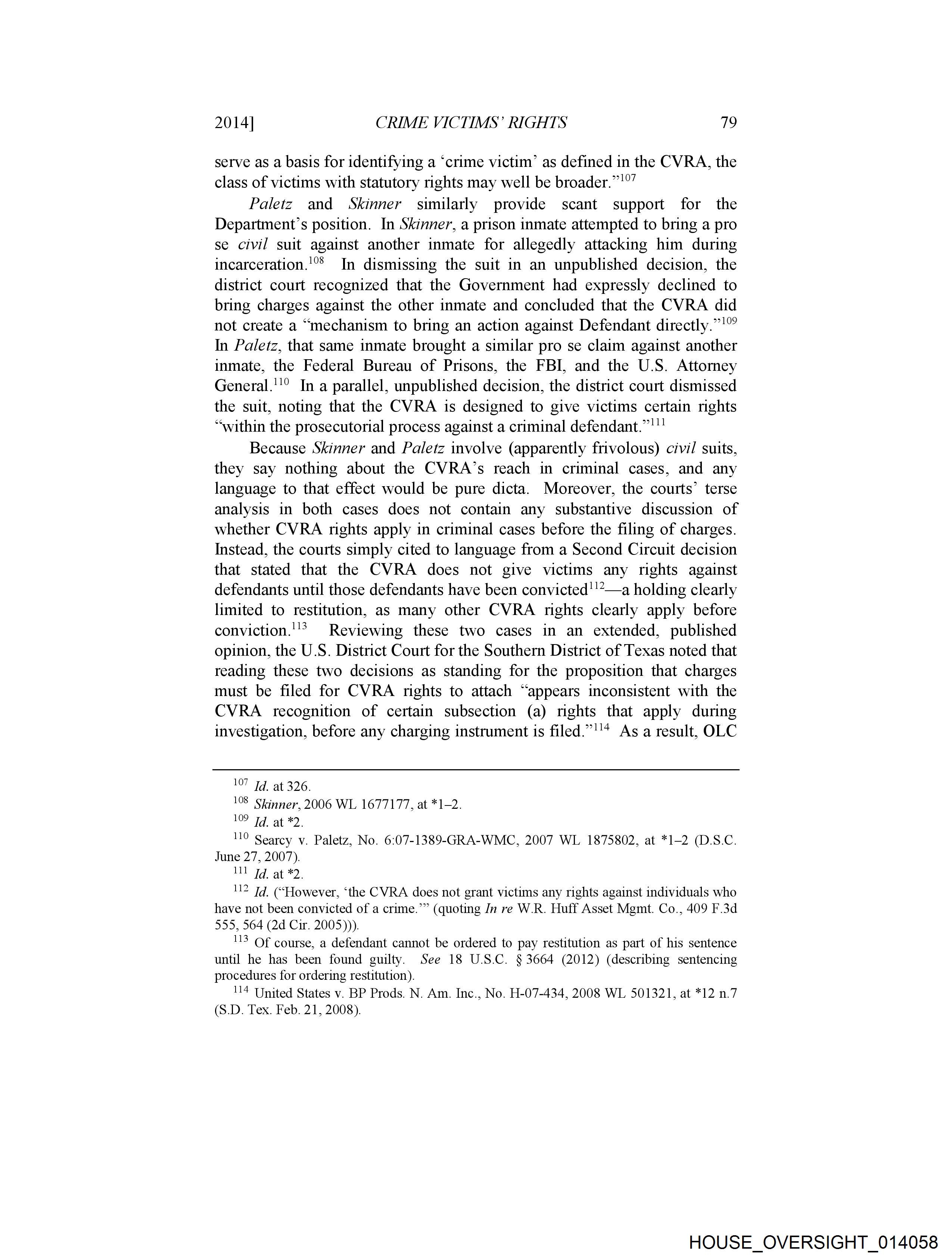
This document discusses the Crime Victims' Rights Act (CVRA) and its implications for victims in criminal cases, particularly in the context of the Epstein investigation. While it does not provide direct evidence of misconduct, it highlights the legal complexities surrounding victims' rights, which are crucial for understanding the broader implications of Epstein's criminal activities and the potential for victims to seek justice.

🔑 Key Evidence:
  • The CVRA does not give victims any rights against defendants until those defendants have been convicted.
  • Certain CVRA rights apply during investigation, before any charging instrument is filed.
  • The courts’ terse analysis in both cases does not contain any substantive discussion of whether CVRA rights apply in criminal cases before the filing of charges.
👥 Connected Entities:
U.S. Department of Justice Federal Bureau of Prisons U.S. Attorney General
From: Bates: HOUSE_OVERSIGHT_014058
No comments yet.
#6 Strength: 5.0/10
Document preview

HOUSE_OVERSIGHT_016527

This document discusses the lack of oversight in state justice systems regarding prosecutorial decisions, which may indirectly relate to the Epstein case by highlighting systemic issues that could allow for misconduct or corruption to go unchecked. It underscores the challenges victims face in seeking justice, which is particularly relevant given the allegations against Epstein and the handling of his case.

🔑 Key Evidence:
  • State justice systems do not go as far as the federal system does, much less provide the kind of oversight or victim recourse that European systems now offer.
  • Few states follow that model. Instead, prosecutors in most states are locally elected and operate autonomously from state justice departments or attorneys general, which generally exercise little, if any, oversight.
  • In accord with common law tradition, state and federal courts have never meaningfully reviewed public prosecutors’ noncharging decisions.
👥 Connected Entities:
U.S. Department of Justice State prosecutors Victims' rights organizations
From: Bates: HOUSE_OVERSIGHT_016527
No comments yet.
#7 Strength: 4.0/10
Document preview

HOUSE_OVERSIGHT_016534

This document discusses the broader context of public corruption and enforcement challenges, which may indirectly relate to the Epstein case by highlighting systemic issues that could have allowed his activities to persist. It underscores the potential for favoritism and underenforcement in cases involving powerful individuals, which is relevant to understanding how Epstein operated within a network of influential figures.

🔑 Key Evidence:
  • Underenforcement in this realm follows more from favoritism toward offenders than the biases against victim groups or types of offenses.
  • Combatting 'public corruption' is a top priority for the Federal Bureau of Investigation, on par with combating threats of terrorism, foreign espionage, and cyber-warfare.
  • Federal anti-corruption prosecutions of state and local officials typically average 350-400 per year.
👥 Connected Entities:
Federal Bureau of Investigation U.S. Department of Justice State and local officials involved in anti-corruption enforcement
From: Bates: HOUSE_OVERSIGHT_016534
No comments yet.
#8 Strength: 5.0/10
Document preview

HOUSE_OVERSIGHT_016551

This document discusses the mixed effectiveness of U.S. prosecutorial oversight and accountability, particularly in cases of underenforcement related to sexual assault and police misconduct. While it does not directly implicate individuals or organizations in the Epstein case, it highlights systemic issues that may have allowed Epstein's activities to persist without adequate legal intervention.

🔑 Key Evidence:
  • The track record of the U.S. responses to underenforcement, then, is mixed.
  • Federal authorities so far have attempted to reinforce state sexual assault enforcement only at the margins.
  • Certain specific pockets of underenforcement - involving police, marginalized victim groups, and sexual assaults - are especially hard to remedy.
👥 Connected Entities:
U.S. Department of Justice Local Prosecutors Victim Advocacy Groups
From: Bates: HOUSE_OVERSIGHT_016551
No comments yet.
#9 Strength: 4.0/10
Document preview

HOUSE_OVERSIGHT_017628

This document outlines the Justice Department's policies regarding victim notification and services, which is significant in the context of the Epstein case as it highlights the procedural framework that should have been followed in notifying victims of their rights. However, it does not provide direct evidence of misconduct or corruption related to Epstein's activities.

🔑 Key Evidence:
  • The Department's mandatory policy regarding notification regarding crime victim services under the VRRA.
  • The Department noted that OLC had issued an opinion that the CVRA did not extend rights before the formal filing of charges.
  • The FBI alone reports that it provided more than 190,000 services to victims during the past fiscal year [FY 2011].
👥 Connected Entities:
U.S. Department of Justice FBI Senator Kyl
From: Bates: HOUSE_OVERSIGHT_017628
No comments yet.
#10 Strength: 5.0/10
Document preview

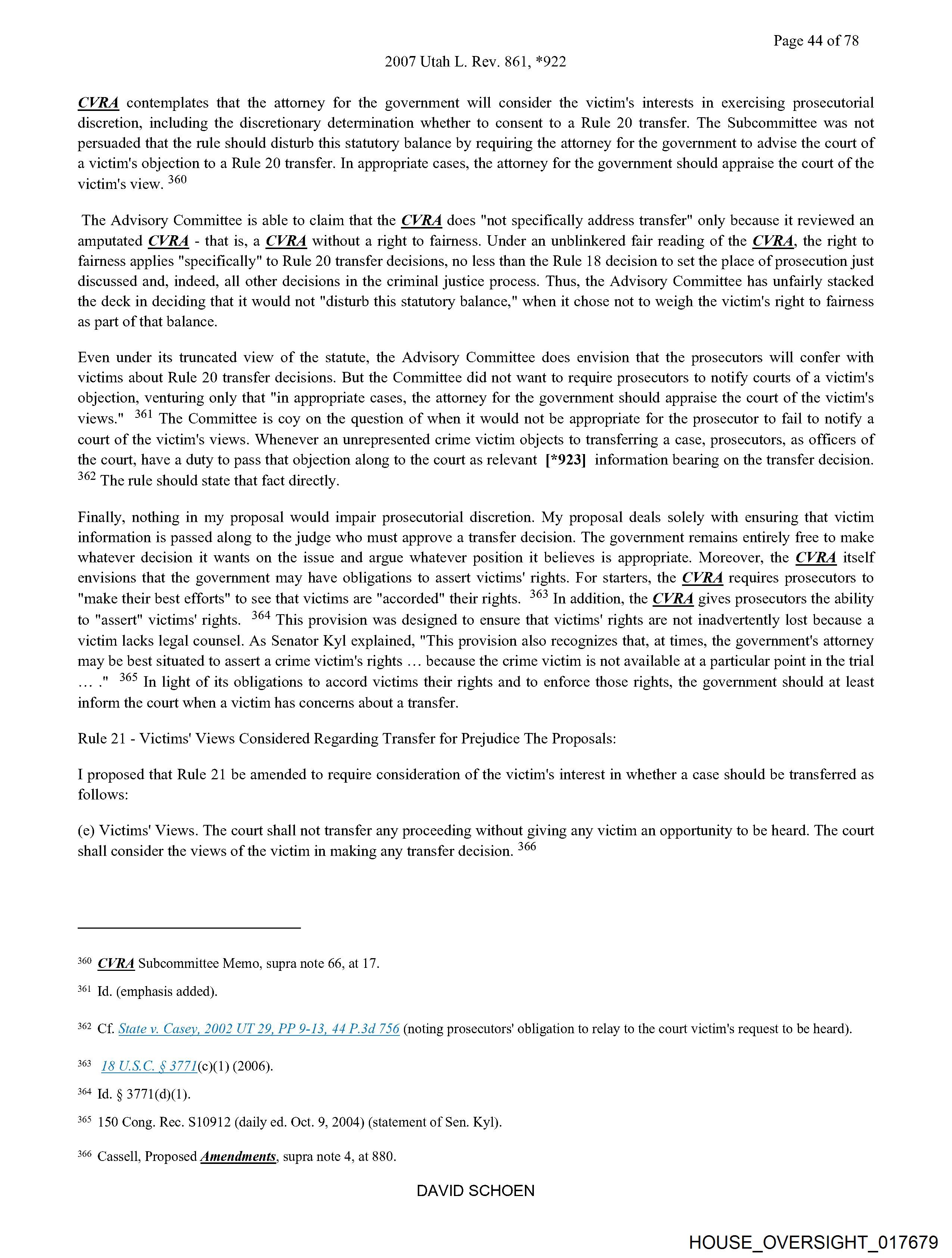
HOUSE_OVERSIGHT_017679

This document highlights the complexities surrounding the rights of victims in the context of prosecutorial discretion, particularly regarding Rule 20 transfers. While it does not provide direct evidence of misconduct related to Epstein, it underscores systemic issues in how victims' rights may be overlooked, which is relevant given the allegations of victim intimidation and discrediting in the Epstein case.

🔑 Key Evidence:
  • The CVRA contemplates that the attorney for the government will consider the victim's interests in exercising prosecutorial discretion.
  • The Advisory Committee has unfairly stacked the deck in deciding that it would not 'disturb this statutory balance,' when it chose not to weigh the victim's right to fairness.
  • Whenever an unrepresented crime victim objects to transferring a case, prosecutors, as officers of the court, have a duty to pass that objection along to the court as relevant information.
👥 Connected Entities:
Victims of Jeffrey Epstein U.S. Department of Justice Advisory Committee on Rules
From: Bates: HOUSE_OVERSIGHT_017679
No comments yet.
#11 Strength: 6.0/10
Document preview

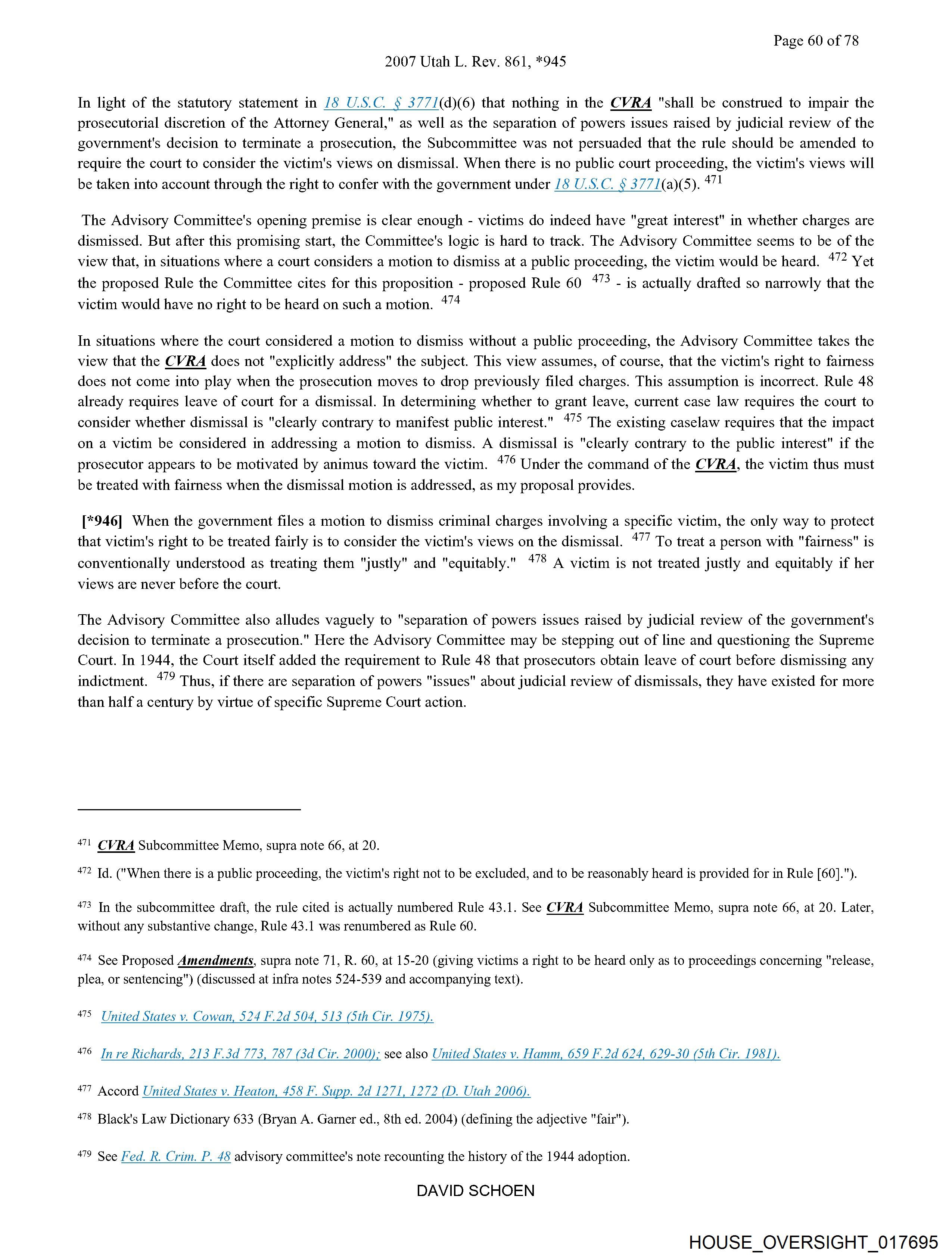
HOUSE_OVERSIGHT_017695

This document highlights the complexities surrounding victims' rights in the context of prosecutorial discretion, particularly in cases involving serious crimes like those associated with Jeffrey Epstein. It underscores the potential for victim discrediting and the implications of dismissing charges without considering victims' perspectives, which is relevant to the broader issues of accountability and justice in the Epstein case.

🔑 Key Evidence:
  • The Advisory Committee's view that the CVRA does not 'explicitly address' the subject of victim input on dismissals, suggesting a gap in protections for victims.
  • The assertion that a dismissal is 'clearly contrary to the public interest' if motivated by animus toward the victim, indicating potential misconduct in prosecutorial decisions.
  • The statement that treating a victim with 'fairness' requires their views to be presented in court, highlighting a systemic issue in how victims are treated in the judicial process.
👥 Connected Entities:
U.S. Department of Justice Advisory Committee on Rules Victims of Epstein's crimes
From: Bates: HOUSE_OVERSIGHT_017695
No comments yet.
#12 Strength: 5.0/10
Document preview

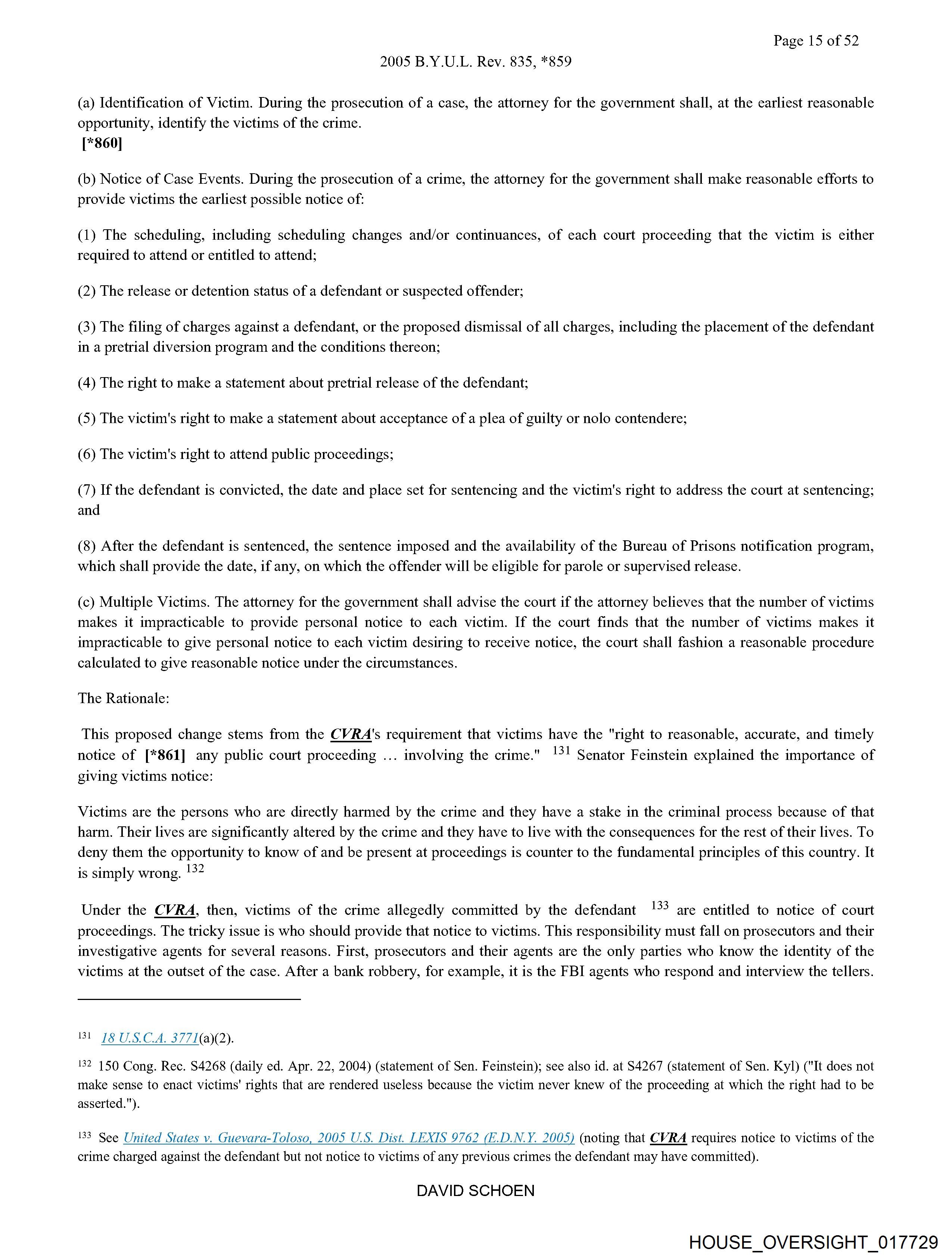
HOUSE_OVERSIGHT_017729

This document outlines the rights of victims in criminal proceedings, emphasizing the importance of timely notice and involvement in the judicial process. While it does not directly implicate individuals or reveal misconduct, it highlights systemic issues regarding victim treatment that are relevant to the Epstein case, particularly in the context of how victims were handled during the prosecution of Epstein and his associates.

🔑 Key Evidence:
  • The attorney for the government shall, at the earliest reasonable opportunity, identify the victims of the crime.
  • Victims are the persons who are directly harmed by the crime and they have a stake in the criminal process because of that harm.
  • Under the CVRA, then, victims of the crime allegedly committed by the defendant are entitled to notice of court proceedings.
👥 Connected Entities:
Senator Dianne Feinstein Victims of Jeffrey Epstein U.S. Department of Justice
From: Bates: HOUSE_OVERSIGHT_017729
No comments yet.
#13 Strength: 8.0/10
Document preview

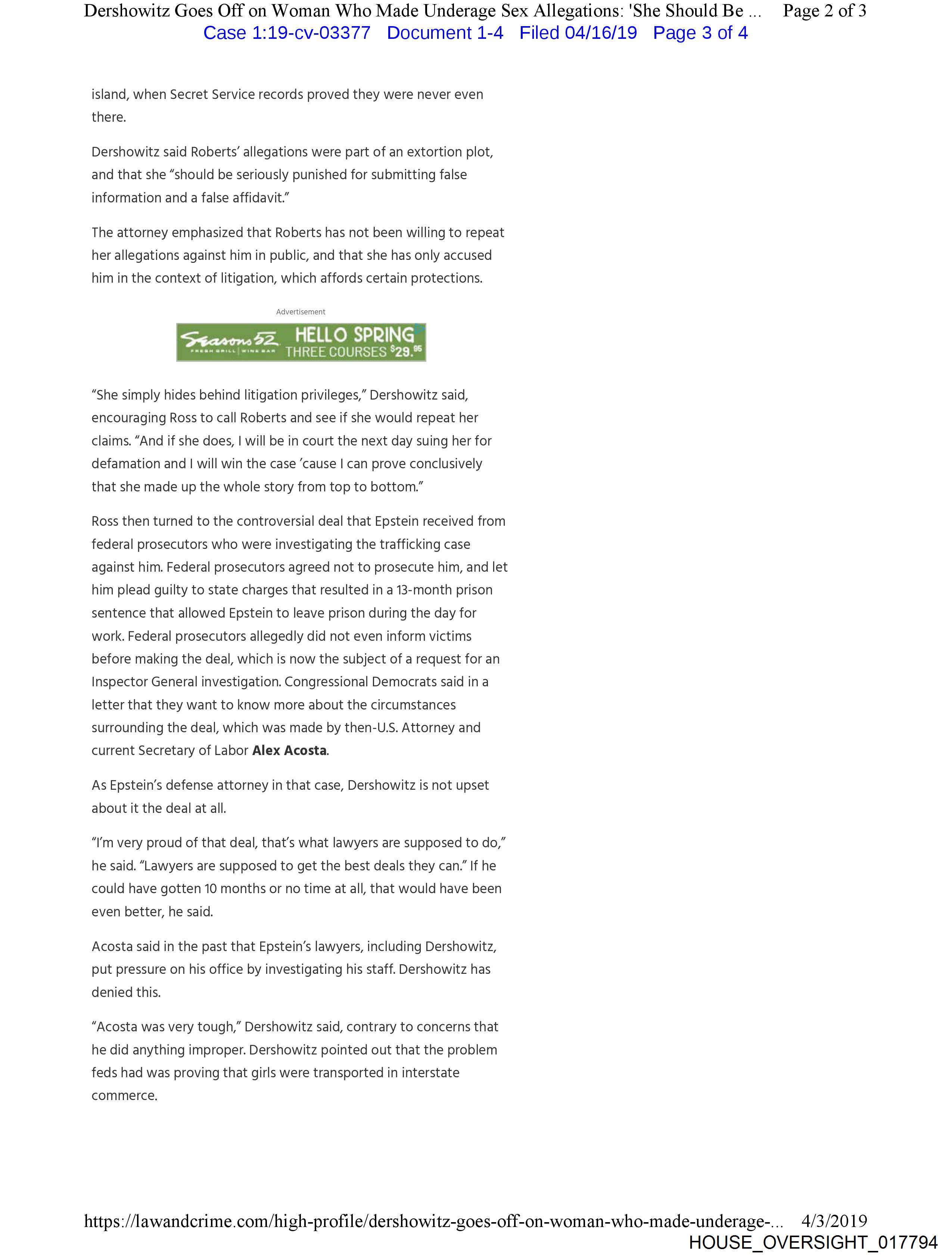
HOUSE_OVERSIGHT_017794

This document reveals significant insights into the defense strategies employed by Alan Dershowitz in response to allegations made by Virginia Roberts, highlighting potential misconduct in the handling of Epstein's plea deal and the broader implications of victim intimidation. It underscores the controversial nature of the legal maneuvers surrounding Epstein's case and raises questions about the integrity of the judicial process.

🔑 Key Evidence:
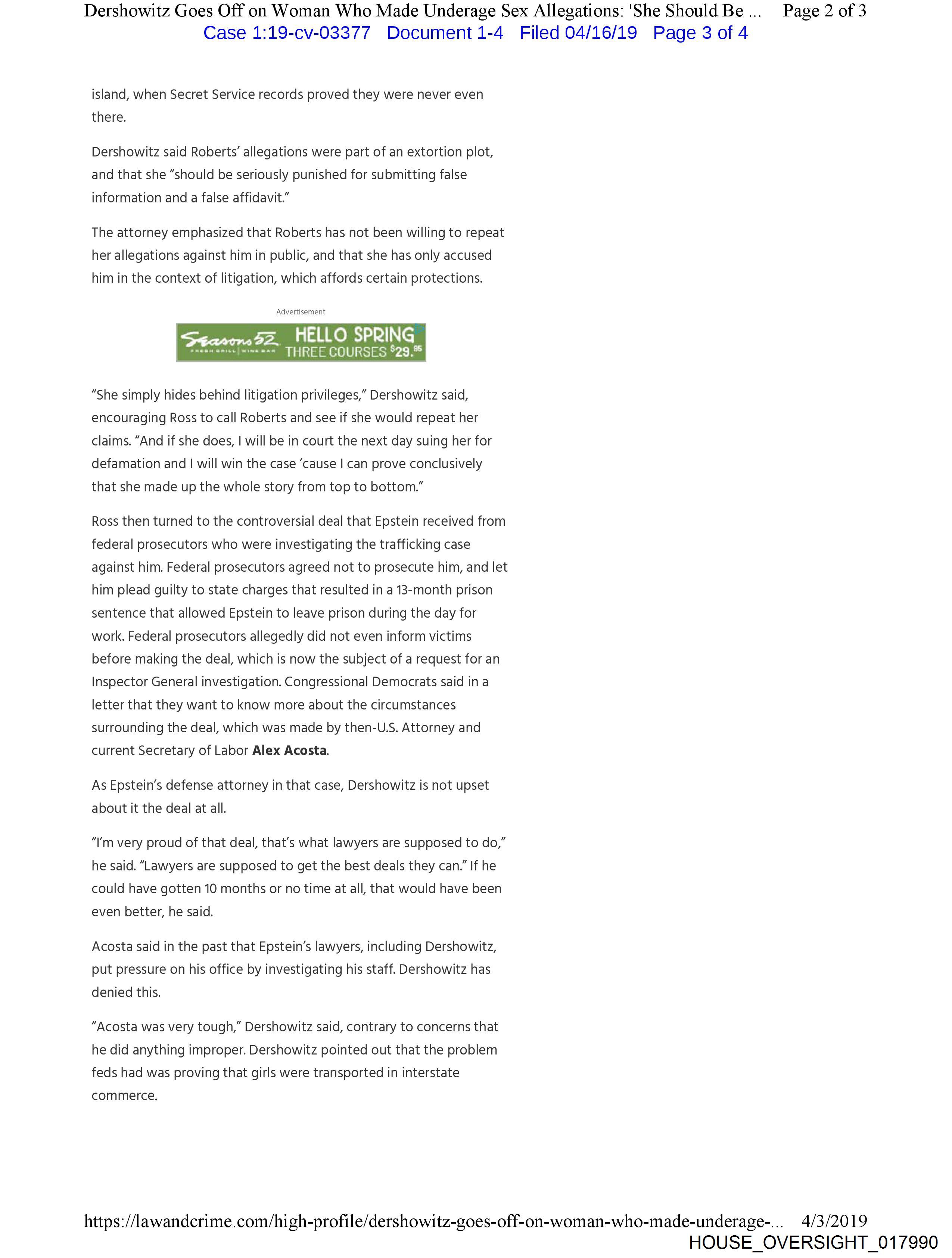
  • Dershowitz claimed Roberts' allegations were part of an extortion plot and suggested she should be punished for submitting false information.
  • He emphasized that Roberts has only accused him in the context of litigation, which affords her certain protections, indicating a potential strategy to discredit her.
  • Dershowitz expressed pride in the plea deal Epstein received, stating, 'that’s what lawyers are supposed to do,' which raises ethical concerns about the legal profession's role in facilitating Epstein's crimes.
👥 Connected Entities:
Alan Dershowitz Virginia Roberts Alex Acosta
From: Bates: HOUSE_OVERSIGHT_017794
No comments yet.
#14 Strength: 8.0/10
Document preview

HOUSE_OVERSIGHT_017990

This document reveals significant insights into the defense strategies employed by Alan Dershowitz in response to allegations made by Virginia Roberts, a key figure in the Epstein case. It highlights potential misconduct in the handling of Epstein's plea deal and raises questions about the integrity of federal prosecutors, particularly Alex Acosta, in their dealings with Epstein's legal team.

🔑 Key Evidence:
  • Dershowitz claimed Roberts’ allegations were part of an extortion plot, suggesting a strategy to discredit victims.
  • He emphasized that Roberts has not repeated her allegations publicly, indicating a tactic to undermine her credibility.
  • Dershowitz expressed pride in the plea deal Epstein received, which allowed him to serve only 13 months in a lenient manner, raising concerns about prosecutorial misconduct.
👥 Connected Entities:
Alan Dershowitz Virginia Roberts Alex Acosta
From: Bates: HOUSE_OVERSIGHT_017990
No comments yet.
#15 Strength: 4.0/10
Document preview

HOUSE_OVERSIGHT_022494

While the document titled 'A Resource Guide to the U.S. Foreign Corrupt Practices Act' does not directly implicate Jeffrey Epstein or his associates in criminal activity, it highlights the legal framework surrounding corruption and misconduct, which could be relevant to understanding the financial dealings and potential illicit activities associated with Epstein's network. The inclusion of this document in the House Oversight Committee's Epstein estate documents suggests a broader investigation into financial irregularities that may connect to Epstein's operations.

🔑 Key Evidence:
  • The document outlines the legal standards for foreign corrupt practices, which could be relevant to Epstein's financial dealings.
  • It provides guidelines on compliance and enforcement, indicating that the U.S. government is vigilant about corruption, which may relate to Epstein's financial transactions.
  • The connection between Epstein's wealth and potential foreign entities could be scrutinized under the provisions of this act.
👥 Connected Entities:
U.S. Department of Justice U.S. Securities and Exchange Commission Potential foreign entities involved in Epstein's financial dealings
From: Bates: HOUSE_OVERSIGHT_022494
No comments yet.
#16 Strength: 4.0/10
Document preview

HOUSE_OVERSIGHT_022595

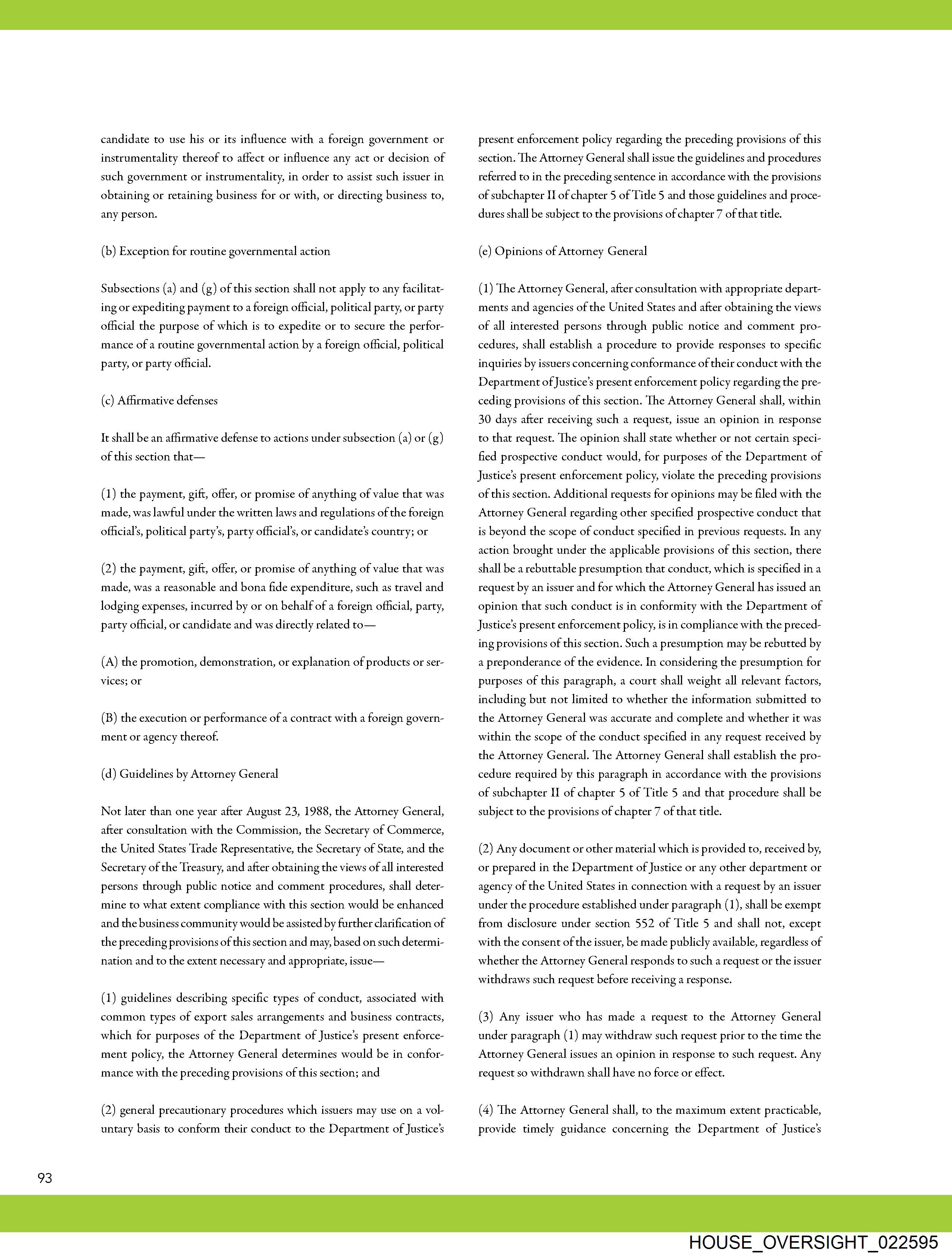
This document outlines provisions related to foreign influence and governmental actions, which could be relevant in understanding the financial operations and political connections surrounding Epstein's network. While it does not directly implicate Epstein or his associates in criminal activity, it raises concerns about the potential for corruption and misuse of influence in business dealings.

🔑 Key Evidence:
  • Subsections (a) and (g) of this section shall not apply to any facilitating or expediting payment to a foreign official, political party, or party official.
  • It shall be an affirmative defense to actions under subsection (a) or (g) of this section that the payment... was lawful under the written laws and regulations of the foreign official's country.
  • The Attorney General shall issue the guidelines and procedures... which issuers may use on a voluntary basis to conform their conduct to the Department of Justice’s present enforcement policy.
👥 Connected Entities:
U.S. Department of Justice Foreign governments or officials Political parties or candidates
From: Bates: HOUSE_OVERSIGHT_022595
No comments yet.
#17 Strength: 4.0/10
Document preview

HOUSE_OVERSIGHT_022611

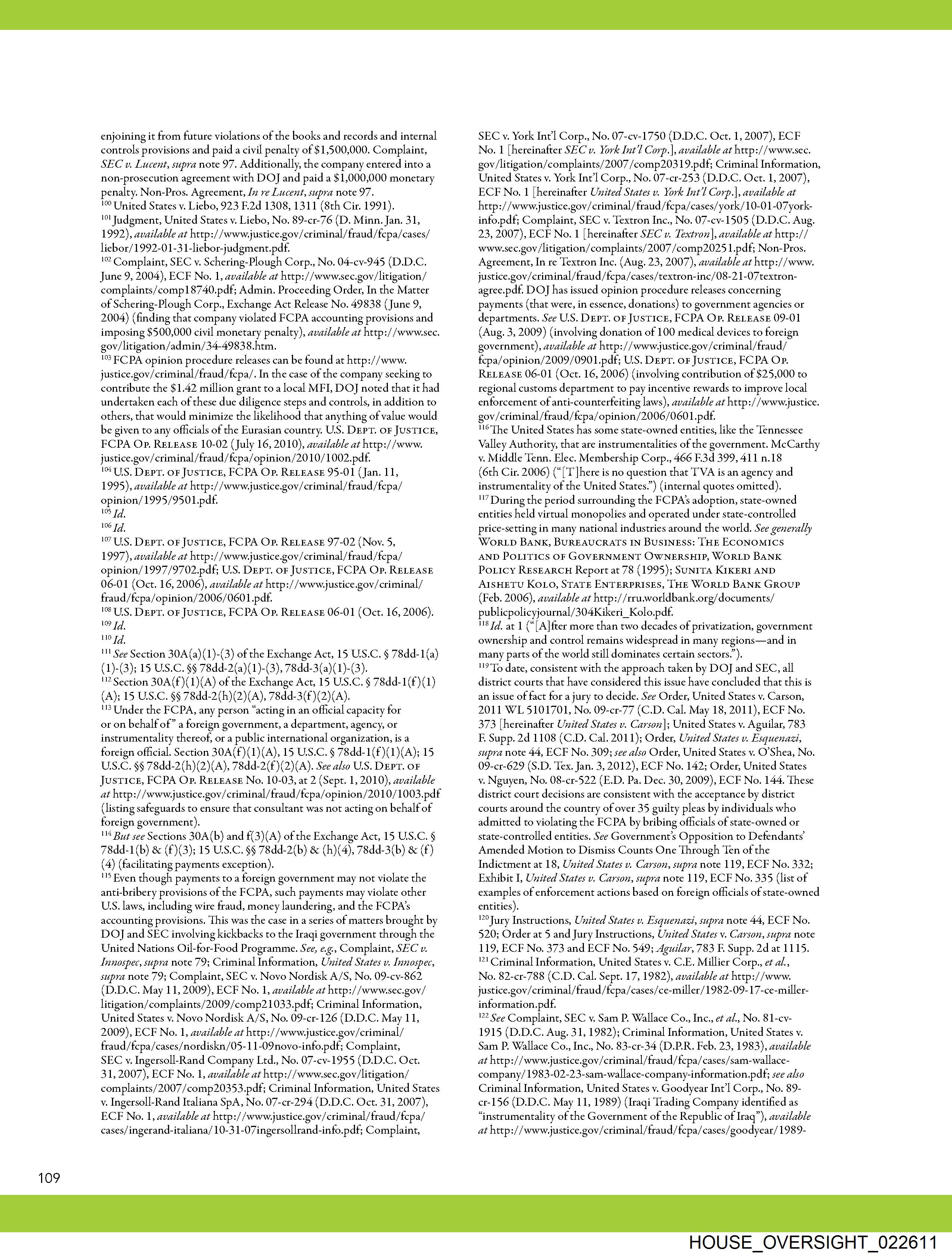
This document primarily discusses financial penalties and compliance issues related to various corporations, which may indirectly relate to the Epstein case through the broader context of financial misconduct and corruption. However, it does not provide direct evidence of criminal activity or misconduct specifically tied to Epstein or his network.

🔑 Key Evidence:
  • The document references civil penalties and non-prosecution agreements involving companies like Lucent and Schering-Plough, indicating a pattern of financial misconduct.
  • It discusses the Foreign Corrupt Practices Act (FCPA) and the implications of financial operations that could involve bribery or corruption, which may relate to Epstein's financial dealings.
  • The mention of due diligence steps taken by companies to minimize corruption risks suggests a broader context of financial oversight that could be relevant to Epstein's financial operations.
👥 Connected Entities:
Lucent Technologies Schering-Plough Corporation U.S. Department of Justice
From: Bates: HOUSE_OVERSIGHT_022611
No comments yet.
#18 Strength: 4.0/10
Document preview

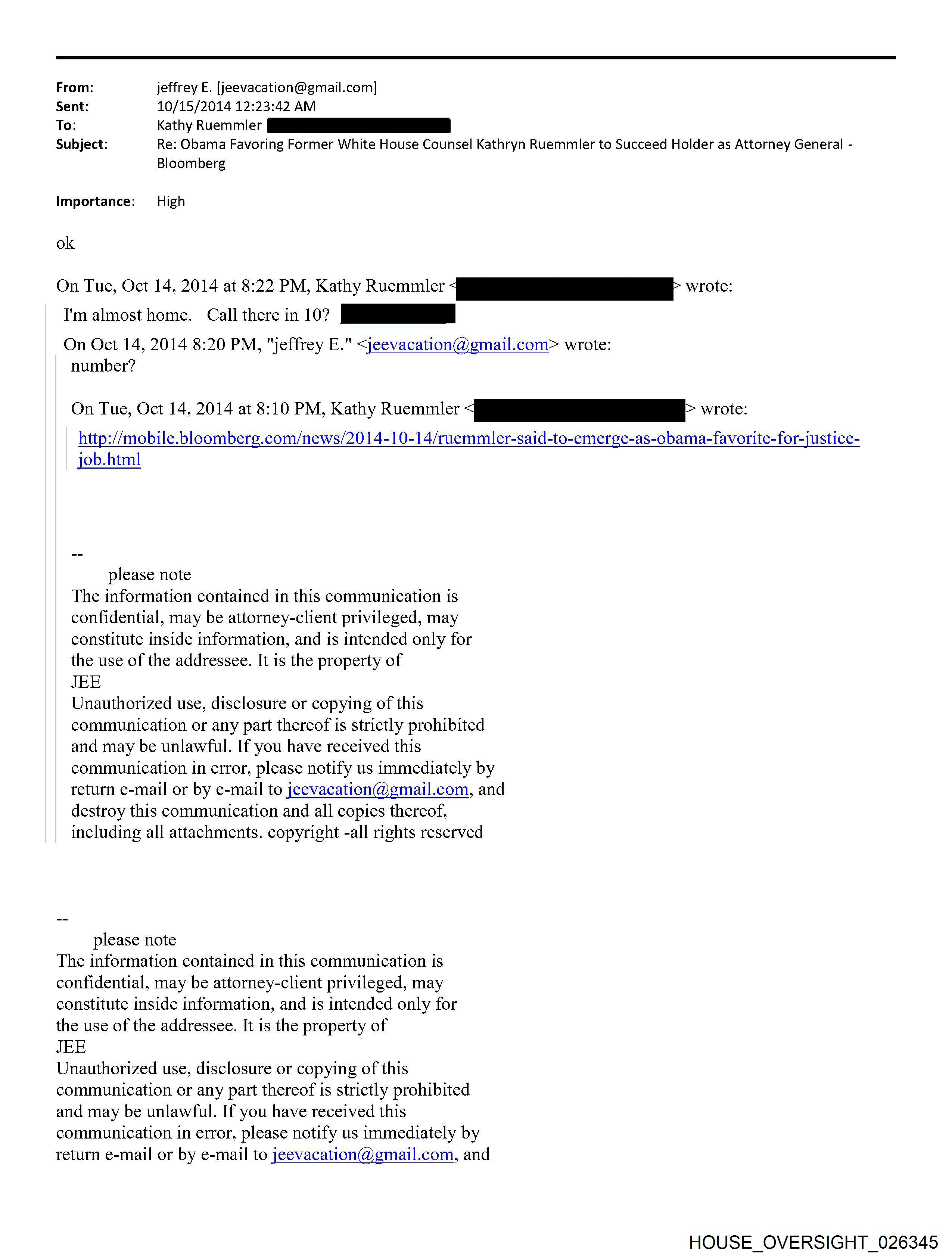
Re: Obama Favoring Former White House Counsel Kathryn Ruemmler to Succeed Holder as Attorney General -

This document reveals a communication between Jeffrey Epstein and Kathryn Ruemmler regarding her potential appointment as Attorney General, indicating Epstein's connections to influential political figures. While it does not provide direct evidence of criminal activity, it highlights the intertwining of Epstein's network with high-level political appointments, raising concerns about the influence and reach of his connections.

🔑 Key Evidence:
  • The subject line references Obama favoring Kathryn Ruemmler for Attorney General, indicating Epstein's awareness of political maneuvers.
  • The email exchange shows Epstein's direct communication with Ruemmler, suggesting a personal relationship that could imply influence.
  • The use of 'confidential' and 'attorney-client privileged' language raises questions about the nature of their discussions and the potential for undisclosed information.
👥 Connected Entities:
Kathryn Ruemmler Barack Obama U.S. Department of Justice
From: jeffrey E. [jeevacation@gmail.com] Bates: HOUSE_OVERSIGHT_026345
No comments yet.
#19 Strength: 9.0/10
Document preview

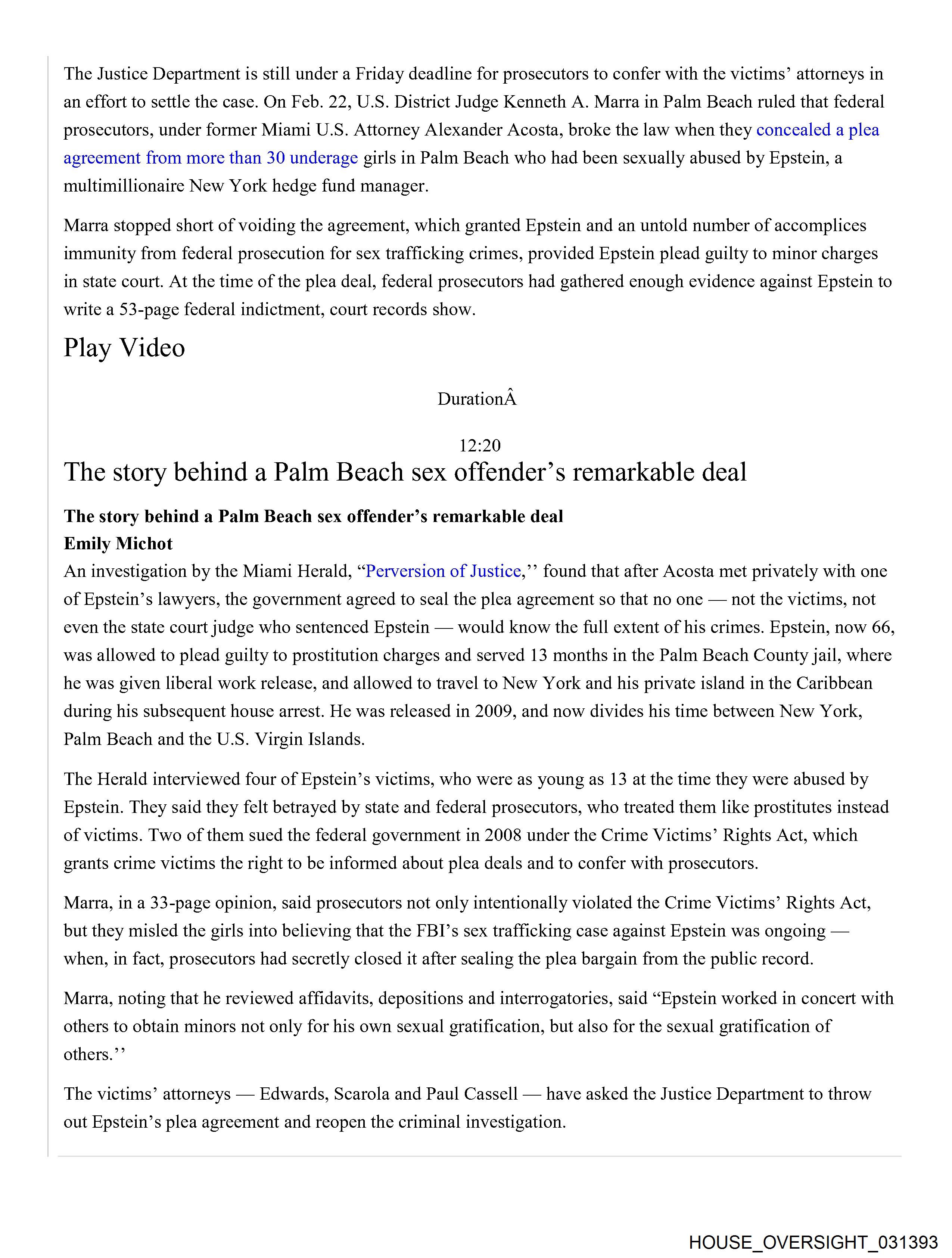
HOUSE_OVERSIGHT_031393

This document reveals significant misconduct by federal prosecutors, particularly under Alexander Acosta, in their handling of Epstein's plea agreement, which concealed critical information from victims and the public. The ruling by Judge Marra highlights intentional violations of the Crime Victims’ Rights Act, suggesting systemic corruption and a failure to protect vulnerable individuals.

🔑 Key Evidence:
  • U.S. District Judge Kenneth A. Marra ruled that federal prosecutors broke the law when they concealed a plea agreement from more than 30 underage girls.
  • Marra noted that prosecutors intentionally violated the Crime Victims’ Rights Act and misled the girls into believing that the FBI’s sex trafficking case against Epstein was ongoing.
  • The document states that Epstein worked in concert with others to obtain minors for his own sexual gratification and for the sexual gratification of others.
👥 Connected Entities:
Alexander Acosta U.S. Department of Justice Miami Herald
From: Bates: HOUSE_OVERSIGHT_031393
No comments yet.
#20 Strength: 9.0/10
Document preview

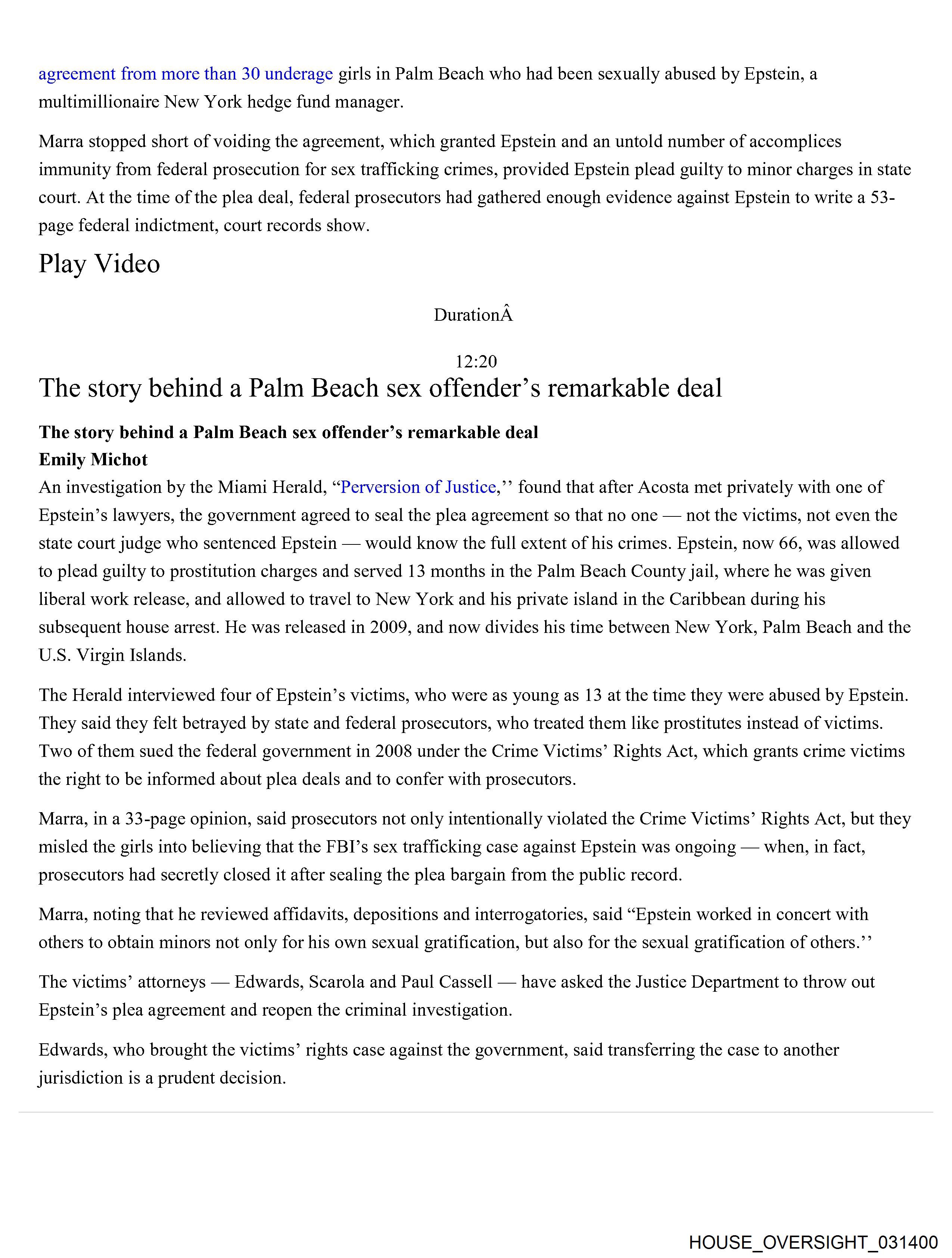
HOUSE_OVERSIGHT_031400

This document reveals significant misconduct by federal prosecutors in their handling of Epstein's case, particularly regarding the sealing of a plea agreement that granted him immunity from federal prosecution despite overwhelming evidence of his crimes. It highlights the betrayal felt by victims and raises serious questions about the integrity of the judicial process.

🔑 Key Evidence:
  • Marra stopped short of voiding the agreement, which granted Epstein and an untold number of accomplices immunity from federal prosecution for sex trafficking crimes.
  • At the time of the plea deal, federal prosecutors had gathered enough evidence against Epstein to write a 53-page federal indictment.
  • Marra noted that prosecutors intentionally violated the Crime Victims’ Rights Act and misled the girls into believing that the FBI’s sex trafficking case against Epstein was ongoing.
👥 Connected Entities:
Alex Acosta (former U.S. Secretary of Labor and prosecutor) Miami Herald (investigative journalism) U.S. Department of Justice
From: Bates: HOUSE_OVERSIGHT_031400
No comments yet.