🔐 Private Research Portal

Epstein Research Portal

Access the full investigative corpus, ranked smoking guns, OCR-linked imagery, and intel briefs.

Front-of-house site Sign In / Sign Up
Same BENED DNA · Investigative Skin
← Back to Entities

📁 epstein Dossier

3,680 documents connected to this entity

Page 184 of 184 (3,680 items)
#3661 Strength: 5.0/10
Document preview

HOUSE_OVERSIGHT_014051

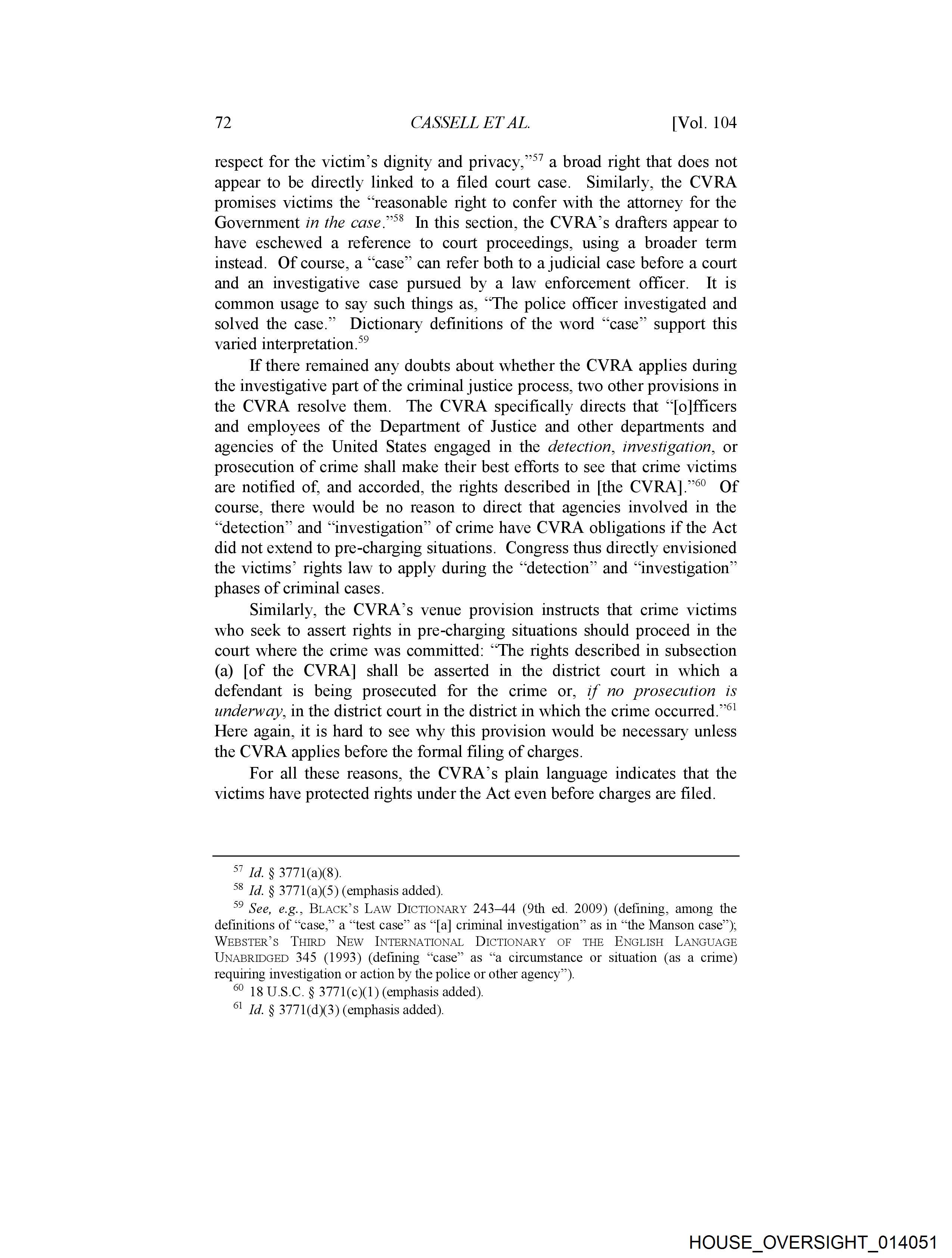
This document outlines the rights of victims under the Crime Victims' Rights Act (CVRA), emphasizing that these rights extend to the investigative phase of criminal cases. While it does not provide direct evidence of misconduct, it highlights the legal framework that could support victims in the Epstein case, particularly regarding their rights to be informed and involved during investigations.

🔑 Key Evidence:
  • The CVRA promises victims the 'reasonable right to confer with the attorney for the Government in the case.'
  • The CVRA specifically directs that '[o]fficers and employees of the Department of Justice... engaged in the detection, investigation, or prosecution of crime shall make their best efforts to see that crime victims are notified of, and accorded, the rights described in [the CVRA].'
  • The rights described in subsection (a) [of the CVRA] shall be asserted in the district court in which a defendant is being prosecuted for the crime or, if no prosecution is underway, in the district court in the district in which the crime occurred.
👥 Connected Entities:
Department of Justice Victims of Jeffrey Epstein Law enforcement agencies involved in the Epstein investigation
From: Bates: HOUSE_OVERSIGHT_014051
No comments yet.
#3662 Strength: 4.0/10
Document preview

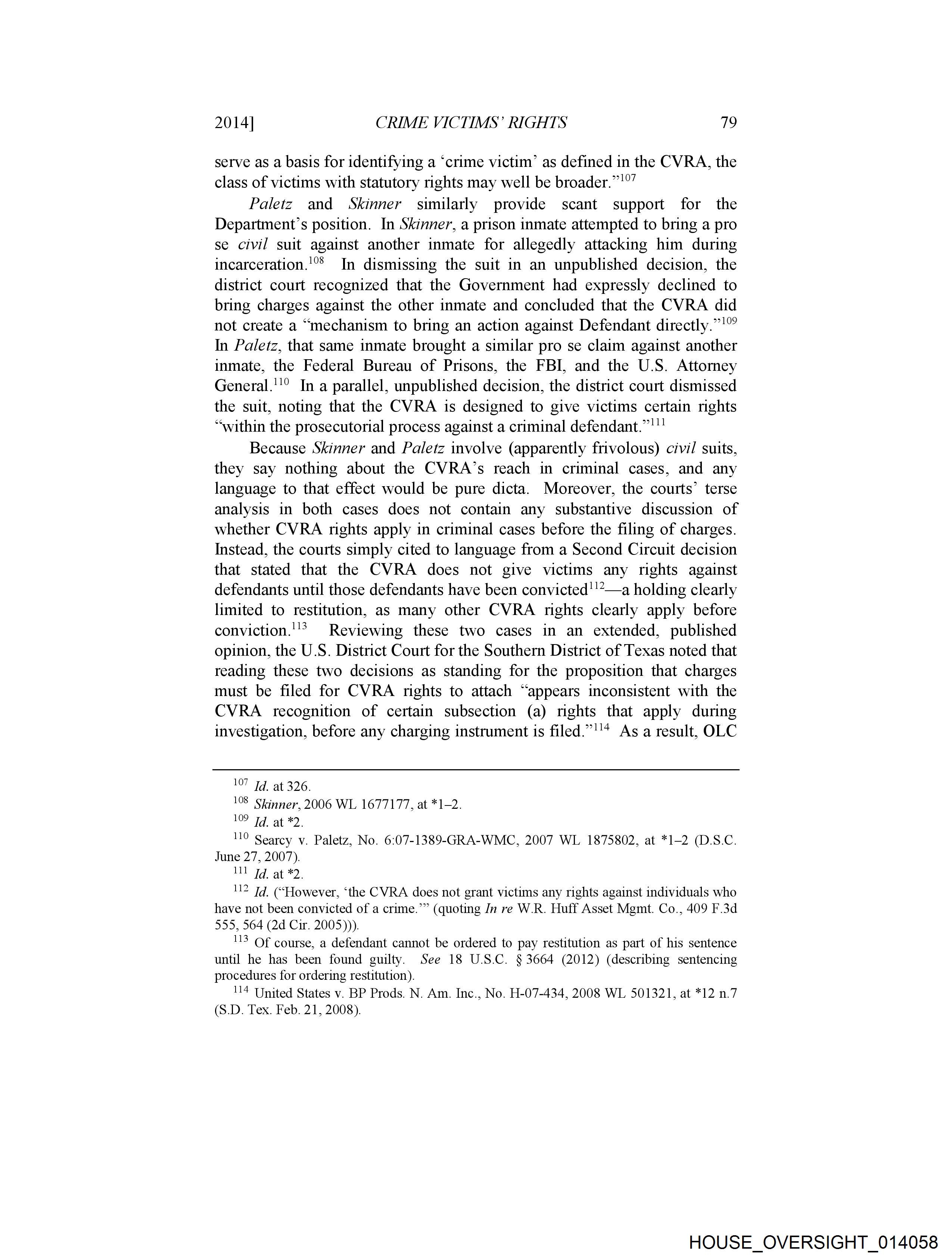
HOUSE_OVERSIGHT_014058

This document discusses the Crime Victims' Rights Act (CVRA) and its implications for victims in criminal cases, particularly in the context of the Epstein investigation. While it does not provide direct evidence of misconduct, it highlights the legal complexities surrounding victims' rights, which are crucial for understanding the broader implications of Epstein's criminal activities and the potential for victims to seek justice.

🔑 Key Evidence:
  • The CVRA does not give victims any rights against defendants until those defendants have been convicted.
  • Certain CVRA rights apply during investigation, before any charging instrument is filed.
  • The courts’ terse analysis in both cases does not contain any substantive discussion of whether CVRA rights apply in criminal cases before the filing of charges.
👥 Connected Entities:
U.S. Department of Justice Federal Bureau of Prisons U.S. Attorney General
From: Bates: HOUSE_OVERSIGHT_014058
No comments yet.
#3663 Strength: 4.0/10
Document preview

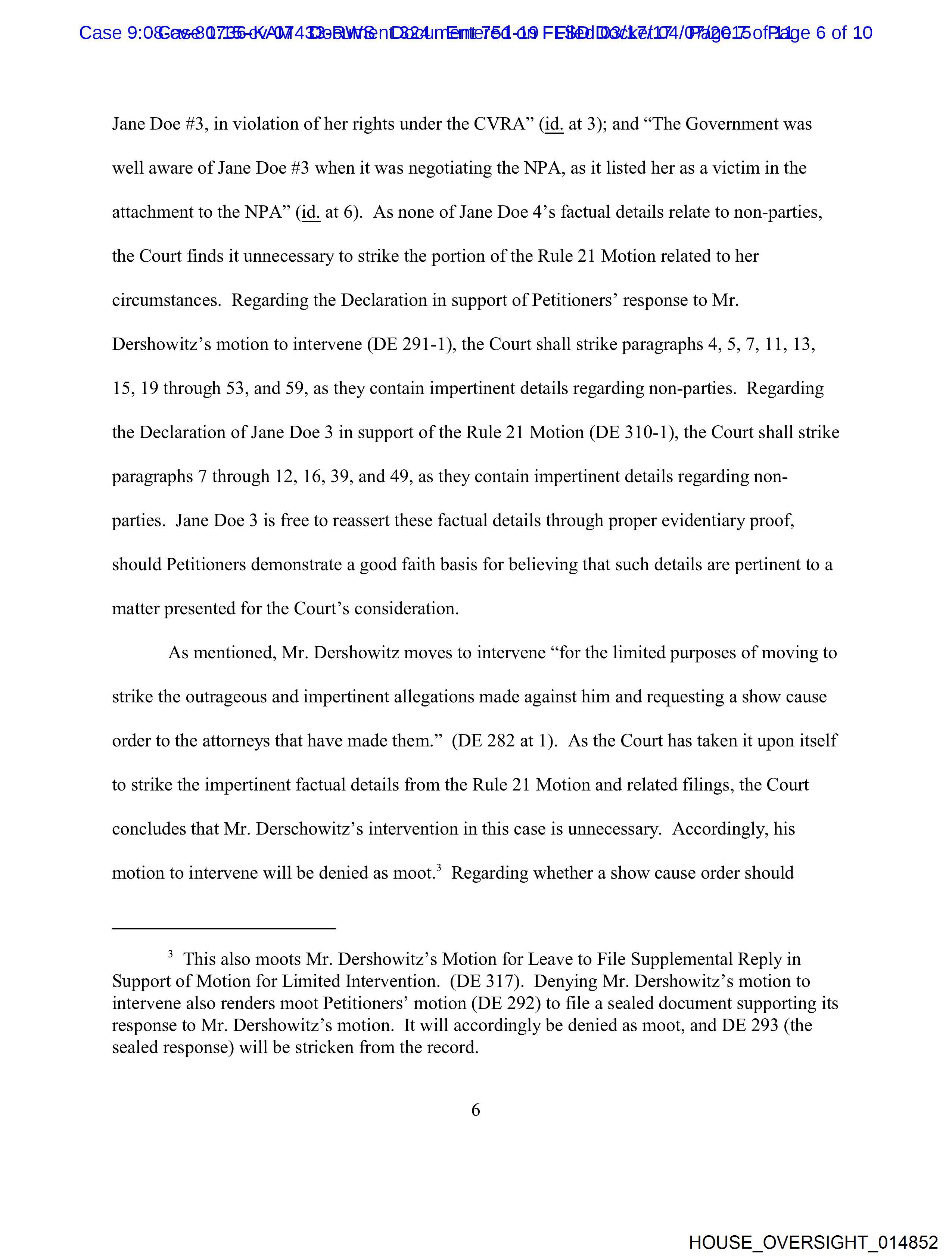
HOUSE_OVERSIGHT_014852

This document highlights procedural aspects of the legal proceedings surrounding Jeffrey Epstein's case, particularly focusing on the motions filed by individuals such as Mr. Dershowitz and the implications of Jane Doe #3's testimony. While it does not provide direct evidence of criminal activity, it underscores the complexities of victim testimonies and the legal maneuvers employed by parties involved, which are critical to understanding the broader context of the Epstein scandal.

🔑 Key Evidence:
  • The Government was well aware of Jane Doe #3 when it was negotiating the NPA, as it listed her as a victim in the attachment to the NPA.
  • The Court finds it unnecessary to strike the portion of the Rule 21 Motion related to her circumstances.
  • Mr. Dershowitz moves to intervene 'for the limited purposes of moving to strike the outrageous and impertinent allegations made against him.'
👥 Connected Entities:
Alan Dershowitz Jane Doe #3 U.S. Government
From: Bates: HOUSE_OVERSIGHT_014852
No comments yet.
#3664 Strength: 8.0/10
Document preview

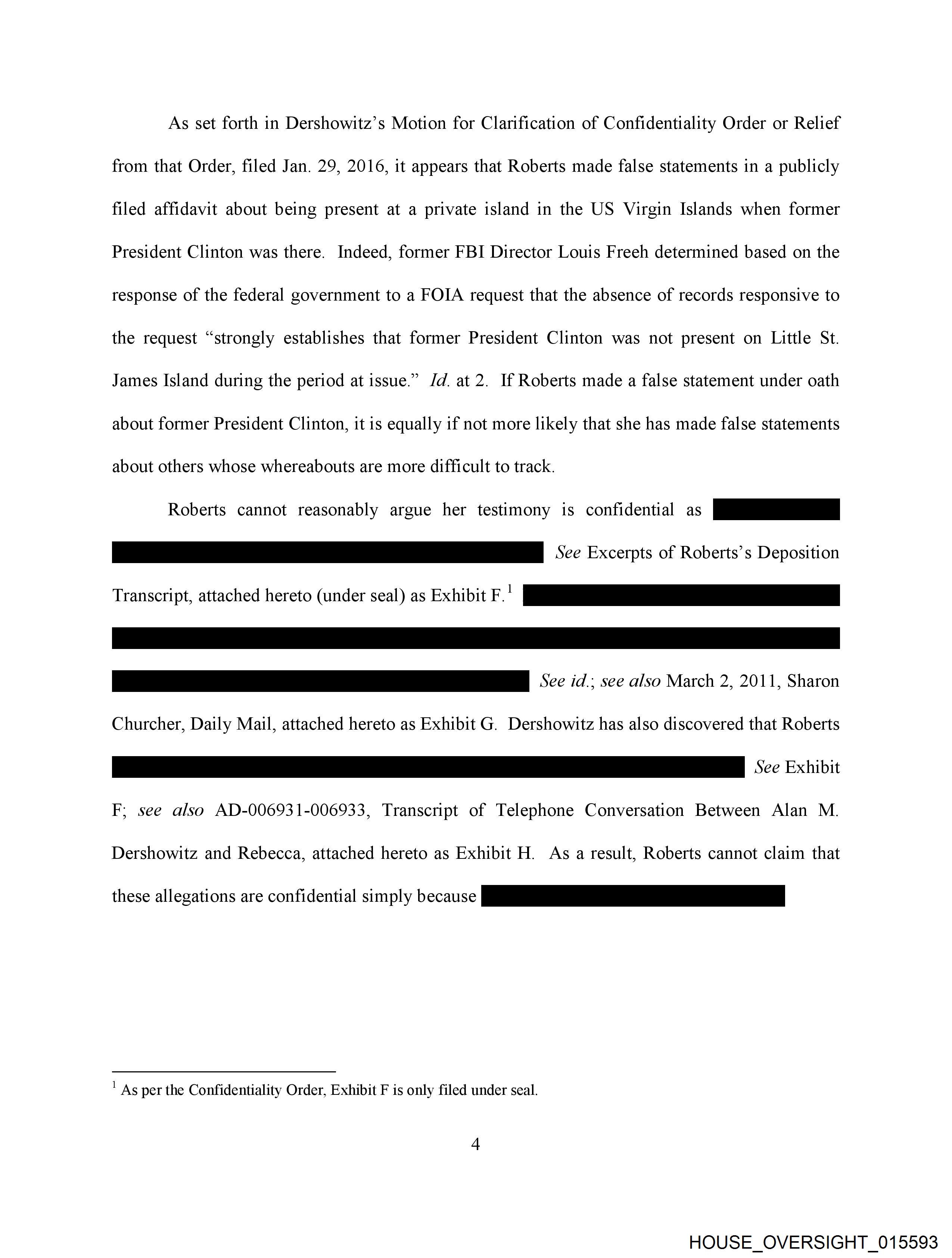
HOUSE_OVERSIGHT_015593

This document highlights potential false statements made by Virginia Roberts regarding the presence of former President Clinton on Epstein's private island, which raises questions about the credibility of her testimony and the broader implications of her allegations against other high-profile individuals. The assertion that Roberts may have lied under oath suggests a pattern of deceit that could undermine the integrity of the investigation into Epstein's network.

🔑 Key Evidence:
  • Roberts made false statements in a publicly filed affidavit about being present at a private island in the US Virgin Islands when former President Clinton was there.
  • Former FBI Director Louis Freeh determined that the absence of records strongly establishes that former President Clinton was not present on Little St. James Island during the period at issue.
  • If Roberts made a false statement under oath about former President Clinton, it is equally if not more likely that she has made false statements about others whose whereabouts are more difficult to track.
👥 Connected Entities:
Virginia Roberts Former President Bill Clinton Alan Dershowitz
From: Bates: HOUSE_OVERSIGHT_015593
No comments yet.
#3665 Strength: 5.0/10
Document preview

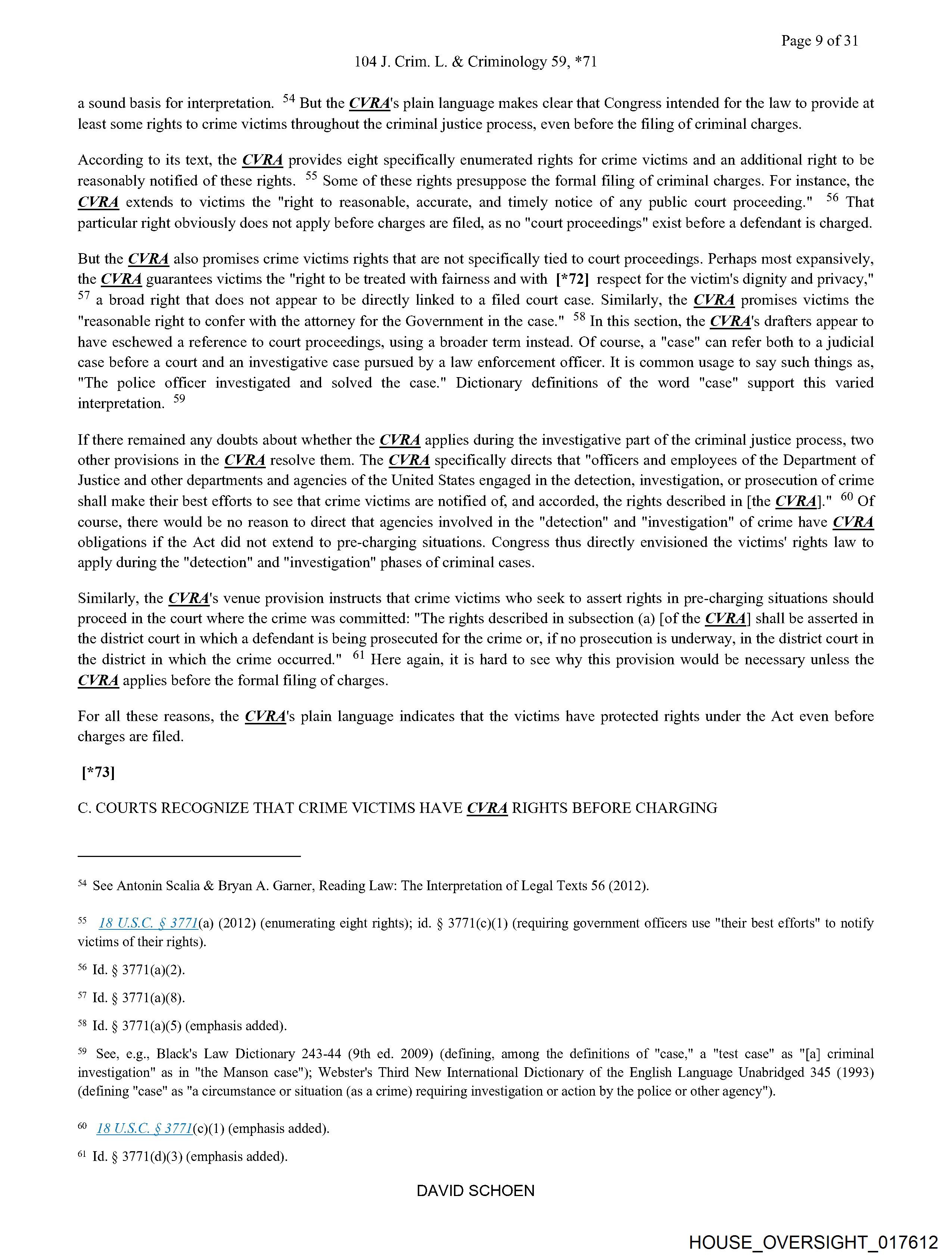
HOUSE_OVERSIGHT_017612

This document outlines the rights of crime victims under the Crime Victims' Rights Act (CVRA), emphasizing that these rights extend to the investigative phase of criminal cases. While it does not provide direct evidence of misconduct, it highlights the obligations of law enforcement and government agencies to inform victims of their rights, which is particularly relevant in the context of the Epstein case where victim intimidation and discrediting were prevalent.

🔑 Key Evidence:
  • The CVRA provides eight specifically enumerated rights for crime victims and an additional right to be reasonably notified of these rights.
  • The CVRA guarantees victims the 'right to be treated with fairness and with respect for the victim's dignity and privacy.'
  • The CVRA specifically directs that 'officers and employees of the Department of Justice and other departments and agencies of the United States engaged in the detection, investigation, or prosecution of crime shall make their best efforts to see that crime victims are notified of, and accorded, the rights described in [the CVRA].'
👥 Connected Entities:
Department of Justice Congress Victims of Jeffrey Epstein
From: Bates: HOUSE_OVERSIGHT_017612
No comments yet.
#3666 Strength: 5.0/10
Document preview

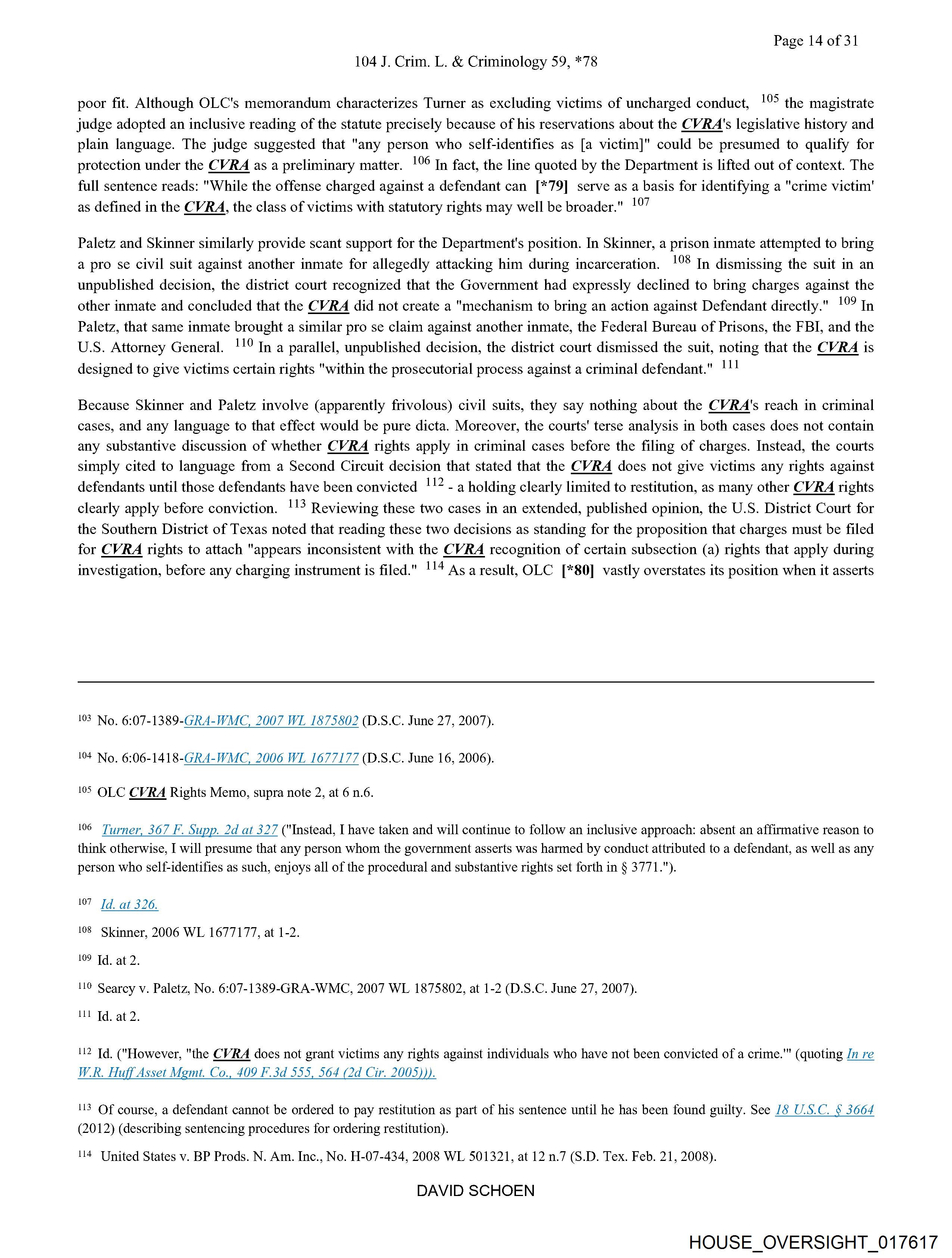
HOUSE_OVERSIGHT_017617

This document provides insight into the interpretation of the Crime Victims' Rights Act (CVRA) and its implications for victims of uncharged conduct, which is relevant to the Epstein case. It highlights the complexities surrounding victim rights and the potential for broader interpretations that could affect how victims are treated in legal proceedings related to Epstein's activities.

🔑 Key Evidence:
  • The magistrate judge suggested that 'any person who self-identifies as [a victim]' could be presumed to qualify for protection under the CVRA.
  • The document critiques the Office of Legal Counsel's (OLC) memorandum for characterizing Turner as excluding victims of uncharged conduct.
  • The courts' terse analysis in Skinner and Paletz does not contain any substantive discussion of whether CVRA rights apply in criminal cases before the filing of charges.
👥 Connected Entities:
Office of Legal Counsel (OLC) U.S. District Court for the Southern District of Texas Victims of Jeffrey Epstein
From: Bates: HOUSE_OVERSIGHT_017617
No comments yet.
#3667 Strength: 5.0/10
Document preview

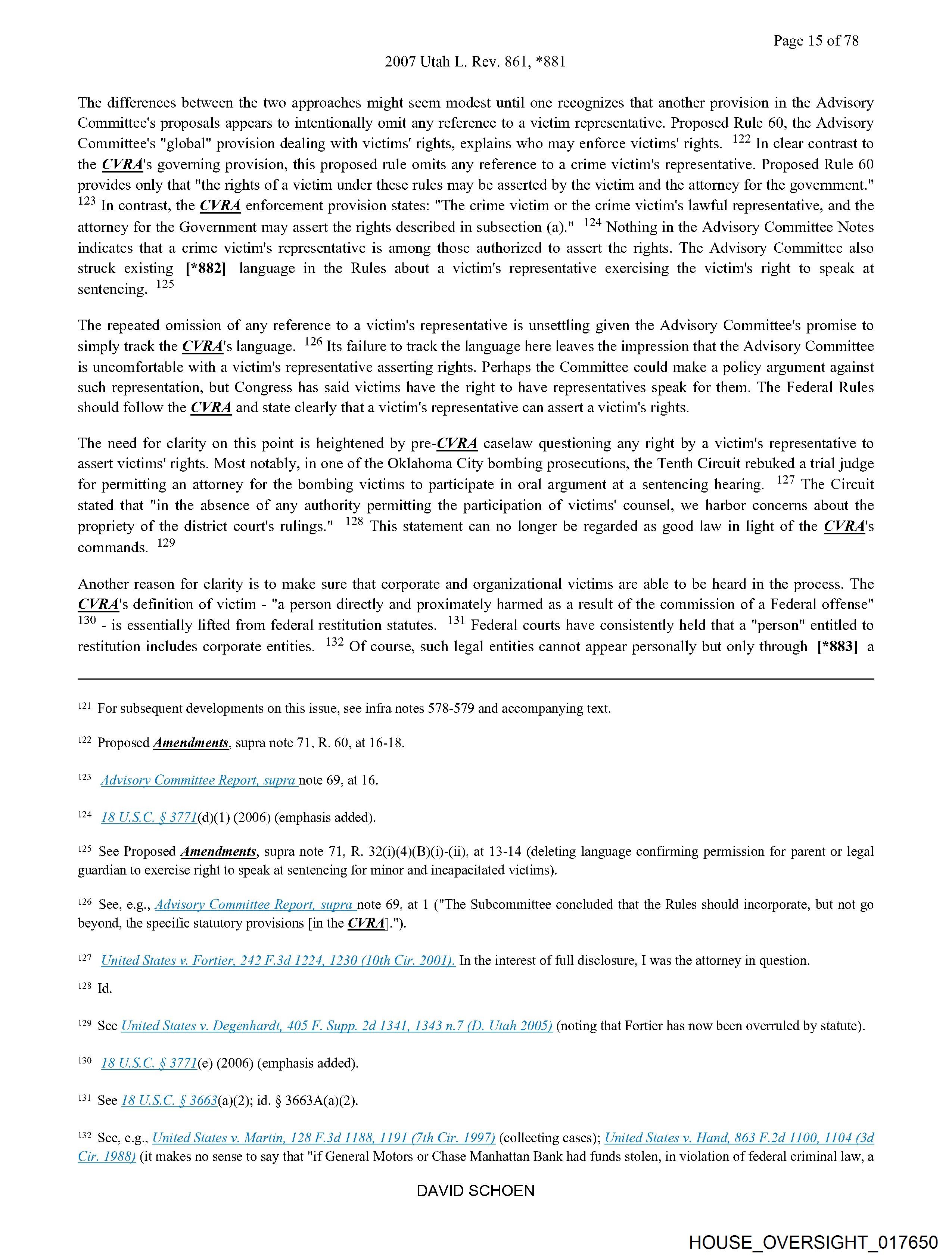
HOUSE_OVERSIGHT_017650

This document highlights significant concerns regarding the rights of victims and their representatives in the context of federal criminal proceedings, particularly in relation to the Crime Victims' Rights Act (CVRA). The omission of victim representatives in proposed rules raises questions about the treatment of victims in cases like Epstein's, where victim intimidation and discrediting were prevalent.

🔑 Key Evidence:
  • The proposed rule omits any reference to a crime victim's representative, which contrasts with the CVRA's enforcement provision that allows for such representation.
  • The Advisory Committee's failure to track the CVRA's language leaves the impression that they are uncomfortable with a victim's representative asserting rights.
  • The document references a Tenth Circuit ruling that rebuked a trial judge for allowing victims' counsel to participate in a sentencing hearing, indicating a historical reluctance to recognize victims' representatives in legal proceedings.
👥 Connected Entities:
Advisory Committee on Rules Crime Victims' Rights Act (CVRA) Federal Courts
From: Bates: HOUSE_OVERSIGHT_017650
No comments yet.
#3668 Strength: 7.0/10
Document preview

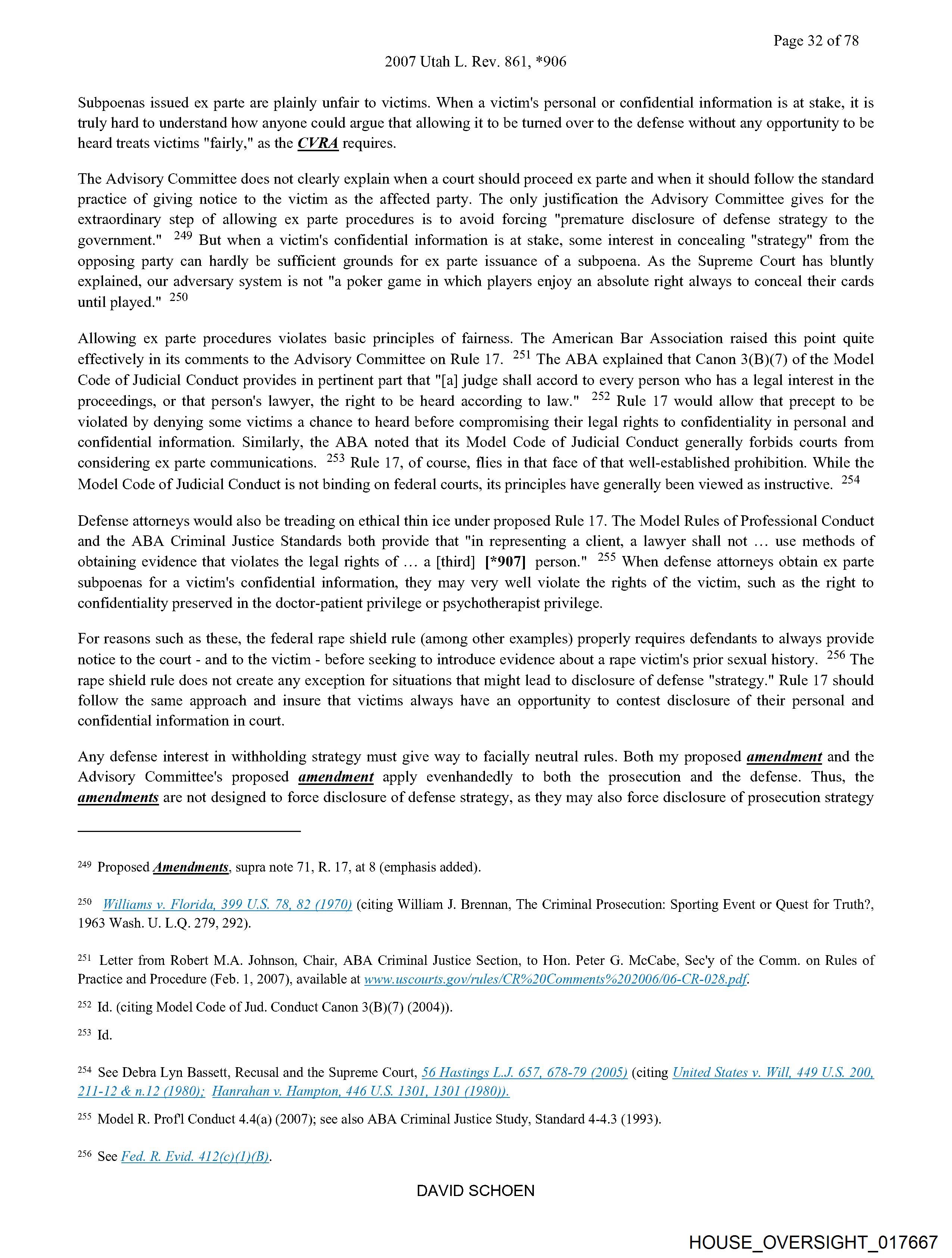
HOUSE_OVERSIGHT_017667

This document highlights significant concerns regarding the fairness of ex parte subpoenas in legal proceedings involving victims, particularly in the context of sexual assault cases. It underscores the potential for victim discrediting and the violation of their rights to confidentiality, which is particularly relevant given the nature of Jeffrey Epstein's criminal activities and the treatment of his victims.

🔑 Key Evidence:
  • Subpoenas issued ex parte are plainly unfair to victims.
  • When a victim's personal or confidential information is at stake, it is truly hard to understand how anyone could argue that allowing it to be turned over to the defense without any opportunity to be heard treats victims 'fairly.'
  • Allowing ex parte procedures violates basic principles of fairness.
👥 Connected Entities:
American Bar Association Advisory Committee on Rule 17 Victims of Epstein's trafficking
From: Bates: HOUSE_OVERSIGHT_017667
No comments yet.
#3669 Strength: 6.0/10
Document preview

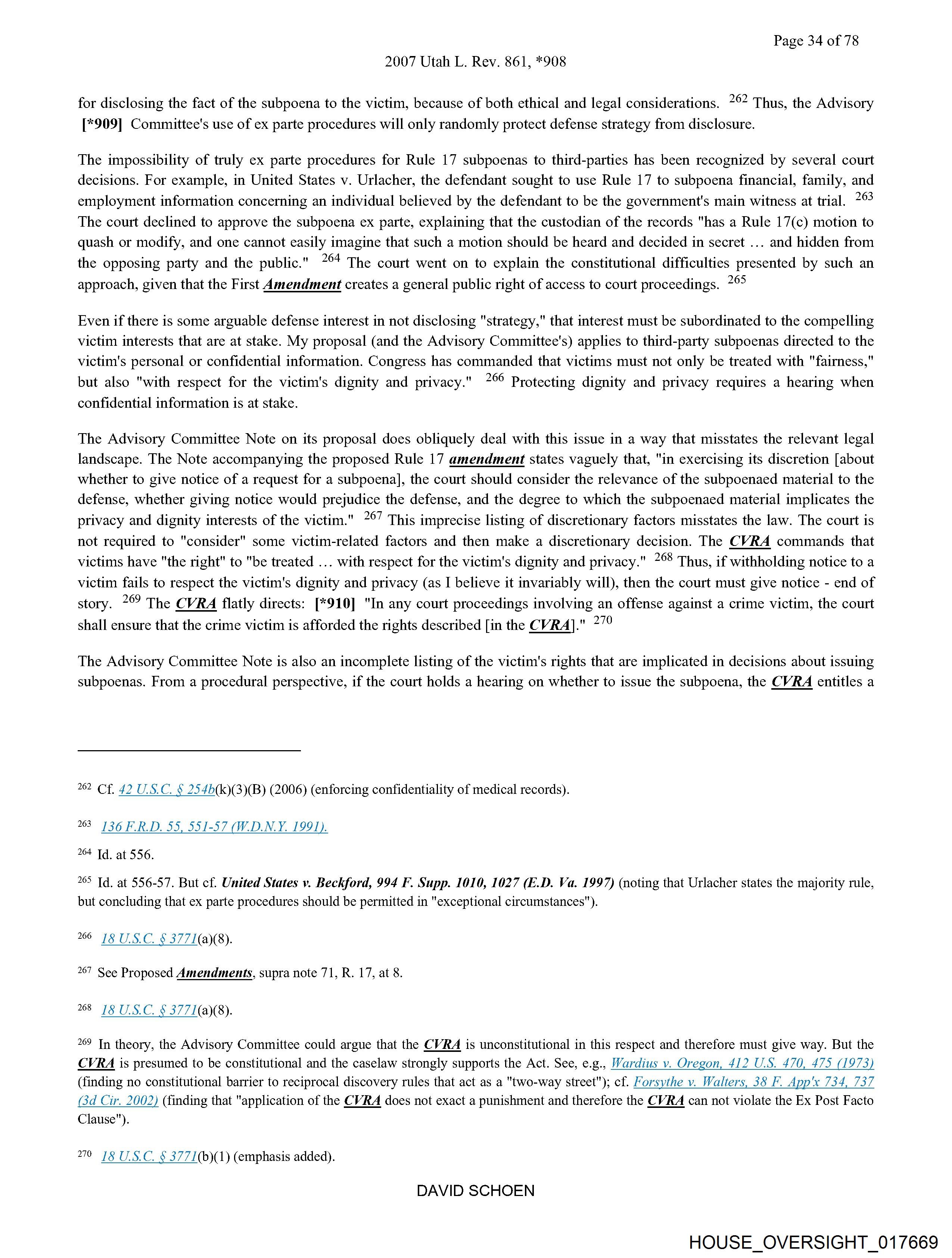
HOUSE_OVERSIGHT_017669

This document highlights the legal complexities surrounding the treatment of victims in court proceedings, particularly in relation to subpoenas that could compromise their dignity and privacy. It underscores the importance of adhering to the Crime Victims' Rights Act (CVRA), which mandates that victims be treated with respect, thereby revealing potential systemic issues in how victims are handled in cases like Epstein's.

🔑 Key Evidence:
  • The court is not required to 'consider' some victim-related factors and then make a discretionary decision. The CVRA commands that victims have 'the right' to 'be treated ... with respect for the victim's dignity and privacy.'
  • Protecting dignity and privacy requires a hearing when confidential information is at stake.
  • Congress has commanded that victims must not only be treated with 'fairness,' but also 'with respect for the victim's dignity and privacy.'
👥 Connected Entities:
Advisory Committee on Rules United States Courts Victims of Epstein's trafficking
From: Bates: HOUSE_OVERSIGHT_017669
No comments yet.
#3670 Strength: 5.0/10
Document preview

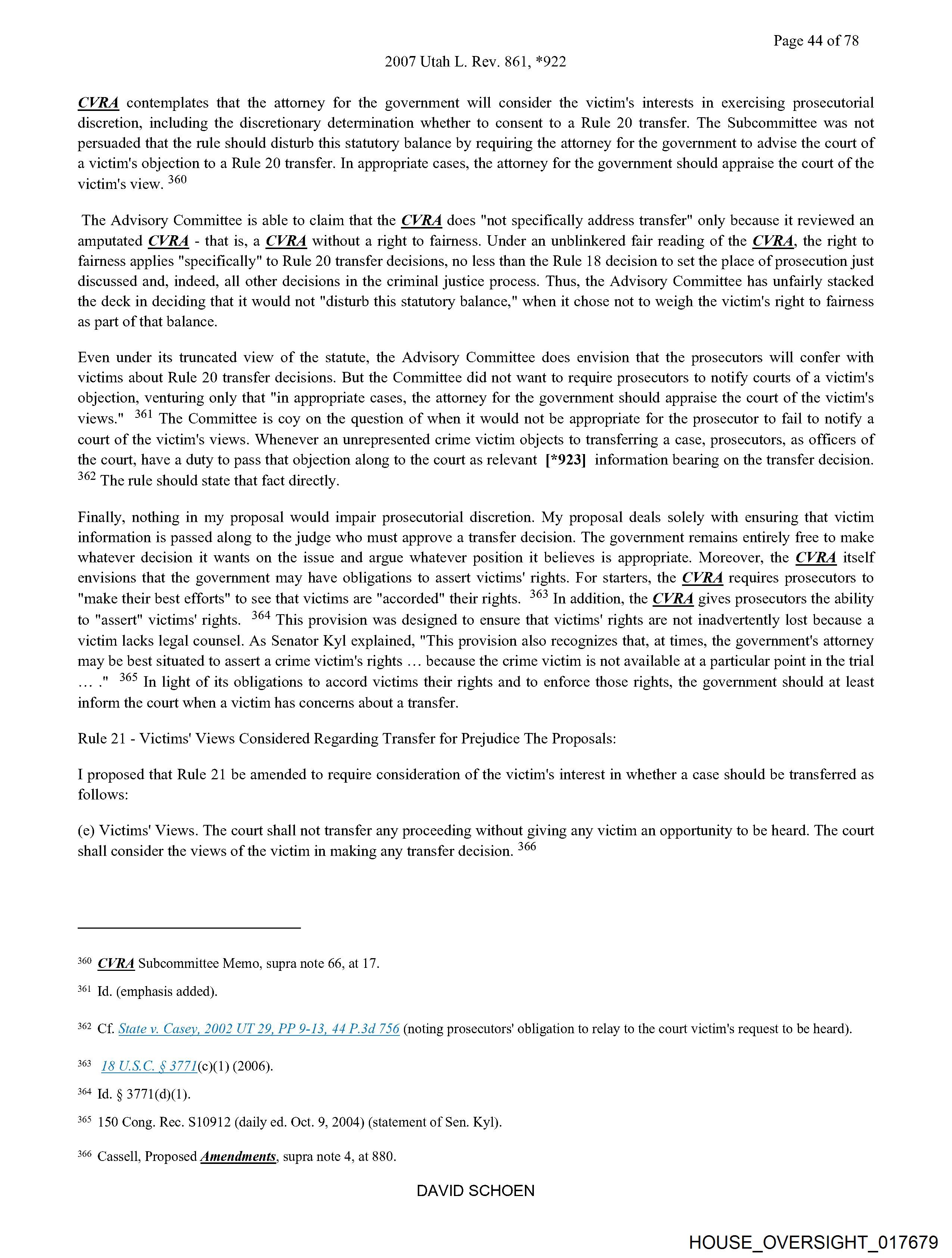
HOUSE_OVERSIGHT_017679

This document highlights the complexities surrounding the rights of victims in the context of prosecutorial discretion, particularly regarding Rule 20 transfers. While it does not provide direct evidence of misconduct related to Epstein, it underscores systemic issues in how victims' rights may be overlooked, which is relevant given the allegations of victim intimidation and discrediting in the Epstein case.

🔑 Key Evidence:
  • The CVRA contemplates that the attorney for the government will consider the victim's interests in exercising prosecutorial discretion.
  • The Advisory Committee has unfairly stacked the deck in deciding that it would not 'disturb this statutory balance,' when it chose not to weigh the victim's right to fairness.
  • Whenever an unrepresented crime victim objects to transferring a case, prosecutors, as officers of the court, have a duty to pass that objection along to the court as relevant information.
👥 Connected Entities:
Victims of Jeffrey Epstein U.S. Department of Justice Advisory Committee on Rules
From: Bates: HOUSE_OVERSIGHT_017679
No comments yet.
#3671 Strength: 5.0/10
Document preview

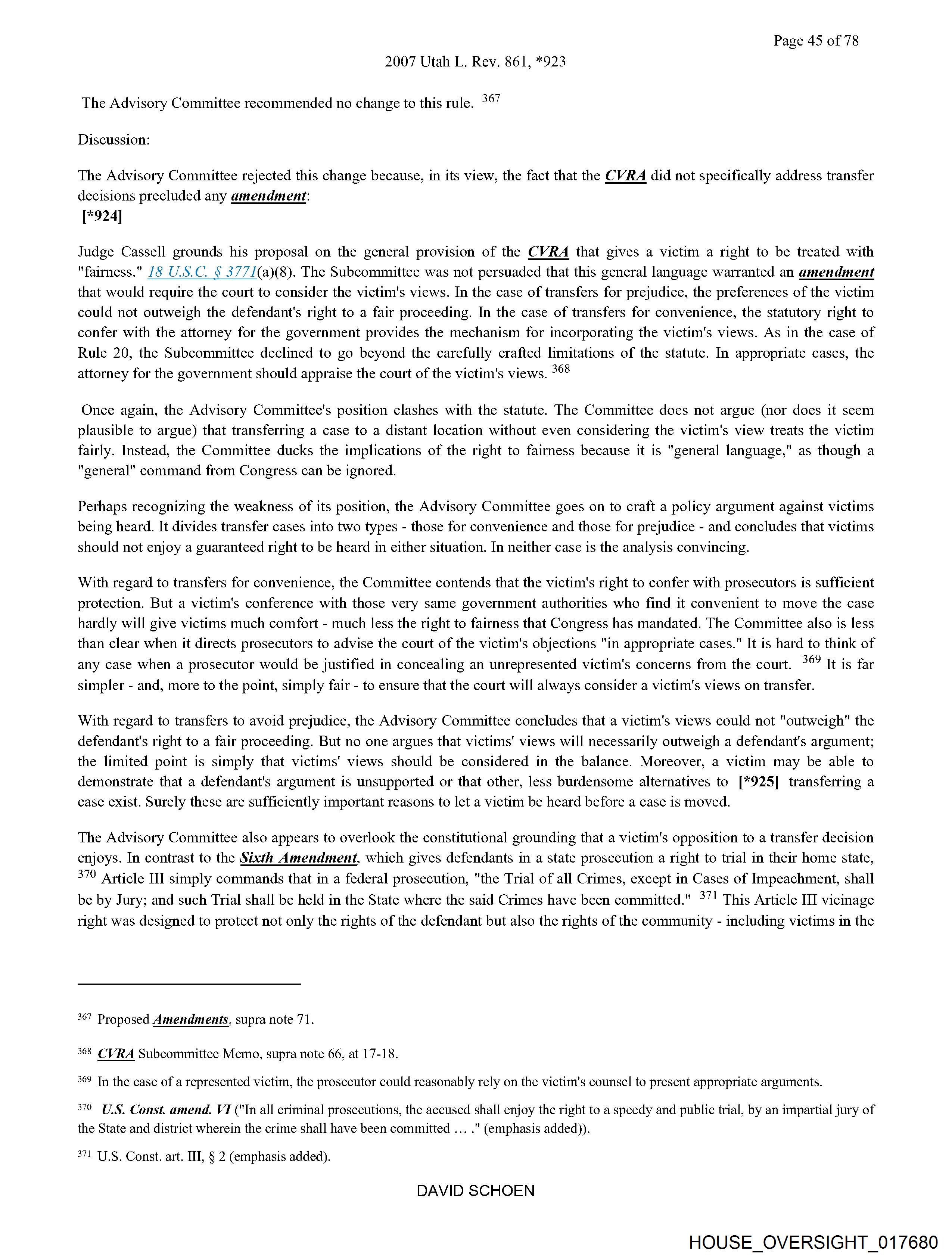
HOUSE_OVERSIGHT_017680

This document highlights the Advisory Committee's stance on victim rights within the context of legal proceedings, particularly regarding case transfers. While it does not directly implicate individuals in criminal activity, it raises concerns about the treatment of victims and the potential for their voices to be marginalized in the judicial process, which is relevant to the broader issues of victim intimidation and discrediting in the Epstein case.

🔑 Key Evidence:
  • The Advisory Committee rejected this change because, in its view, the fact that the CVRA did not specifically address transfer decisions precluded any amendment.
  • The Committee does not argue (nor does it seem plausible to argue) that transferring a case to a distant location without even considering the victim's view treats the victim fairly.
  • It is hard to think of any case when a prosecutor would be justified in concealing an unrepresented victim's concerns from the court.
👥 Connected Entities:
Advisory Committee on Rules U.S. Congress Victims of Epstein's trafficking network
From: Bates: HOUSE_OVERSIGHT_017680
No comments yet.
#3672 Strength: 4.0/10
Document preview

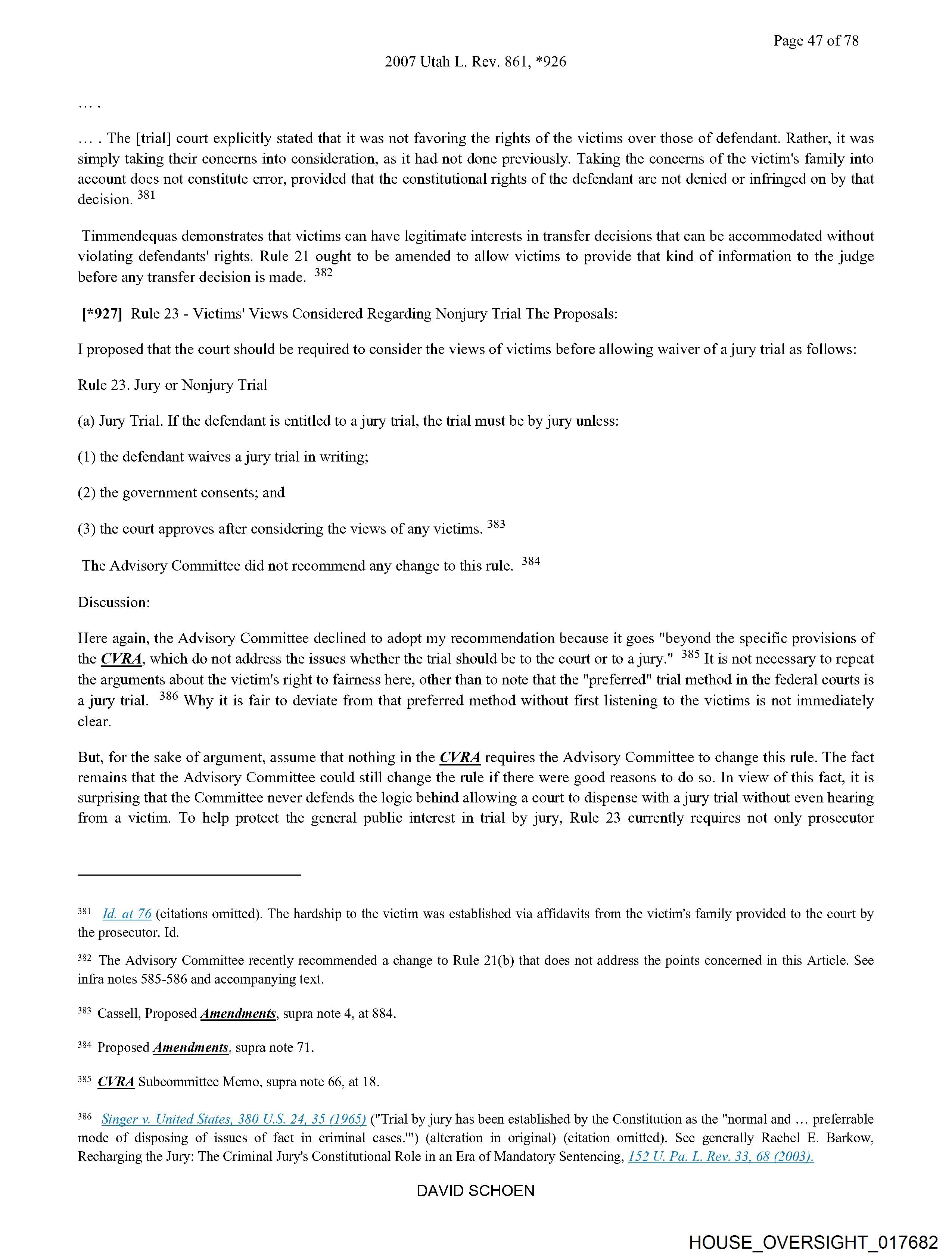
HOUSE_OVERSIGHT_017682

This document discusses the rights of victims in the context of trial procedures, particularly regarding jury trials and the consideration of victims' views. While it does not provide direct evidence of misconduct related to Epstein, it highlights systemic issues in how victims' rights are often overlooked in legal proceedings, which is relevant to the broader context of Epstein's case and the treatment of his victims.

🔑 Key Evidence:
  • The court explicitly stated that it was not favoring the rights of the victims over those of the defendant.
  • Taking the concerns of the victim's family into account does not constitute error, provided that the constitutional rights of the defendant are not denied.
  • The Advisory Committee declined to adopt recommendations that would require consideration of victims' views before waiving a jury trial.
👥 Connected Entities:
Advisory Committee on Rules Victims of Jeffrey Epstein Federal Courts
From: Bates: HOUSE_OVERSIGHT_017682
No comments yet.
#3673 Strength: 5.0/10
Document preview

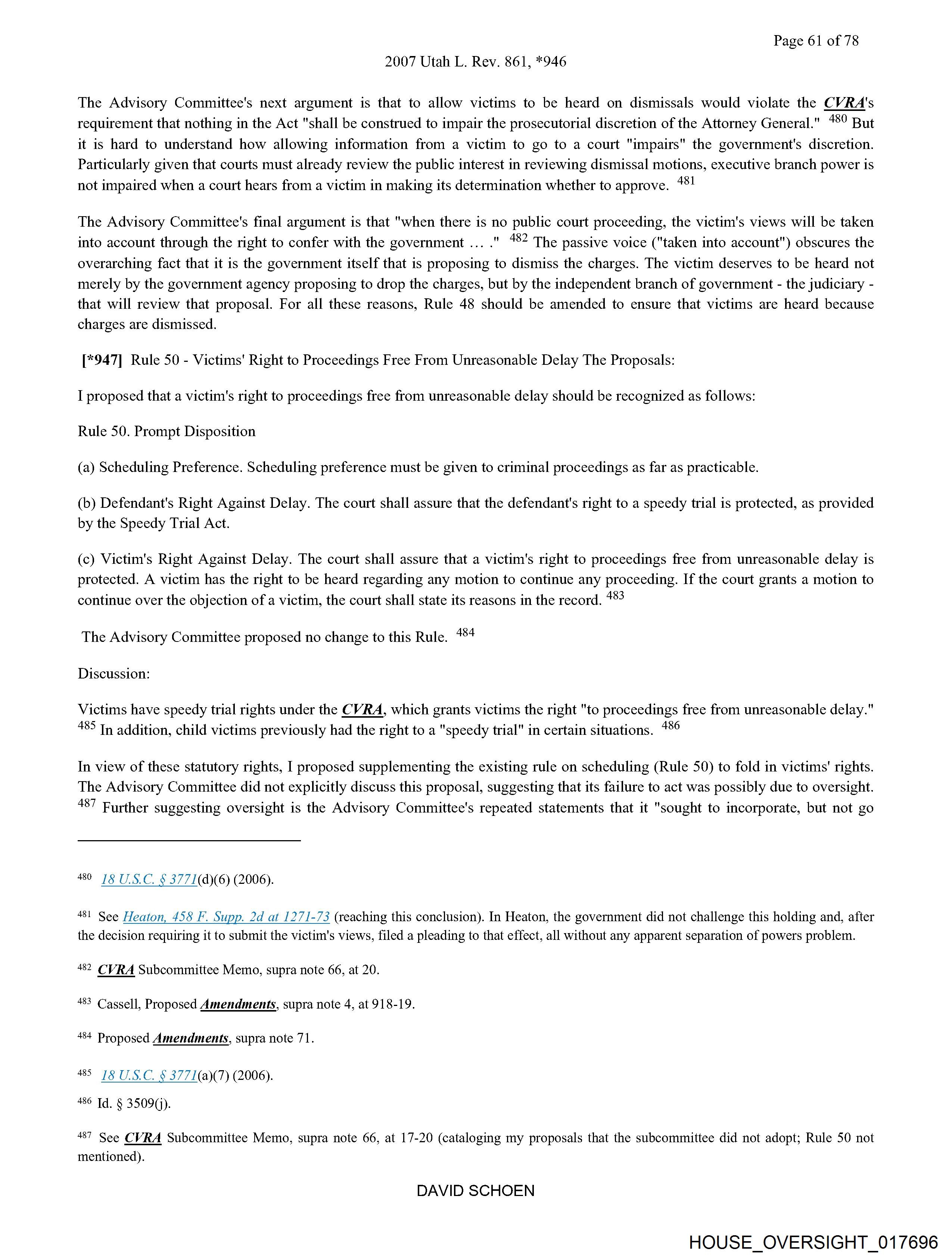
HOUSE_OVERSIGHT_017696

This document highlights the legal framework surrounding victims' rights in criminal proceedings, particularly in relation to the dismissal of charges. While it does not directly implicate individuals or reveal new evidence of misconduct, it underscores systemic issues that may have allowed for the dismissal of charges against powerful individuals, potentially including Epstein.

🔑 Key Evidence:
  • The Advisory Committee's argument that allowing victims to be heard on dismissals would violate prosecutorial discretion raises concerns about the balance of power in the judicial process.
  • The document emphasizes that victims deserve to be heard by the judiciary, not just the government, which could indicate a lack of accountability in cases involving influential defendants.
  • The proposal for victims' rights to proceedings free from unreasonable delay suggests a recognition of systemic delays that could be exploited in high-profile cases.
👥 Connected Entities:
Advisory Committee on Rules Department of Justice Victims of Epstein's trafficking network
From: Bates: HOUSE_OVERSIGHT_017696
No comments yet.
#3674 Strength: 5.0/10
Document preview

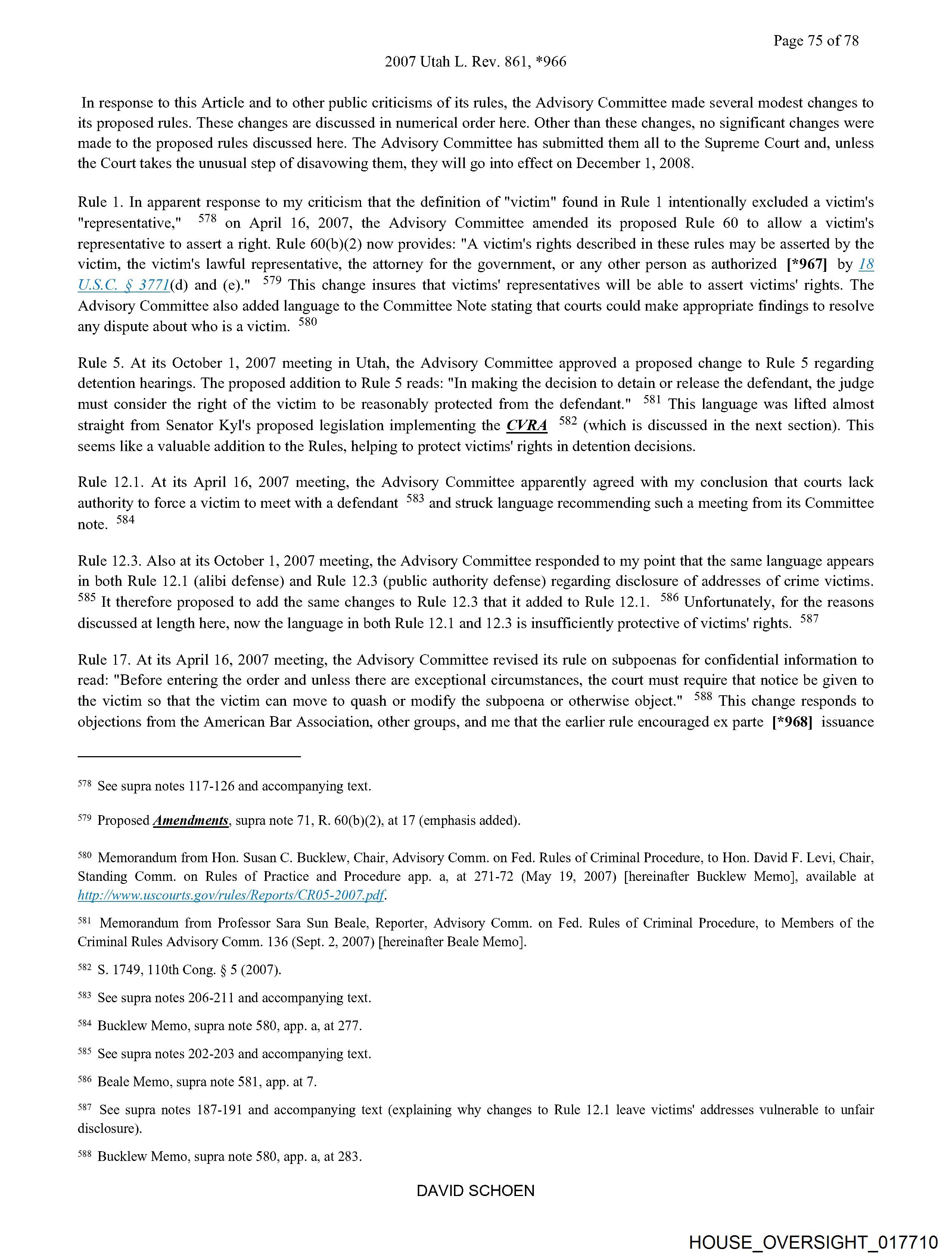
HOUSE_OVERSIGHT_017710

This document outlines proposed changes to rules regarding victims' rights in the legal system, reflecting ongoing discussions about the protection of victims, which is particularly relevant in the context of the Epstein case. While it does not provide direct evidence of misconduct, it highlights systemic issues in how victims are treated, which can be connected to the broader patterns of intimidation and discrediting seen in Epstein's operations.

🔑 Key Evidence:
  • The Advisory Committee amended its proposed Rule 60 to allow a victim's representative to assert a right.
  • Rule 5 states that judges must consider the right of the victim to be reasonably protected from the defendant.
  • The document notes that courts lack authority to force a victim to meet with a defendant, indicating a recognition of victim autonomy.
👥 Connected Entities:
Advisory Committee on Rules Senator Kyl Victims of Jeffrey Epstein
From: Bates: HOUSE_OVERSIGHT_017710
No comments yet.
#3675 Strength: 5.0/10
Document preview

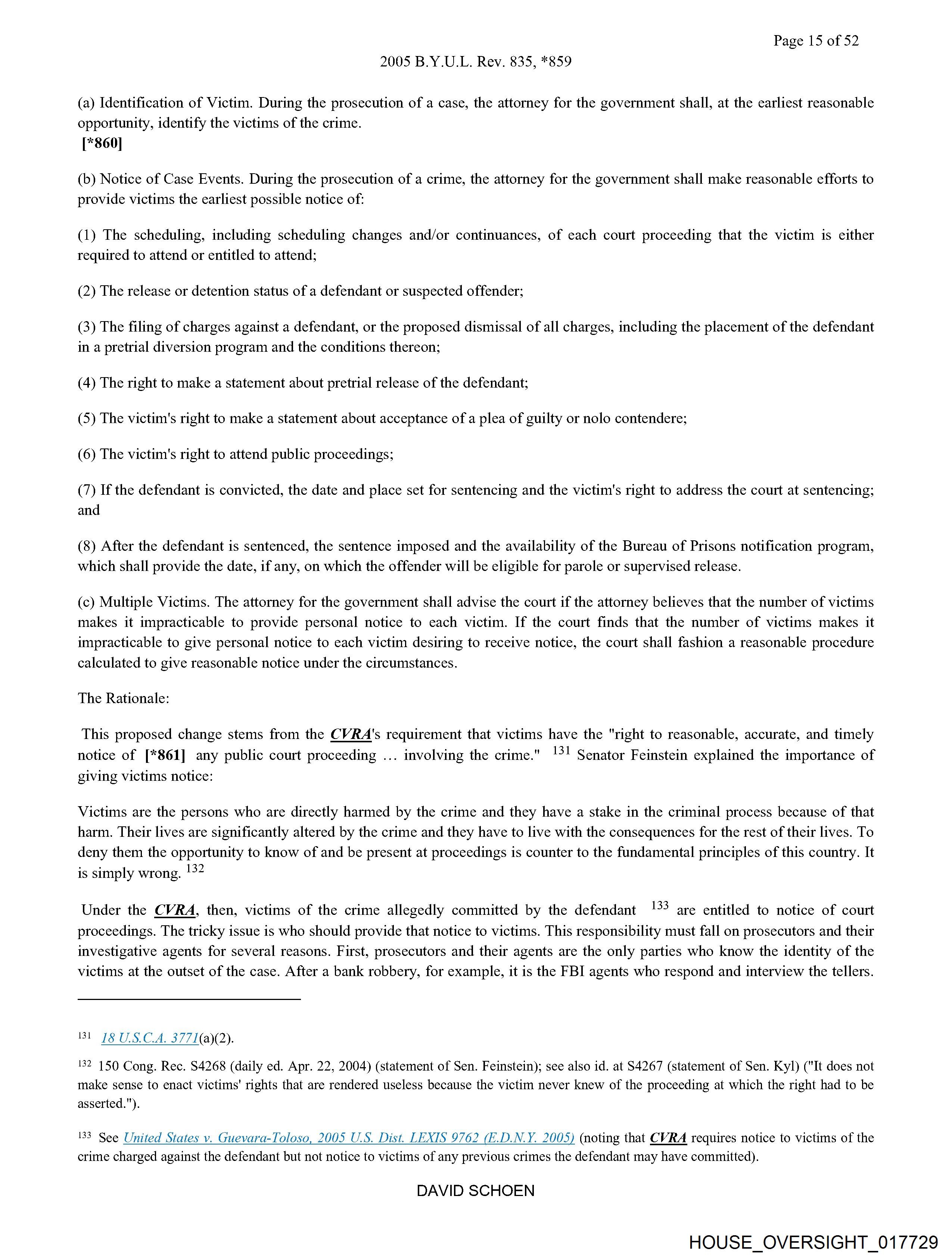
HOUSE_OVERSIGHT_017729

This document outlines the rights of victims in criminal proceedings, emphasizing the importance of timely notice and involvement in the judicial process. While it does not directly implicate individuals or reveal misconduct, it highlights systemic issues regarding victim treatment that are relevant to the Epstein case, particularly in the context of how victims were handled during the prosecution of Epstein and his associates.

🔑 Key Evidence:
  • The attorney for the government shall, at the earliest reasonable opportunity, identify the victims of the crime.
  • Victims are the persons who are directly harmed by the crime and they have a stake in the criminal process because of that harm.
  • Under the CVRA, then, victims of the crime allegedly committed by the defendant are entitled to notice of court proceedings.
👥 Connected Entities:
Senator Dianne Feinstein Victims of Jeffrey Epstein U.S. Department of Justice
From: Bates: HOUSE_OVERSIGHT_017729
No comments yet.
#3676 Strength: 4.0/10
Document preview

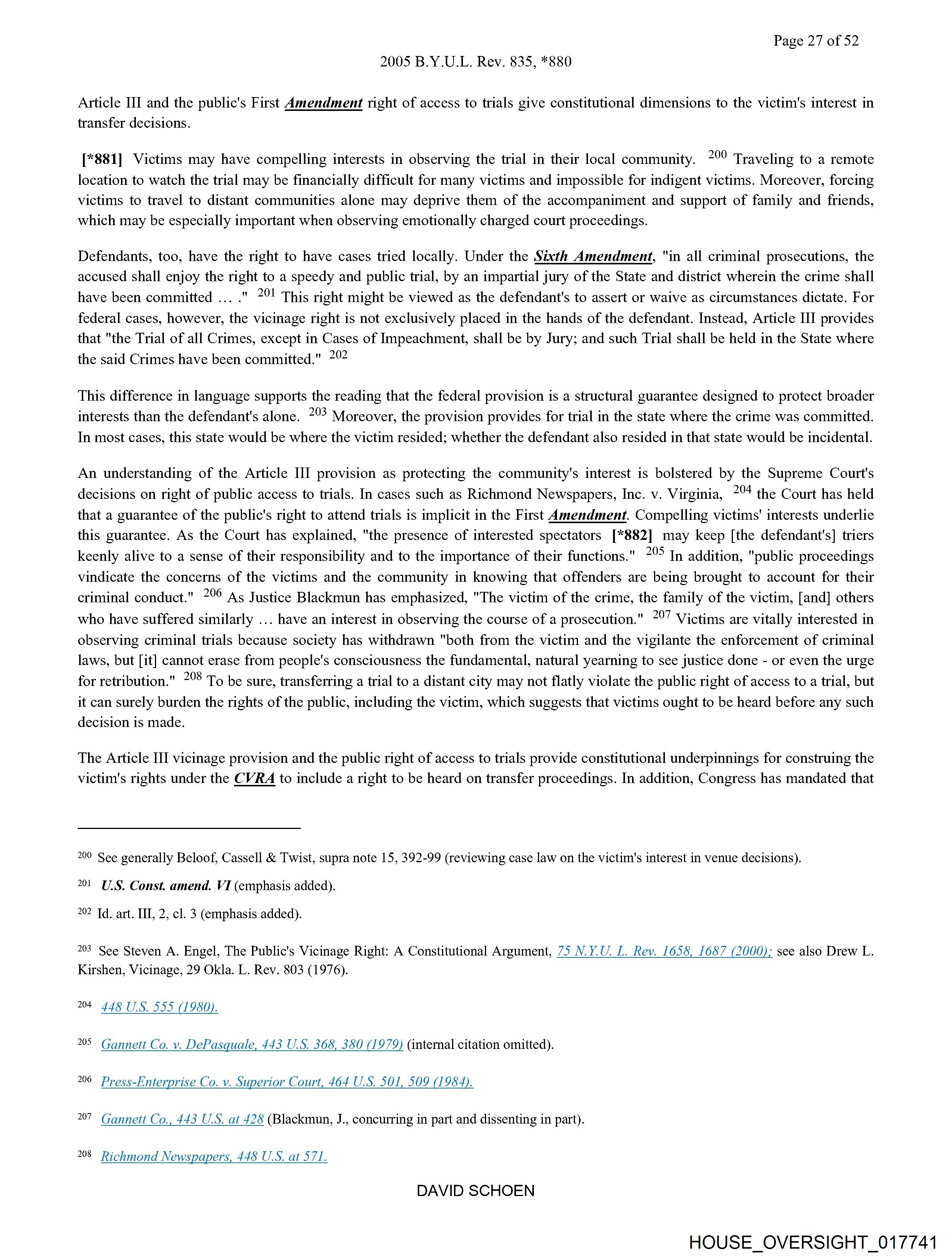
HOUSE_OVERSIGHT_017741

This document discusses the constitutional rights of victims in the context of trial proceedings, emphasizing their interest in observing trials locally. While it does not provide direct evidence of misconduct related to Jeffrey Epstein, it highlights the broader implications of victim rights and access to justice, which are critical in understanding the dynamics of the Epstein case and the treatment of victims.

🔑 Key Evidence:
  • Victims may have compelling interests in observing the trial in their local community.
  • Traveling to a remote location to watch the trial may be financially difficult for many victims and impossible for indigent victims.
  • The presence of interested spectators may keep the defendant's triers keenly alive to a sense of their responsibility.
👥 Connected Entities:
Victims of Jeffrey Epstein Judicial system Supreme Court (Richmond Newspapers, Inc. v. Virginia case)
From: Bates: HOUSE_OVERSIGHT_017741
No comments yet.
#3677 Strength: 5.0/10
Document preview

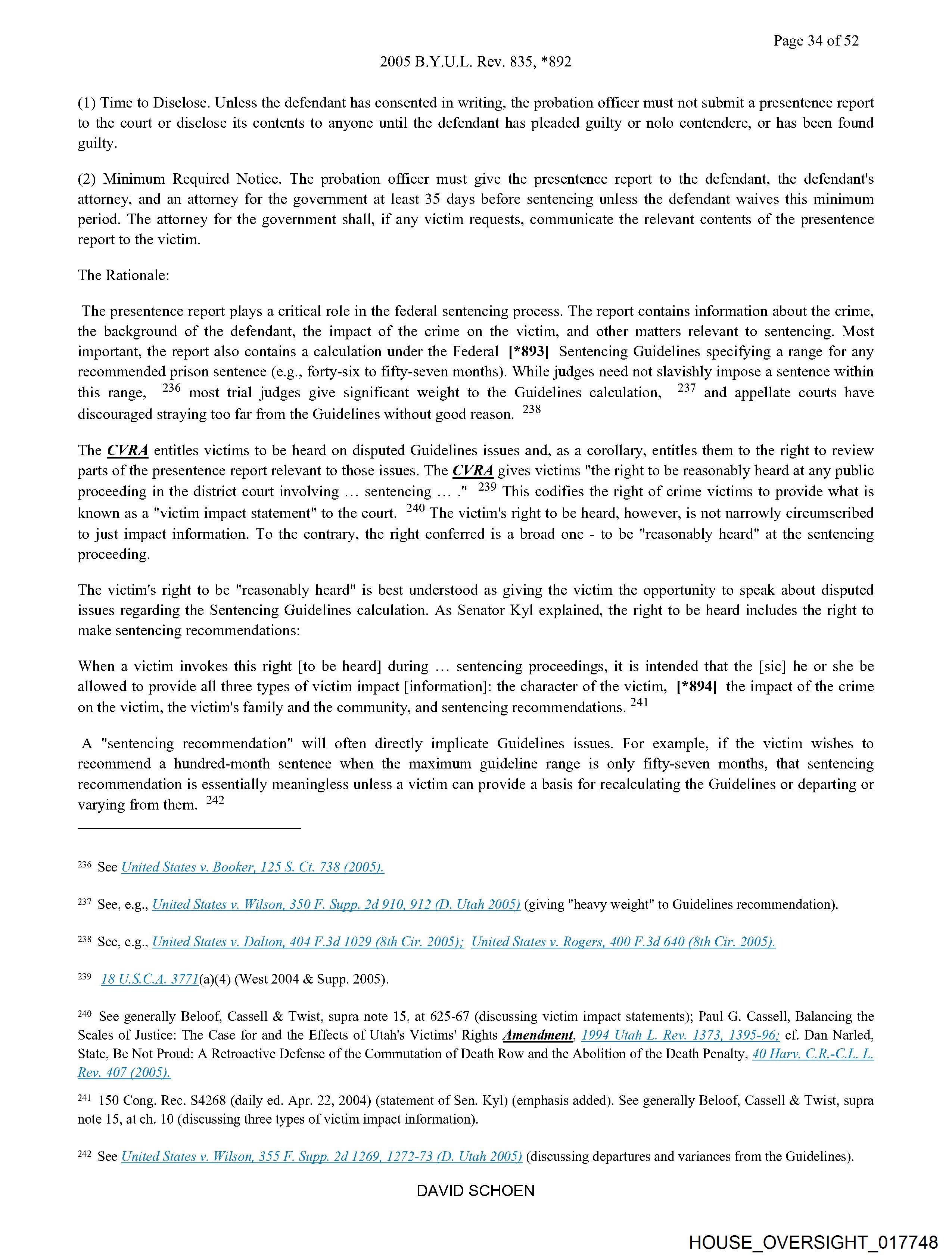
HOUSE_OVERSIGHT_017748

This document outlines the procedural rights of victims in the federal sentencing process, particularly their right to be heard regarding sentencing recommendations. While it does not directly implicate individuals or reveal new evidence of misconduct, it highlights the importance of victim impact statements in the context of Epstein's case, where victim voices were often marginalized.

🔑 Key Evidence:
  • The CVRA entitles victims to be heard on disputed Guidelines issues and, as a corollary, entitles them to the right to review parts of the presentence report relevant to those issues.
  • The victim's right to be 'reasonably heard' is best understood as giving the victim the opportunity to speak about disputed issues regarding the Sentencing Guidelines calculation.
  • When a victim invokes this right [to be heard] during ... sentencing proceedings, it is intended that the [sic] he or she be allowed to provide all three types of victim impact [information]: the character of the victim, the impact of the crime on the victim, the victim's family and the community, and sentencing recommendations.
👥 Connected Entities:
Victims of Jeffrey Epstein Federal Sentencing Guidelines Crime Victims' Rights Act (CVRA)
From: Bates: HOUSE_OVERSIGHT_017748
No comments yet.
#3678 Strength: 5.0/10
Document preview

HOUSE_OVERSIGHT_017753

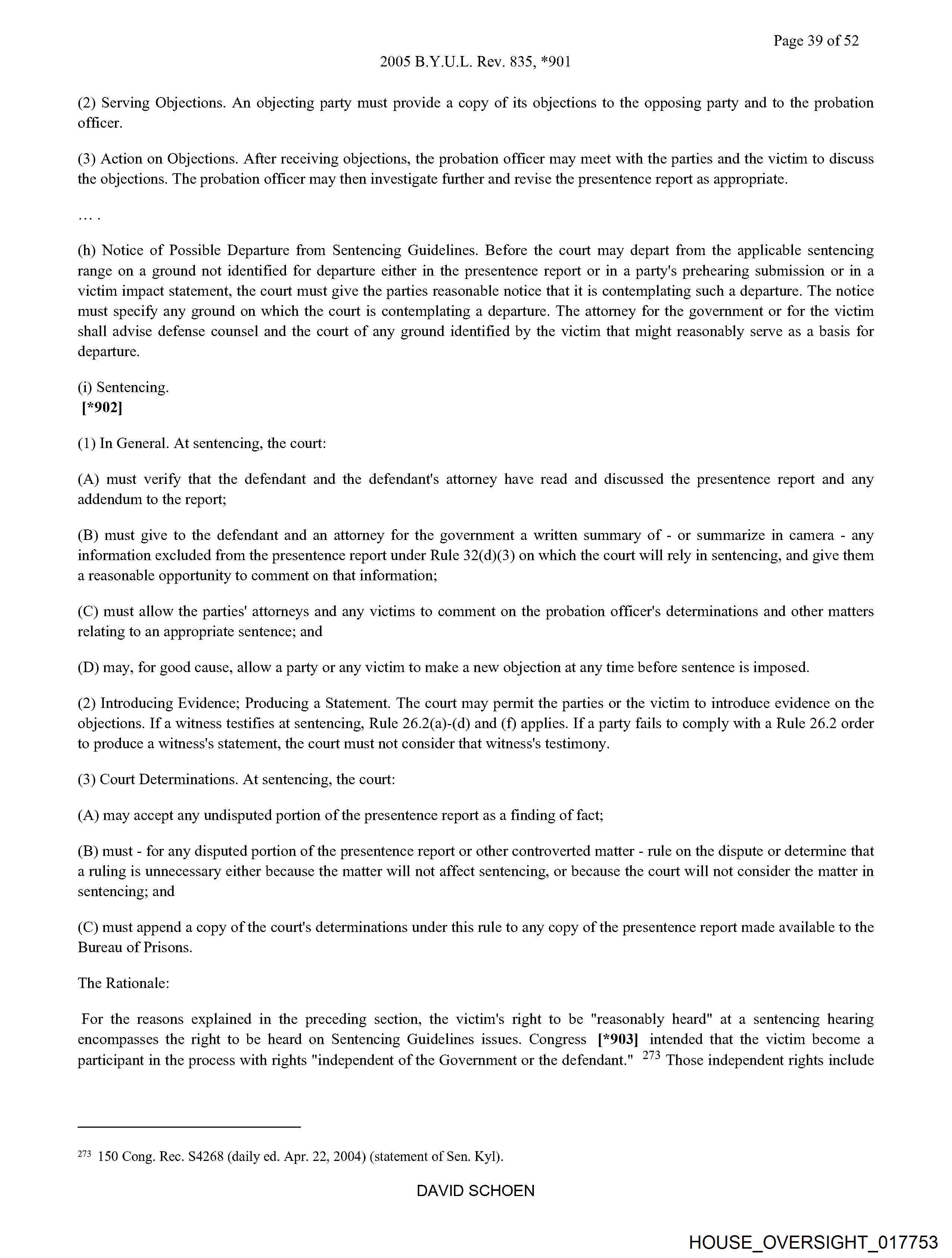
This document outlines procedural aspects of sentencing, particularly the rights of victims to be heard and the obligations of the court regarding presentence reports. While it does not directly implicate individuals in criminal activity, it highlights the legal framework that could be relevant in cases involving Epstein's victims and the judicial process they faced.

🔑 Key Evidence:
  • The document emphasizes the victim's right to be 'reasonably heard' at a sentencing hearing, which is crucial in the context of Epstein's numerous victims.
  • It details the requirement for the court to provide notice of any potential departure from sentencing guidelines, which could relate to how Epstein's case was handled.
  • The mention of the probation officer's role in discussing objections with victims indicates a procedural safeguard that may not have been adequately applied in Epstein's case.
👥 Connected Entities:
Victims of Jeffrey Epstein U.S. Probation Officers Judicial System
From: Bates: HOUSE_OVERSIGHT_017753
No comments yet.
#3679 Strength: 4.0/10
Document preview

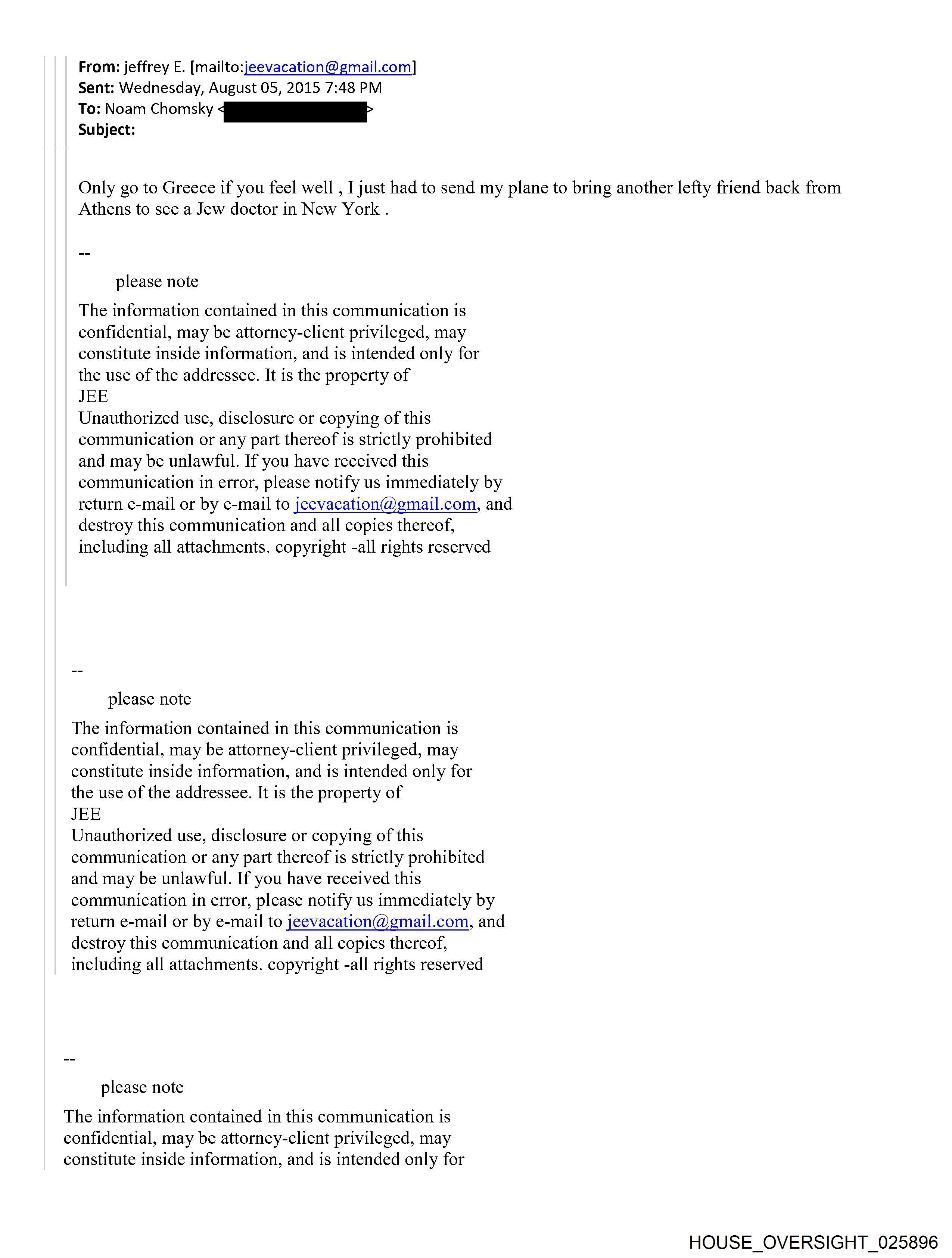
Only go to Greece if you feel well , I just had to send my plane to bring another lefty friend back from

This document reflects a communication from Jeffrey Epstein that hints at his connections with influential individuals and his potential involvement in questionable activities. The mention of a 'lefty friend' needing medical attention and the reference to a 'Jew doctor' in New York could suggest a network of relationships that Epstein maintained, but it does not provide direct evidence of criminal activity.

🔑 Key Evidence:
  • The phrase 'Only go to Greece if you feel well' implies a level of concern for the health of associates, which may indicate a network of individuals who were involved in Epstein's activities.
  • The reference to sending a plane to bring a friend back from Athens suggests Epstein's access to private air travel, which is a known aspect of his operations.
  • The repeated emphasis on confidentiality and potential attorney-client privilege raises questions about the nature of the communication and the activities being discussed.
👥 Connected Entities:
Noam Chomsky Jewish medical professionals in New York Individuals involved in Epstein's social and political circles
From: jeffrey E. [mailto:jeevacation@gmail.com] Bates: HOUSE_OVERSIGHT_025896
No comments yet.
#3680 Strength: 4.0/10
Document preview

HOUSE_OVERSIGHT_026391

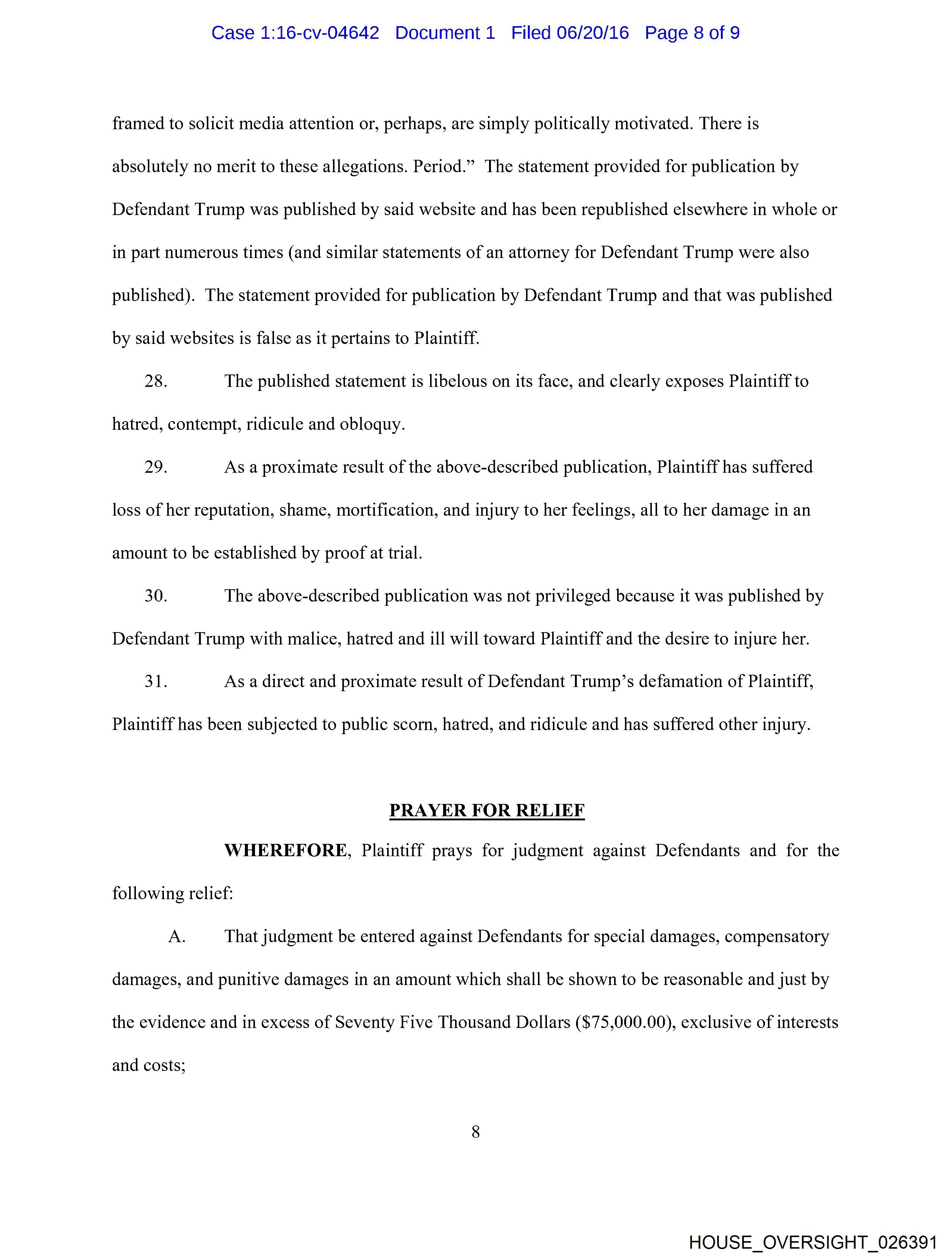
This document highlights a defamation case involving statements made by Defendant Trump regarding a Plaintiff, who is likely connected to the Epstein scandal. While it does not provide direct evidence of criminal activity, it underscores the potential for victim discrediting and the political motivations that may surround allegations related to Epstein's network.

🔑 Key Evidence:
  • The statement provided for publication by Defendant Trump was published by said website and has been republished elsewhere in whole or in part numerous times.
  • The published statement is libelous on its face, and clearly exposes Plaintiff to hatred, contempt, ridicule and obloquy.
  • The above-described publication was not privileged because it was published by Defendant Trump with malice, hatred and ill will toward Plaintiff.
👥 Connected Entities:
Donald Trump Plaintiff (potentially a victim of Epstein's network) Media outlets involved in publishing statements
From: Bates: HOUSE_OVERSIGHT_026391
No comments yet.